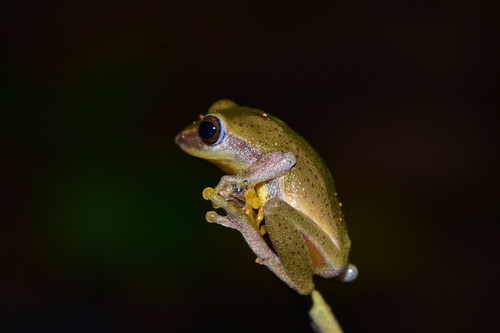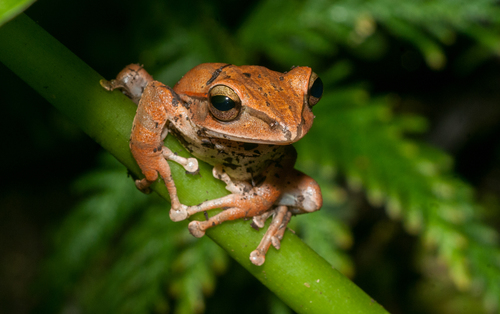
About Zhangixalus arvalis (Lue, Lai & Chen, 1995)
Size
Zhangixalus arvalis is a medium-sized treefrog. Adult males measure 39–46 mm (1.5–1.8 in) in snout–vent length, while adult females measure 60–64 mm (2.4–2.5 in).
Tympanum Morphology
Its tympanum is visible, but is concealed along its dorsal and posterior edges by a thin supratympanic fold.
Limb Structure
The fingers and toes have well-developed adhesive discs and webbing; webbing is weakly developed between the fingers, but more prominent between the toes.
Skin Texture
Its skin is granulated.
Dorsal Coloration
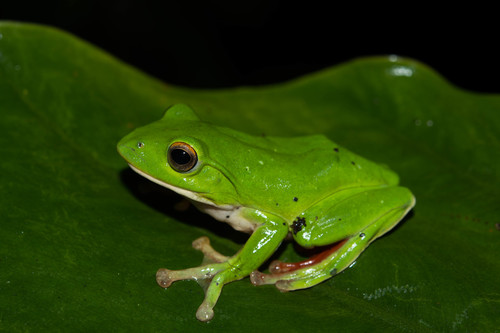
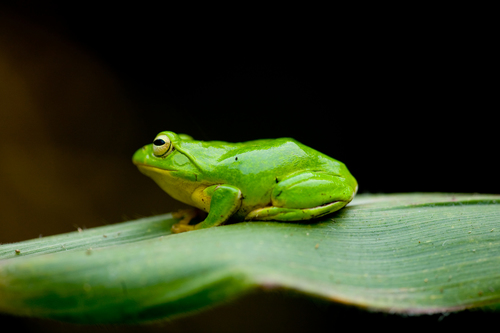
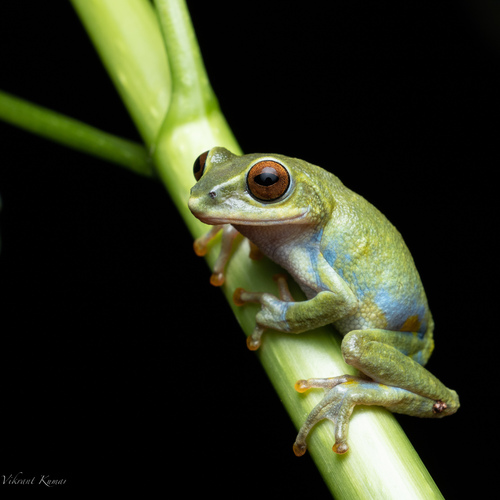
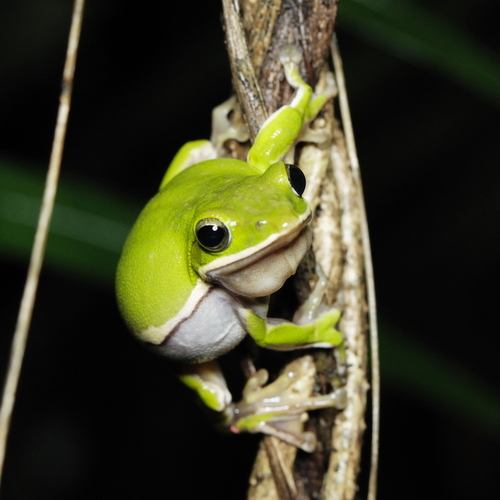
The dorsal surface color ranges from dark green, green, and yellowish-green to nearly yellow.
Flank Coloration
The upper lip is white, and this white color extends as a stripe along the flanks; the area of the flank below this white stripe is dark purple.
Ventral Head Coloration
The lower lip and the edge of the gular region are silver gray to white.
Distribution Range
Zhangixalus arvalis is found in disturbed lowland agricultural areas (at elevations below 1,000 m (3,300 ft)) where traditional farming practices are still used.
Habitat Types
It inhabits bamboo forests, orchards, sugar-cane fields, scrubland, and cultivated fields.
Mating System
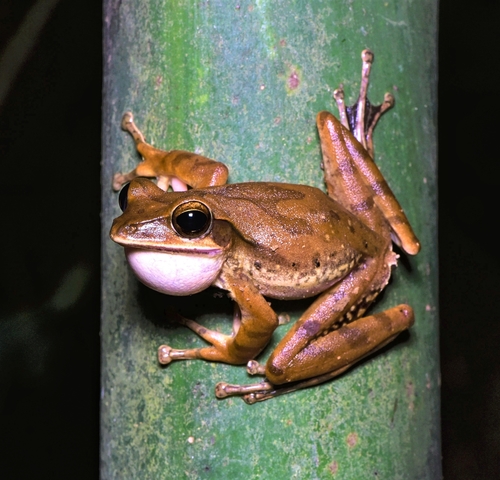
This species has a lek-type mating system for reproduction: males form chorus groups on twigs or leaves near the canopy.
Reproductive Behavior
A female will select a male, carry him down to the damp forest floor (usually a temporary pool), dig a hole, lay foamy eggs into the nest she creates, and then cover the nest with decomposed bamboo leaves or other plant material.
Larval Development Period
Development from egg to metamorphosis takes approximately 40 days.
Population Structure
The population of Zhangixalus arvalis is fragmented.
Threats
It is threatened by habitat loss caused by infrastructure development for industry and human settlement, as well as by agricultural pollution.
Conservation Measures
A key conservation measure for this species is maintaining traditional agricultural practices.
Conservation Status
Both the Taiwan Wildlife Conservation Act and the IUCN Red List of Threatened Species classify Zhangixalus arvalis as endangered.