About Polypedates occidentalis Das & Dutta, 2006
Species Identification
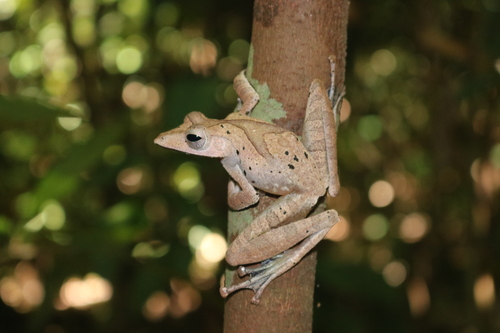
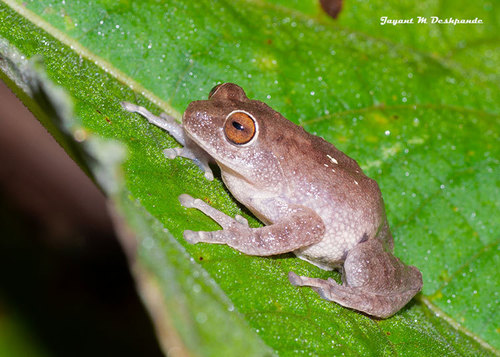
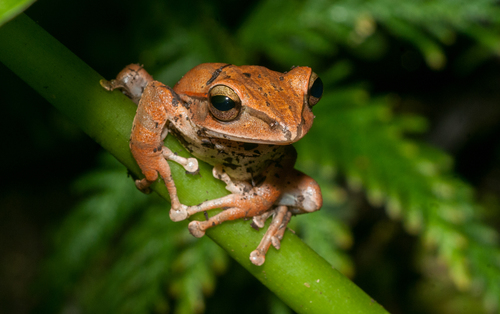
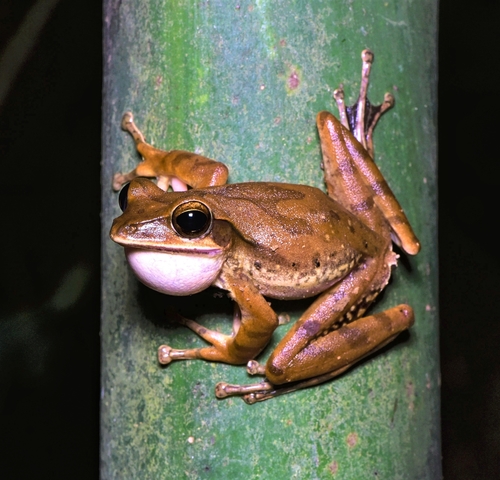
This species of tree frog, Polypedates occidentalis, has a set of key distinguishing features: an obtusely pointed snout, a large tympanum, a prominent fold running from the back of the eye to the shoulder, and an hourglass pattern on the dorsum that ends in a trident shape.
Breeding Season Male Traits
During breeding season, males of this species develop nuptial pads on their first and second fingers.
Closely Related Species
Polypedates occidentalis is closely related to Polypedates cruciger, a species found in Sri Lanka, and Polypedates pseudocruciger from the Western Ghats. It can be distinguished from these related species by a number of additional diagnostic traits.
Male Size
Adult males reach a maximum size of 55.1 mm.
Vomerine Teeth Arrangement
Its vomerine teeth are arranged obliquely between the choanae.
Finger and Forearm Morphology
Its fingers have only rudimentary webbing, and there is no dermal fold along the forearm.
Third Toe Webbing
The webbing on the third toe reaches the digit tips' disks.
Additional Diagnostic Morphological Traits
It has no conical lingual papillae, the skin of its forehead is free, its snout has no dermal flap, and its heel does not have a cutaneous spur.
Habitat and Elevation Range
In terms of ecology and natural history, Polypedates occidentalis is typically found on shrubs and in the understory of evergreen, semievergreen, and moist deciduous forests, at elevations up to 1200 m above sea level.
Breeding Season Habitat Association
During the breeding season, individuals are commonly spotted near water bodies.