About Zanda latirostris (Carnaby, 1948)
Size and Weight
Carnaby's black cockatoo measures 53–58 cm (21–23 in) in length, has a 110 cm (43 in) wingspan, and weighs 520–790 grams.
General Plumage
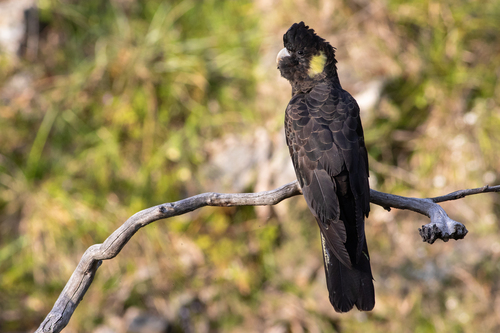
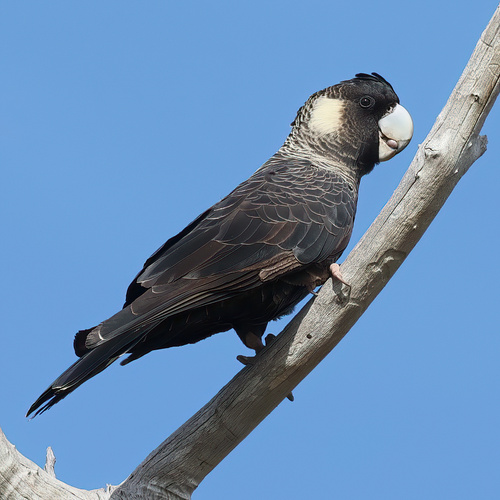
Its plumage is mostly greyish black, with narrow light grey scalloping created by narrow off-white margins at the tips of its dark feathers; this scalloping is most prominent on the neck.
Head Features
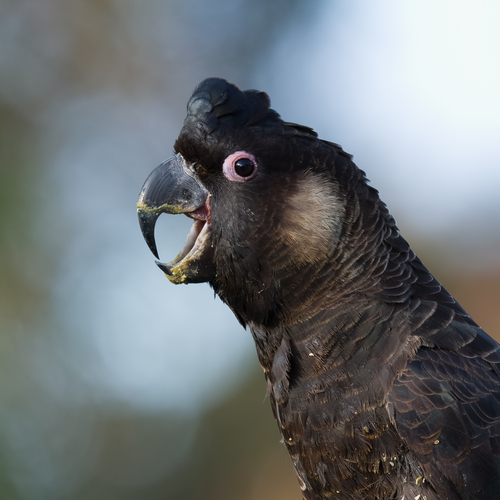
It has a short, 2.5–3 cm (0.98–1.18 in) long crest of feathers on its head that can be raised or lowered, plus a prominent off-white feather patch on its cheek.
Tail Feather Pattern
Its lateral tail feathers are white with black tips, while all central tail feathers are black.
Morphology Comparison to Related Species
This species has dark brown irises, brown-grey legs, and a beak that is shorter and broader than that of the closely related, similar-looking Baudin's black cockatoo; the two species are often hard to tell apart in the field.
Adult Male Morphology
Adult males have a dark grey beak and pink eye-rings.
Adult Female Morphology
Adult females have a bone-coloured beak, grey eye-rings, and whiter, more distinctive cheek patches than males. The underpart and underwing covert feathers of females have larger white margins than males, producing a more strongly barred or scalloped plumage pattern, and their legs and feet are slightly lighter in color than males.
Moulting Pattern
Moulting occurs in stages during late summer, between January or February and April or May, and this process is still poorly understood.
Juvenile Morphology
Juveniles have a bone-coloured beak, grey eye-rings, and less white in their tail feathers. They can also be identified by their constant begging calls.
Juvenile Sex Differentiation
Sex cannot be distinguished in juveniles until the male’s bill begins to darken; this darkening starts when males are around one year old, and completes sometime after they reach two years of age.
General Distribution Range
Carnaby's black cockatoo ranges across a broad area of southwest Australia, mostly within the Wheatbelt region, in areas that receive over 300 mm (12 in) of rainfall annually.
Range Boundaries
The edges of its range extend to Cape Arid in the east, Lake Cronin, Hatters Hill and Lake Moore inland, and Kalbarri in the north.
Breeding Distribution
Breeding occurs in areas that get 350–700 mm (14–28 in) of rainfall per year, spanning from the Stirling Range to Three Springs, as well as around Bunbury.
Non-breeding Flock Movement
Outside of the breeding season, mated pairs gather into flocks and move away from nesting areas.
Movement Patterns
Carnaby's black cockatoo is sedentary in wetter parts of its range, while populations in drier areas are migratory: birds move south and west toward the coast during summer.
Woodland Habitat
The species inhabits Eucalyptus woodland, most commonly wandoo (Eucalyptus wandoo) or salmon gum (Eucalyptus salmonophloia) woodland.
Other Habitat Types
It is also found near pine plantations, and on sandplains or kwongan heath with abundant Hakea, Banksia, and Grevillea shrubs.