About Zanda funerea (Shaw, 1794)
Common Name and Basic Size
Zanda funerea, commonly known as the yellow-tailed black cockatoo, measures 55–65 cm (22–26 in) in length and weighs 750–900 grams.
Plumage and Tail Features
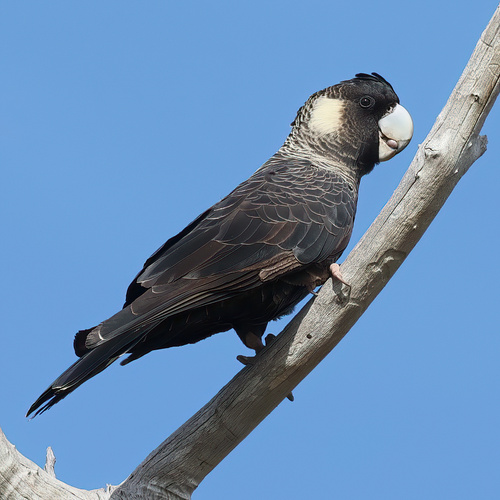
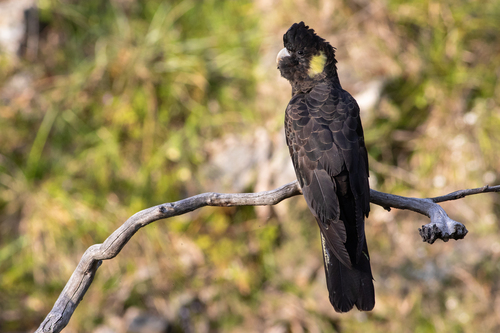
It has a short, mobile crest on the top of its head, with mostly brownish-black plumage that has paler feather margins along the neck, nape, and wings, and pale yellow bands on its tail feathers.
Subspecies Tail Length Comparison
For the nominate subspecies Z. f. funereus, average tail length is around 33 cm (13 in), which is 5 cm (2.0 in) longer than that of subspecies Z. f. xanthanotus.
Nominate Subspecies Weight
Male funereus weigh an average of around 731 g (1.612 lb), while female funereus weigh about 800 g (1.8 lb).
Xanthanotus Subspecies Weight Variation
Mainland xanthanotus individuals average heavier than Tasmanian xanthanotus: mainland males average around 630 g, mainland females average 637 g (1.404 lb), while Tasmanian males average 583 g and Tasmanian females average 585 g (1.290 lb).
Xanthanotus Subspecies Tail Length
Both mainland and Tasmanian xanthanotus average 28 cm (11 in) in tail length.
Subspecies Plumage Differences
The eastern subspecies has more solid brown-black plumage, while the southern race has more prominent yellow scalloping on the underparts.
Male Adult Appearance
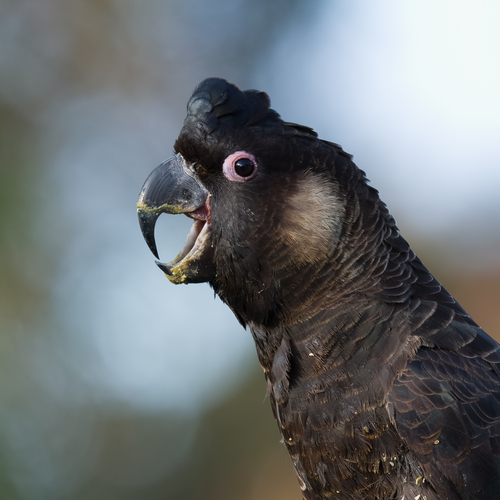
Male yellow-tailed black cockatoos have a black bill, a dull yellow patch behind each eye, and pinkish or reddish eye-rings.
Female Adult Appearance
Females have grey eye-rings, a horn-coloured bill, and brighter, more clearly defined yellow cheek patches.
Immature Bird General Appearance
Immature birds have duller plumage overall, a horn-coloured bill, and grey eye-rings.
Immature Male Beak Darkening Timeline
The upper beak of immature males darkens to black by two years of age, starting at the bill base and spreading over ten weeks. The lower beak blackens later, by four years of age.
Bill Adaptation
The species has an elongated bill with a pointed upper maxilla, adapted for digging grubs out of tree branches and trunks.
Male Eye Ring Change Timing
Records of when male eye rings change from grey to pink are sparse, with observed timings ranging from one to four years of age.
Eye Ring Function Hypothesis
Australian farmer and amateur ornithologist John Courtney proposed that the similarity between juvenile and female eye rings prevents adult males from acting aggressively toward younger birds. He also observed that the eye rings flush to a brighter shade when males are aggressive.
Moulting Process
Moulting occurs in stages over the course of a year, and the process remains poorly understood.
Species Distinguishing Features
The yellow-tailed black cockatoo can be distinguished from other dark-plumaged birds by its yellow tail and ear markings, as well as its contact call.
Overlapping Range Similar Cockatoo Species
Parts of its range overlap with two other cockatoo species that have red tail banding: the red-tailed cockatoo and the glossy black cockatoo.
Similar Crow Species Differences
Crow species may look similar when seen flying at a distance, but crows have shorter tails, quicker wing beats, and different calls.
All-Yellow Plumage Record (1996)
One completely yellow (lacking black pigment) individual was recorded in Wauchope, New South Wales in December 1996, and stayed with the local cockatoo group for four years.
Partial Yellow Plumage Records
Birds with partial yellow plumage have been recorded across different areas of Victoria.
All-Yellow Plumage Record (2024)
Another all-yellow individual was discovered in 2024, and is currently housed at the Bonorong Wildlife Sanctuary.
Elevation and Southeastern Australia Distribution
The yellow-tailed black cockatoo occurs up to 2,000 m (6,600 ft) above sea level across southeastern Australia, including Tasmania, the Bass Strait islands of King, Flinders, and Cape Barren, and Kangaroo Island.
Tasmania and Bass Strait Endemic Status
It is the only native black-coloured cockatoo on Tasmania and the Bass Strait islands.
Mainland Distribution Range
On the Australian mainland, its range extends from the area around Gin Gin and Gympie in south and central eastern Queensland, south through New South Wales where it occurs along the Great Dividing Range and to the coast, into and across most of Victoria excluding the northern and northwestern corner, reaching the Coorong and Mount Lofty Ranges in southeastern South Australia.
Eyre Peninsula Population
A small population of 30 to 40 birds lives on the Eyre Peninsula, where they occupy sugar gum (Eucalyptus cladocalyx) woodland in the lower peninsula and migrate to northern peninsula mallee areas after breeding.
New South Wales Seasonal Movement
There is evidence that birds on the New South Wales south coast move from elevated areas to lower coastal areas in winter.
General Population Abundance
The species is generally common or locally very common across a wide range of habitats, though it tends to be locally rare at the edges of its range.
Breeding Range Limitation
Its breeding range is limited to areas with large old trees.
Preferred Habitat Types
It prefers native temperate forests, is also widespread in pine plantations, and occasionally occurs in urban areas, as long as there is an abundant food supply.
Sydney Urban Spread
It has spread into parts of suburban Sydney, particularly on or near golf courses, pine plantations, and parks such as Centennial Park in the eastern suburbs. It remains unclear whether this spread is an adaptive change or a result of habitat loss elsewhere.
Melbourne Urban Records
In urban Melbourne, the species has been recorded at Yarra Bend Park. The 2009 Black Saturday bushfires caused enough natural habitat loss that the species has since been sighted in other parts of urban Melbourne.
Climate Change Threat
Climate change is predicted to cause major habitat loss for the species on the Australian mainland.
Mornington Peninsula Occurrence
It also occurs along the Mornington Peninsula.
General Behaviour Traits
Yellow-tailed black cockatoos are diurnal, raucous, and noisy, and are often heard before they are seen. They travel long distances flying at considerable height while calling to one another, and are often seen flying high overhead in pairs, trios (a pair plus their young), or small groups.
Non-breeding Season Flocking
Outside the breeding season in autumn or winter, multiple groups may merge into flocks of one hundred birds or more, while maintaining family interactions between pairs and trios.
Wariness and Ground Activity
They are generally wary birds, though they are less shy in urban and suburban areas. They mostly stay in trees, only coming to the ground to examine fallen pine or Banksia cones or to drink.
Flight Characteristics
Their flight is fluid, described as "lazy," with deep, slow wingbeats.
Roosting Site Selection
Tall emergent eucalypts above other trees in wooded areas are chosen as roosting sites. Cockatoos rest here overnight, and also shelter here from daytime heat.
Roosting Social Behaviour
They often socialize before dusk, engaging in preening, feeding young, and acrobatic flight. Flocks return to roost earlier during bad weather.
Contact Call Description
The species' usual call is a high-pitched wailing contact call, rendered as kee-ow ... kee-ow ... kee-ow, given while flying or roosting, and can be heard from far away.
Other Call Types
Birds may also give a harsh screeching alarm call. They make a soft, chuckling call when searching for cossid moth larvae.
Feeding Period Vocalizations
Adults are normally quiet while feeding, while juveniles make frequent, noisy begging calls.
Call Mimicry by Other Species
The superb lyrebird can successfully mimic the adult yellow-tailed black cockatoo's contact call.