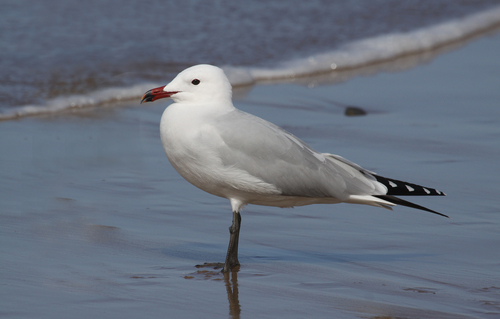
About Ichthyaetus audouinii (Payraudeau, 1826)
Nomenclature and Taxonomy
Audouin's gull, with the scientific name Ichthyaetus audouinii, is a large gull found only in the Mediterranean, the western coast of Saharan Africa, and the Iberian Peninsula. The genus name Ichthyaetus comes from the Ancient Greek words ikhthus, meaning "fish", and aetos, meaning "eagle". Both the specific epithet audouinii and the common English name honor the French naturalist Jean Victoire Audouin.
Genus Classification History
Traditionally, like many other gull species, this gull was placed in the genus Larus.
Breeding Habits
This species breeds colonially or alone on small islands, building a ground nest where it lays 2 to 3 eggs.
Historical Population Status
In the late 1960s, Audouin's gull was one of the rarest gull species in the world, with a total population of just 1,000 breeding pairs. While the species has since established new colonies, it remains rare, with a current population of approximately 10,000 pairs.
Feeding Behavior
Unlike many other large gulls, Audouin's gull rarely scavenges. It is a specialist fish-eater, and is therefore strictly coastal and pelagic. It will feed at night, often far out at sea, but it also moves slowly along close to beaches, occasionally dangling its legs to increase drag.
Adult Appearance
Adult Audouin's gulls are broadly similar in appearance to small European herring gulls. The most distinct differences are its short, stubby red bill, and the "string of pearls" pattern on the white tips of its primary wing feathers, instead of the large "mirrors" seen in some other gull species. Its legs are grey-green.
Plumage Maturation
It takes four years for this gull to reach full adult plumage.
Vagrant Records
Audouin's gull rarely wanders far from its breeding areas, but there are single documented records of the species in the Netherlands and England in May 2003, and one individual overwintered in Trinidad from December 2016 to April 2017.
Conservation Agreement
This gull is one of the species covered by the Agreement on the Conservation of African-Eurasian Migratory Waterbirds, or AEWA.