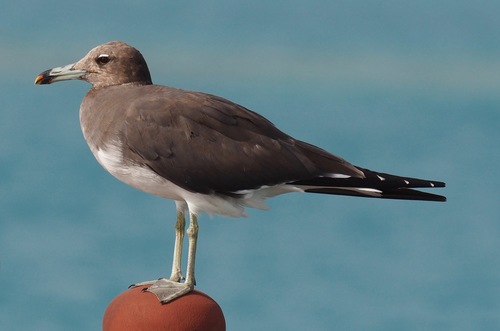
About Sterna forsteri Nuttall, 1834
Species Naming
Forster's tern (Sterna forsteri Nuttall, 1834) is a medium-sized tern with a slender body, a long deeply forked tail, and relatively long legs.
Non-breeding Plumage
In non-breeding plumage, it has a white crown, a black comma-shaped patch covering the eye and ear-covert, gray wings with dark silvery gray primaries, a white underside, a black bill, and dull brownish red legs.
Breeding Plumage
In breeding plumage, it develops a solid intense black cap that extends down the neck; its wings and back are pale gray, its underside is bright white, and it has an orange bill with a black tip and bright orange legs.
Juvenile Plumage
Juveniles have similar coloration to non-breeding adults, but often have darker primaries.
Habitat Types
Forster's tern is a marsh-dwelling species that lives in freshwater, brackish, or saltwater environments.
Common Habitats
It is most often found over shallow open water deep within marshes, and its main habitats include marshes, estuaries, islands, salt marshes, and marshy areas surrounding lakes and streams.
General Distribution
This species is usually restricted to North America.
Breeding Range
It nests in marshes during summer, along both the Atlantic and Pacific coasts, as well as in the Prairies and Great Lakes of Canada and the United States.
Nesting Turnover Rate
Because its nesting habitat is unstable, Forster's tern has a high annual turnover rate.
Winter Range
It winters in marshes along the southern coast of the US and Mexico, and can sometimes reach the northern extremity of Central America. It also commonly winters in the Caribbean.
Vagrant Occurrences
It is a near-annual vagrant to Western Europe, and has occasionally wintered in Great Britain and Ireland.
Breeding Season Timing
The breeding season for Forster's tern can start as early as April on the Gulf Coast of the United States, and runs from May to mid-June further north, varying with latitude.
Colonial Nesting Traits
Forster's tern is a colonial nester, with colony sizes ranging from 1 to 1000 nests. Adults establish very small territories around their nests, and nests are usually clumped closely together.
Courtship Behavior
During courtship, males provide courtship feeding, while females beg for food using a repeated "kerr kerr kerr" call.
Clutch and Incubation
A typical clutch holds 2 to 4 eggs, and incubation lasts 24 or 25 days after laying.
Post-hatching Behavior
The young are semi-precocial, and parents remove empty eggshells after hatching.
Chick Egg Teeth
Newly hatched chicks have egg teeth on both their upper and lower mandibles, which they lose 3 to 5 days after hatching.
Chick Development
Chicks usually leave the nest with their parents 4 days after hatching to move into areas of denser vegetation. Fledging occurs 28 days after hatching.
Post-fledging Behavior
A few weeks after fledging, young terns leave their natal colony, but join groups for roosting while migrating to wintering grounds.
Parental Care
Both males and females contribute equally to incubation and chick rearing: males typically incubate eggs during the day, while females mostly incubate at night.
Reproductive Success
Reproductive success varies from year to year and between different colonies.