About Xanthichthys auromarginatus (Bennett, 1832)
Common Name and Baseline Coloration
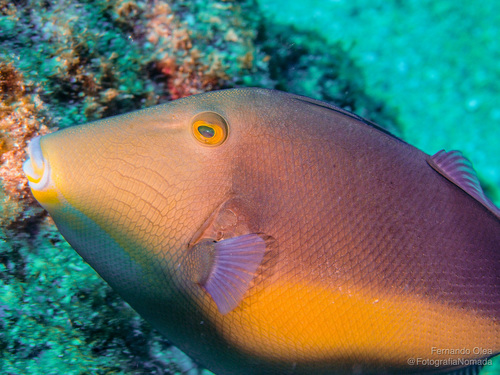
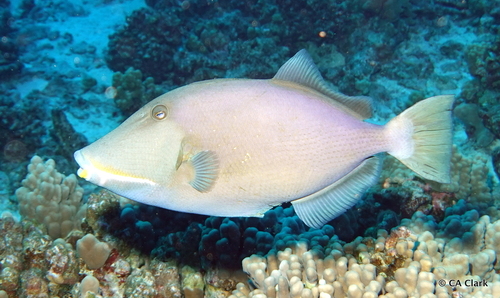
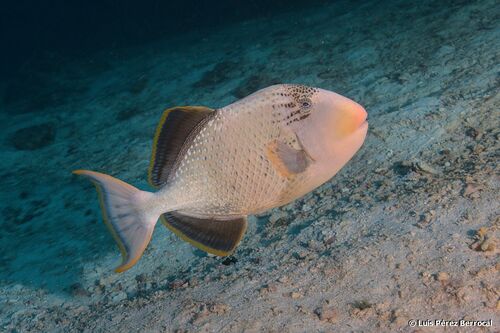
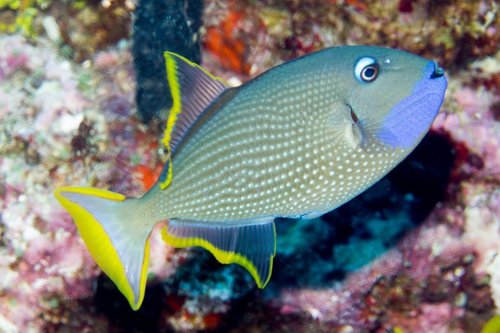
Xanthichthys auromarginatus, commonly known as the gilded triggerfish, is a spotted brownish-gray triggerfish that sometimes displays a bluish or lavender tint.
General Body and Fin Structure
It has a laterally compressed body, a small upturned mouth, and a truncated, emarginate caudal fin that ends in a slight inward curve.
Body Scale Pattern
The rear three-quarters of its body has scales with pale central white spots.
Sexual Dichromatism Trait
This species is permanently sexually dichromatic, meaning males and females have distinct coloration, a trait that is unusual among other triggerfish species.
Male Coloration
Males have distinctive blue cheek patches on the lower (ventral) part of the head, plus yellow-bordered white second dorsal, anal, and caudal fins; unlike this species, all other triggerfish have red or reddish brown caudal fins.
Female Coloration
Females lack both the blue cheek patches and yellow-bordered fins, and instead have thin brown margins along the edges of their second dorsal, anal, and caudal fins.
Shared Sex Coloration Traits
Both sexes have dark brown lips and gill membranes, plus a small white spot near the nostrils (nares).
Cheek Groove Positioning
Five or six longitudinal cheek grooves run from the lower rear corners of the mouth almost to the upper pectoral base and gill opening, dividing the cheek’s scale rows.
Cheek Groove Orientation
These grooves slope upward toward the rear and are spaced closely together.
Cheek Groove Comparison to Congeners
Compared to other triggerfish, the cheek grooves of the gilded triggerfish are less pronounced and lack pigmentation.
Scale Row Ridge Traits
The ridges along its scale rows are positioned further forward on the body, and are considerably rougher and firmer to the touch.
Fin Ray and Scale Count
On average, this species has 27 to 30 soft dorsal rays, 25 to 27 anal rays, and 12 to 14 pectoral rays, with 42 to 47 body scale rows and 17 to 20 head scale rows.
Balistiform Swimming Classification
Like other members of the Balistidae (triggerfish) family, the gilded triggerfish uses median paired fin swimming called balistiform swimming, which is one of the most distinctive traits of balistids.
Swimming Movement Mechanics
During this swimming, the fish maintains a rigid body while oscillating its side pectoral fins, and uses the dorsal and anal fins for propulsion.
Swimming Style Occurrence Across Taxa
While this swimming style is most common in triggerfish, it also occurs in flatfish and filefish.
Native Biogeographic Region
The gilded triggerfish is native to the Indo-Pacific region.
Core Geographical Range
Its range extends from eastern Africa in the western Indian Ocean to the Hawaiian Islands, and spans latitudinally between the Ryukyu Islands and New Caledonia.
Additional Range Records
Specimens have also been recorded from the Maldive Islands, Nicobar Islands, and the islands of Micronesia.
First Marshall Islands Documentation
This species was first documented from Kwajalein Atoll in the Marshall Islands in 1978, as part of a taxonomic revision of the triggerfish genus Xanthichthys.
General Habitat Preferences
Similar to most triggerfish, gilded triggerfish are found off islands and reefs, and may also venture into more open waters.
Depth Range
Their usual depth range is 20 to 50 meters, though they have been observed across a broader depth span of 8 to 161 meters.
Depth Distribution Tendency
They are typically found toward the deeper end of their usual range, and are rarely found in depths shallower than 20 meters.
Recreational Diver Observability
Despite this preference for deeper water, scuba divers can frequently observe gilded triggerfish at recreational diving depths.
Triggerfish Reproduction Baseline
Reproduction across all triggerfish species follows the same general pattern of ovipary, and no group spawning has ever been reported.
Spawning Pair Behavior
Spawning occurs between a single male and a single female: the pair touches abdomens and releases gametes within seconds.
Spawning Site Selection
Pairs select spawning sites based on both time and location, preferring sandy substrates on reefs, and spawn in early morning.
Fecundity
A single female can release between 55,500 and 430,000 eggs during a spawning event.
Egg Traits and Attachment
The eggs, which measure 0.47–0.55 mm in diameter, attach to sand particles on the seafloor.
Egg Care and Hatching
Both maternal and biparental care have been recorded in the triggerfish family, and eggs typically hatch on the same evening they are laid.
Mating Strategy Drivers
The distribution of food and breeding locations is linked to the variation in mating strategies and parental care patterns seen across triggerfish.
Male Territoriality
Establishing a territory is typical for male triggerfish, and territories may be either temporary or permanent depending on the species.
Female Territoriality
Only females of some triggerfish species establish their own territories.
Female Territory Association During Mating
During mating, some females only visit male territories, while others reside in the male’s territory alongside the male.
Territoriality Variability Drivers
Territorial behavior and mating systems can shift based on local ecological conditions and geographic location.