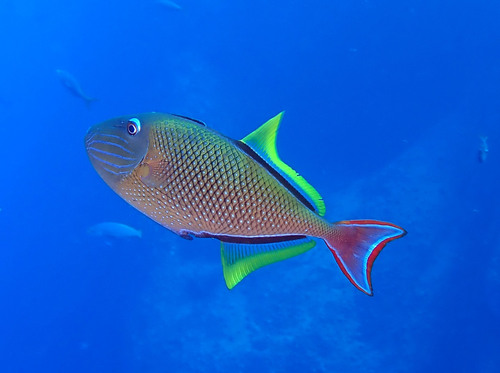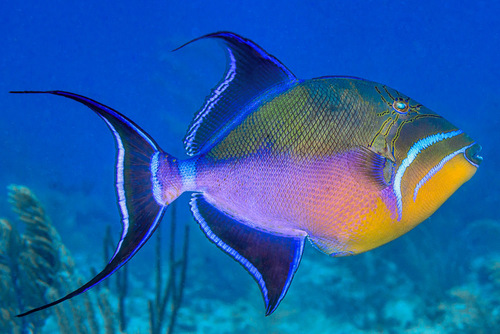
About Balistes vetula Linnaeus, 1758
Taxonomy and Size
The queen triggerfish, scientifically named Balistes vetula Linnaeus, 1758, is a fairly large species among all triggerfishes that often reaches a total length of 45 centimeters. Females of this species tend to be larger than males.
Body Shape and Jaw Structure
It has an oval-shaped, laterally compressed body, with small eyes positioned close to the top of its head. Though it has a small mouth, its jaw is extremely powerful and equipped with sharp incisors.
Distinguishing Color Pattern Context
Compared to other larger triggerfishes with overlapping ranges, such as the grey triggerfish and ocean triggerfish, the queen triggerfish is easily identifiable by its distinct color patterns.
Base Body Coloration
Its body is generally steel grey to olive green, with orange coloring on areas below its mouth and pectoral fin.
Head and Fin Markings
Electric blue lines appear around its mouth, and dark blue lines radiate out from its eyes. There is also a distinct visible blue line along the edge of its caudal fin.
First Dorsal Fin Function
Its first dorsal fin is triangular, and has spines that lock the fish into crevices when it is resting or escaping from predators.
Other Fin Shapes
Its second dorsal fin and anal fin are very long and triangular, while its caudal fin is crescent-shaped.
Juvenile Appearance
Juvenile queen triggerfish have almost the same appearance as adults, but their coloration is duller.
Color Change Ability
This species can change its color to some degree to match its surroundings, or when it is under stress.
General Distribution Range
The queen triggerfish is found in Atlantic waters, and is most common in warmer regions.
Western Atlantic Range
In the Western Atlantic, its range extends from Massachusetts to Brazil, and also includes the Caribbean Sea; it is most abundant in Florida, the Bahamas, and the Caribbean.
Eastern Atlantic Range
In the Eastern Atlantic, its range stretches from the Azores to southern Angola.
Habitat Types
Queen triggerfish generally live on rocky seabeds or coral reefs, but are occasionally found on sandy seabeds or in seagrass meadows.
Depth Range
They can inhabit waters as deep as 275 meters, but are most commonly found in much shallower water that is no deeper than 30 meters.
Breeding Frequency
Queen triggerfish breed year-round. It is thought that larger females can release eggs more than 80 times per year.
Breeding Timing and Migrations
Most breeding activity takes place around the full moon. This species often migrates to a specific breeding ground to mate.
Egg Laying Behavior
When breeding, the fish digs a shallow sand pit on the seabed with its fin and lays eggs inside the pit.
Parental Care and Territoriality
After laying eggs, parent fish provide intensive care for the eggs, and become extremely aggressive and territorial. They may use a membrane below their pectoral fins to produce noise to warn other animals to stay away.
Larval Dispersal
After hatching, larvae are usually carried away by ocean currents.
Sexual Maturity Age
On average, males reach sexual maturity at 2.7 years old, while females reach maturity at 4 years old.
Lifespan Research Discrepancies
The maximum lifespan of the queen triggerfish remains debated. A 1980s study of otoliths claimed that the species can only live for 7 years, while a later study of its growth pattern reported a maximum lifespan of 14 years.
Updated Lifespan Estimate
Analysis using bomb radiocarbon has proposed a much longer maximum lifespan of 40 years.
Human Consumption and Harvest
The queen triggerfish is a staple food fish for many coastal Latin American communities around the Caribbean Sea. It is most often harvested using hook-and-line or fish traps, and is also commonly caught as bycatch in commercial longline fisheries.
Consumption Risk
However, the flesh of this fish may contain ciguatoxin.