About Vulpes lagopus (Linnaeus, 1758)
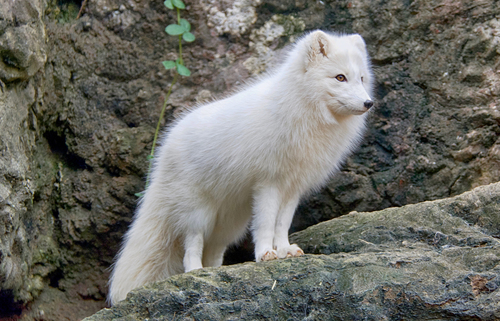
The Arctic fox (scientific name Vulpes lagopus), also called the white fox, polar fox, or snow fox, is a small fox species native to Arctic regions of the Northern Hemisphere, and common across the Arctic tundra biome. It is well adapted to cold environments, and is best known for its thick, warm fur that also serves as camouflage. It has a large, very fluffy tail. In the wild, most individuals do not live past their first year, but some exceptional individuals survive up to 11 years. Its body length ranges from 46 to 68 cm (18 to 27 in), and it generally has a rounded body shape to reduce body heat loss. Arctic foxes prey on many small creatures including lemmings, voles, ringed seal pups, fish, waterfowl, and seabirds. They also eat carrion, berries, seaweed, insects, and other small invertebrates. Arctic foxes form monogamous pairs during the breeding season, and stay together to raise their young in complex underground dens. Occasionally, other family members may assist in raising the young. Natural predators of the Arctic fox include golden eagles, Arctic wolves, polar bears, wolverines, red foxes, and grizzly bears. Arctic foxes have a circumpolar distribution, and live in Arctic tundra habitats across northern Europe, northern Asia, and North America. Their range includes Greenland, Iceland, Fennoscandia, Svalbard, Jan Mayen (where it was hunted to extinction), other Barents Sea islands, northern Russia, Bering Sea islands, Alaska, and Canada as far south as Hudson Bay. In the late 19th century, it was introduced to the Aleutian Islands southwest of Alaska. Today, the Aleutian Islands population is being eradicated as part of conservation efforts to protect the local bird population. Arctic foxes mostly live in tundra and pack ice, but are also present in Canadian boreal forests (northeastern Alberta, northern Saskatchewan, northern Manitoba, Northern Ontario, Northern Quebec, and Newfoundland and Labrador) and on Alaska's Kenai Peninsula. They can be found at elevations up to 3,000 m (9,800 ft) above sea level, and have been spotted on sea ice near the North Pole. The Arctic fox is the only land mammal native to Iceland. It reached this isolated North Atlantic island at the end of the last ice age, walking across the frozen sea. The Arctic Fox Center in Súðavík hosts an exhibition about the Arctic fox and runs studies on how tourism affects the species' population. During the last ice age, the Arctic fox's range was far more extensive than it is today, and fossil remains of the Arctic fox have been found across much of northern Europe and Siberia. Coat color affects where Arctic foxes are most likely found: the white morph mainly lives inland and blends into snowy tundra, while the blue morph lives on coasts, where its darker color blends into cliffs and rocks. In spring, Arctic foxes shift their focus to reproduction and finding a home for their potential offspring. They live in large dens on frost-free, slightly raised ground. These dens are complex tunnel systems that can cover as much as 1,000 m² (11,000 sq ft), and are often located in eskers: long ridges of sedimentary material left behind in formerly glaciated regions. These dens can exist for many decades, and are used by many generations of foxes. Arctic foxes generally choose easily accessible dens with many entrances that are clear of snow and ice, making burrowing easier. They build and select dens that face south toward the sun, which keeps the den warmer. Arctic foxes prefer large, maze-like dens to evade predators and allow for quick escape, especially when red foxes are in the area. Natal dens are usually found in rugged terrain, which may provide more protection for pups. Parents will also relocate their litters to nearby dens to avoid predators. When no red foxes are present in an area, Arctic foxes will reuse dens previously occupied by red foxes. Shelter quality is more important to Arctic foxes than how close a den is to spring prey. In the tundra, lemmings are the Arctic fox's main prey, which is why the white fox is often called the "lemming fox". The white fox's reproduction rate matches the cyclical fluctuations of lemming population density, which changes every 3–5 years. When lemmings are abundant, white foxes can give birth to 18 pups, but they often do not reproduce at all when food is scarce. The coastal blue fox lives in an environment with relatively consistent food availability, and produces up to 5 pups every year. Breeding usually occurs in April and May, with a gestation period of around 52 days. Litters can hold as many as 25 pups, which is the largest litter size recorded in the order Carnivora. Young foxes emerge from the den when they are 3 to 4 weeks old, and are weaned by 9 weeks of age. Arctic foxes are primarily monogamous, and both parents care for their offspring. When both predators and prey are abundant, Arctic foxes (both males and females) are more likely to be promiscuous, and develop more complex social structures. Larger packs of foxes made up of breeding or non-breeding males and females can guard a single territory more effectively, improving pup survival. When resources are scarce, competition increases, and the number of foxes in a territory decreases. On the coasts of Svalbard, complex social structures are more common than among inland, monogamous Arctic foxes, due to differing food availability. In Scandinavia, complex social structures are more common than in other populations because of the presence of red foxes; conservationists also provide supplemental food to the region's declining Arctic fox population. A unique case is Iceland, where monogamy is the most common mating system. Older 1-year-old offspring often stay within their parent's territory even when there are no predators and fewer resources, which may indicate kin selection in this species.