About Varanus bengalensis (Daudin, 1802)
Taxonomy and Size
The Bengal monitor, scientifically Varanus bengalensis (Daudin, 1802), can reach a total length of 175 cm (69 in), with a 75 cm (30 in) snout-to-vent length (SVL) and a 100 cm (39 in) tail. Males are typically larger than females, and heavy individuals can weigh almost 7.2 kg (16 lb).
Juvenile Coloration
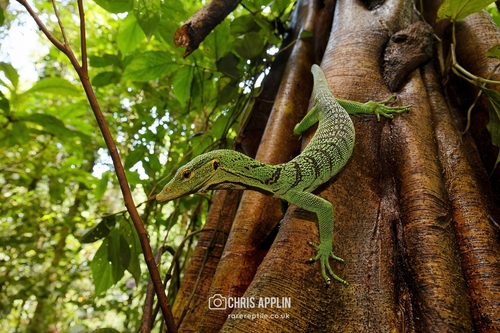
Young Bengal monitors are more colorful than adults. Juveniles have a series of dark crossbars on the neck, throat, and back; their white belly is banded with dark crossbars and spotted with grey or yellow, a pattern most common in the eastern part of the species' range.
Dorsal Juvenile Markings
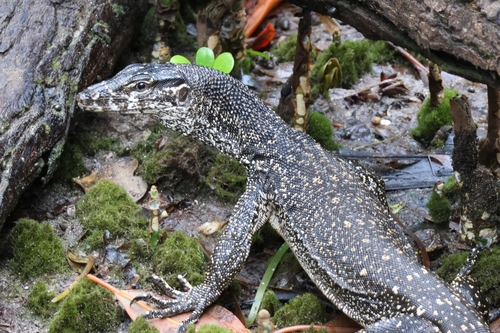
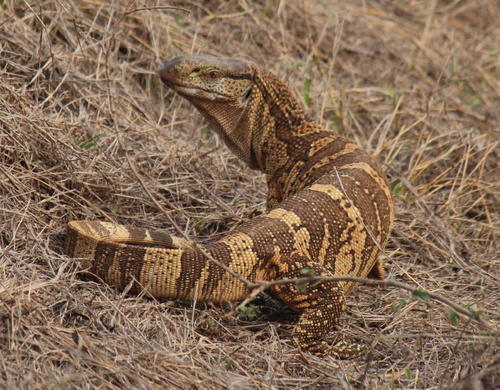
On the dorsal surface of young monitors, there is a series of yellow spots connected by dark transverse bars. As the lizards mature, their base color fades to light brown or grey, and dark spots create a speckled appearance.
Nostril Structure
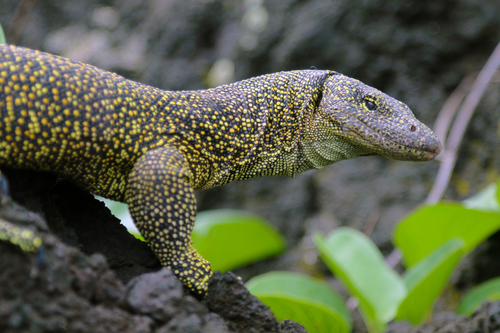
Bengal monitors have slit-like external nostril openings oriented nearly horizontally, positioned between the eye and the tip of the snout. They can close these nostrils at will to keep out debris or water.
Skin Scales and Glands
Their skin scales are rougher in patches and on the sides, and have minute pits that are particularly well-distributed in males. These pitted scales have glandular structures in the underlying dermal tissue that produce a secretion thought to be similar to pheromones.
Tongue and Fat Storage
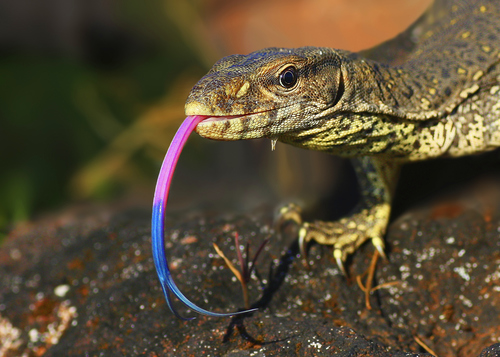
Like snakes, Bengal monitors have a forked tongue that functions primarily for sensory purposes, and plays little role in moving food down the throat. They store fat deposits in their tail and body to sustain them when prey is scarce.
Lung Structure
Unlike the simple lung sacs of other lizards, the lungs of the Bengal monitor contain spongy tissue that allows a higher rate of gas exchange, supporting a faster metabolic rate and higher activity levels.
Tooth Attachment and Replacement Trait
Like all monitor lizards, they have subpleurodont teeth, which means the teeth are fused to the inside of the jaw bones. Teeth are arranged one behind another, and replacement teeth grow behind and between each functional tooth, a trait called polyphyodonty.
Tooth Morphology
Maxillary and dentary teeth are laterally compressed, sometimes with a slightly serrated cutting edge, while premaxillary teeth are conical. In total, there are typically 78 premaxillary teeth, 10 maxillary teeth, and 13 dentary teeth.
Tooth Replacement Rate
Replacement teeth move forward as older teeth are lost, and each tooth is replaced around four times per year. Bengal monitors have venom glands, but only one controversial case report exists of fatal renal failure resulting from an envenomation.
Species Distribution
The Bengal monitor ranges from Iran to Java, making it one of the most widely distributed monitor lizards. It inhabits river valleys at elevations below 1,500 m (4,900 ft), occurring in habitats ranging from dry semiarid desert to moist forest.
Habitat Preferences
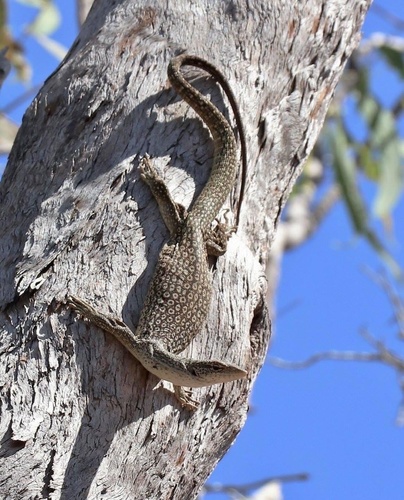
It also lives in agricultural areas, though it prefers forests with large trees; generally, areas with high ground cover and large trees are favorable. Bengal monitors are usually solitary and ground-dwelling, though young individuals are often found in trees.
Sympatric Habitat Separation
They are sympatric with yellow monitors, and the two are partially separated by habitat, as Bengal monitors prefer forest over agricultural areas. Bengal monitors shelter in burrows they dig, or in crevices in rocks and buildings, while clouded monitors prefer tree hollows; both species will use abandoned termite mounds for shelter.
Activity Pattern
Like other monitors, Bengal monitors are diurnal, becoming active around 6 AM and basking in the morning sun. During winter in the colder parts of their range, they may take shelter and enter a period of reduced metabolic activity.
Home Range and Avoidance of Humans
They are not territorial, and may change their home range seasonally in response to food availability. They are typically shy and avoid humans; they have keen eyesight and can detect human movement from almost 250 m away.
Defense and Lifespan
When caught, only a few individuals will bite, and biting is rare. Captive Bengal monitors have been recorded living almost 22 years.
Predators and Parasites
Adult Bengal monitors are preyed on by pythons, mammalian predators, and birds. A number of ectoparasites and endoparasites have been recorded on this species.
Reproductive Trait: Sperm Retention
Female Bengal monitors can retain sperm, so females held in confinement have been able to lay fertile eggs. The main breeding season runs from June to September, though males begin displaying combat behavior as early as April.
Nesting Behavior
Females dig a nest hole in level ground or a vertical bank to lay their eggs, then fill the hole and use their snouts to compact the soil. They often dig false nests nearby and shovel soil around the nesting area, and will sometimes use a termite mound for nesting.
Clutch Size and Hatching
A single clutch contains around 20 eggs. Eggs hatch between 168 days and almost 254 days after laying, and hatching success typically ranges from 40% to 80%.