About Valenciennea helsdingenii (Bleeker, 1858)
Common Name and Body Shape
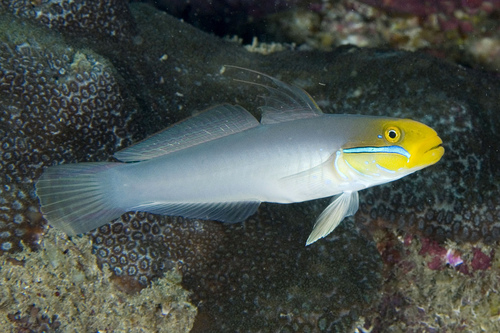
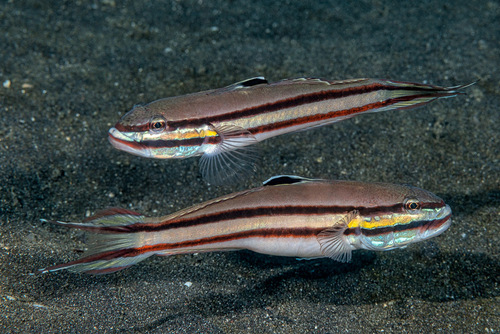
This species, commonly called the twostripe goby, has an elongated, laterally compressed body.
Size
It commonly reaches 18 cm (7.1 in) in length, with a maximum recorded length of 25 cm (9.8 in).
Base Body Coloration
Its body is mostly white to pale gray, with a darker brownish gray dorsal surface.
Longitudinal Stripe Characteristics
Two prominent longitudinal stripes run along the sides of its body; these stripes may be orange, dark red, reddish-brown, or black, and are darkest at the anterior end, lightening toward the rear of the body.
Upper Stripe Position
The upper stripe starts at the front of the snout, runs through the eye, and ends at the tip of the upper fork of the caudal fin.
Lower Stripe Position
The lower stripe runs parallel to the upper one, starting at the side of the upper lip, passing through the middle of the pectoral fin base, and ending at the tip of the lower fork of the caudal fin.
Stripe Outline at Caudal Fin
Both stripes are outlined in white at the caudal fin.
Dorsal Fin Spot
A large oval black spot sits between the third and fifth spines of the dorsal fin.
Pelvic and Dorsal Fin Connection
The pelvic fins are completely separated, and there is no connecting membrane between the first and second dorsal fins.
First Dorsal Fin Structure
The first dorsal fin is shallow with a rounded margin, and its fourth spine is slightly longer than the other spines.
Caudal Fin Variation by Age
Adult twostripe gobies have a deeply notched caudal fin with two long filaments, while juveniles have more rounded caudal fins.
Distribution Range
Twostripe gobies have a wide distribution across temperate and tropical waters of the Indian Ocean and western Pacific Ocean.
Specific Range Localities
Their range extends along the coast of East Africa, and includes the southern Red Sea, the Maldives, southeast India, Sri Lanka, Southeast Asia, Australia, western Oceania, and Japan.
Population Abundance
This species is relatively rare.
Social Behavior and Substrate Association
It usually occurs in pairs, but may also be found alone on silty flat sand patches or rubble substrates.
Habitat Preference
It typically inhabits outer reefs at the base of coral or rocky dropoffs, and only rarely occurs in lagoons.
Diet and Feeding Behavior
It is a carnivorous species that feeds on small fossorial (burrowing) invertebrates by sifting prey from mouthfuls of sand.
Spawning and Larval Development
After spawning, eggs hatch within two days; larvae reach a length of 5.25 mm (0.207 in) 35 days after hatching.
Juvenile Habitat
Juveniles are most often found near rocks in clear estuaries.