About Vachellia sieberiana (DC.) Kyal. & Boatwr.
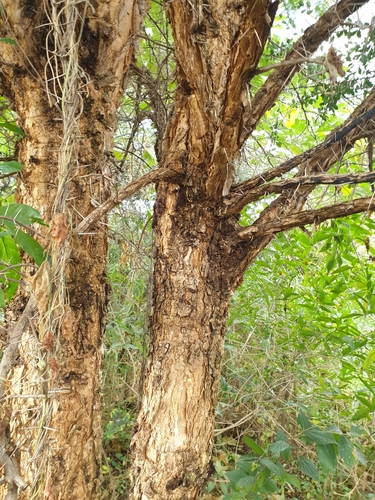
Vachellia sieberiana, which was known as Acacia sieberiana until recently, is a tree native to southern Africa that has been introduced into Pakistan. This tree reaches a height between 3 and 25 metres, with a trunk diameter from 0.6 to 1.8 metres. It is not listed as a threatened species. In its natural range, Vachellia sieberiana is widespread and faces no threats. It is browsed by livestock and game animals including elephants and giraffes. Vachellia sieberiana is primarily valued as a source of forage, medicine, and wood. Its inner bark provides fibre, which is used for purposes such as stringing beads. Its gum is edible. Both livestock and game browse the tree and feed on its fallen pods, spreading viable seeds through their dung. The tree's flowers are good forage for bees, and beekeepers place hives directly on the trees to use this resource. When the tree is heavily browsed, its leaves commonly release toxic chemical compounds. Some of these compounds can release hydrogen cyanide when ingested, which can be lethal to cattle. Fallen pods and foliage of the tree provide critical lifesaving forage during dry seasons. The tree's gum is used as food, an adhesive, and an ingredient in ink production. In African traditional medicine, the bark or root of Vachellia sieberiana is used to treat urinary tract inflammation. The bark has astringent properties, and is used to treat colds, cough, and childhood fever. As cited from the World AgroForestry Centre, a decoction of the root is taken as a remedy for stomach-ache. The bark, leaves, and gums are used to treat tapeworm, bilharzia, haemorrhage, orchitis, colds, diarrhoea, gonorrhoea, kidney problems, syphilis, ophthalmia, rheumatism, and disorders of the circulatory system, and are also used as an astringent. The pods act as an emollient, while the roots are used for stomach-ache, acne, tapeworms, urethral problems, oedema, and dropsy.