About Rhynchosia reniformis DC.
Growth Habit and Height
Rhynchosia reniformis DC. can grow erect, trail, or climb, and reaches 5–25 cm in height.
Stem Characteristics
Its stems are strongly angled and densely covered with short hairs.
Leaflet Count
Most leaves consist of a single leaflet, though the lowest leaves may have three leaflets.
Leaflet Shape and Texture
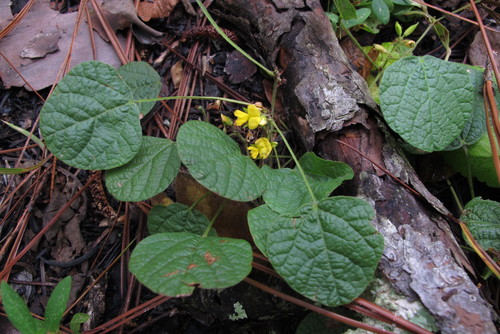
Leaflets are round to kidney-shaped and thick, and are often wider than they are long.
Leaflet Surface Features
They have visible veins, soft hairs, and scattered tiny amber-colored glands.
Stipule Characteristics
The stipules located at the base of each leaf are narrow and persistent.
Flower Arrangement
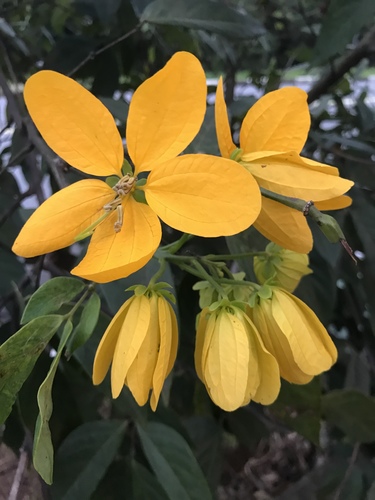
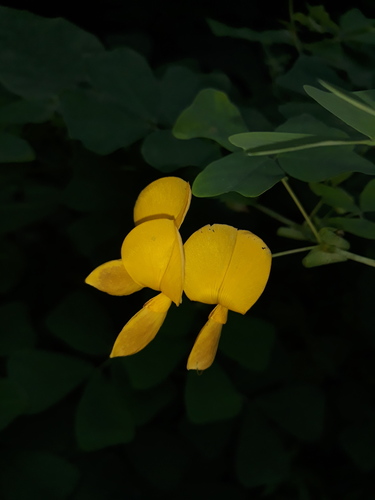
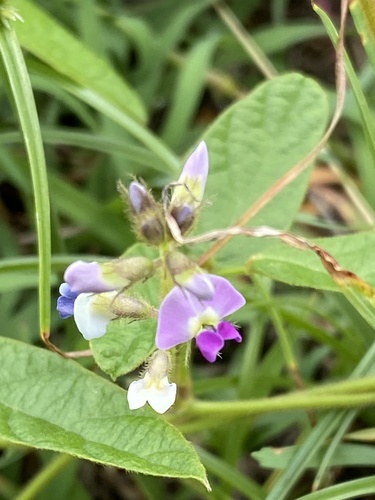
The small yellow pea-like flowers are arranged in clusters in leaf axils, or sometimes at the ends of branches.
Flower Stalk and Bract
Each flower grows from a short stalk, and is subtended by a narrow bract that falls off early.
Calyx and Petal Features
The calyx is hairy with five pointed lobes, and the petals are usually about the same length as the calyx or slightly shorter.
Fruit Characteristics
The fruit is a flat, oblong pod 1–1.8 cm long, covered in short hairs, and holds one or two seeds.
Root Tuber Function
The root system produces stem tubers that store non-structural carbohydrates, which help the plant resprout after fire and persist during periods of fire exclusion.
Species Distribution
Rhynchosia reniformis ranges from southeastern North Carolina south to South Florida and west to East Texas.
Native Habitat
It grows in longleaf pine sandhills and pine rocklands.
Post-Agricultural Indicator Role
It has been observed regrowing in longleaf pine communities disturbed by agriculture in South Carolina, which means it may act as an indicator species for post-agricultural woodlands.
Regrowth Resistance in Disturbed Forests
It has shown resistance to regrowth, however, in reestablished pine forests that were previously disturbed by military training.
Flowering and Fruiting Period
Ecologically, this species flowers from June through September and produces fruit from August to October.
Faunal Interactions
Its seeds are a food source for small mammals, songbirds, and northern bobwhite, and white-tail deer forage on the plant itself.