About Vachellia nilotica (L.) P.J.H.Hurter & Mabb.
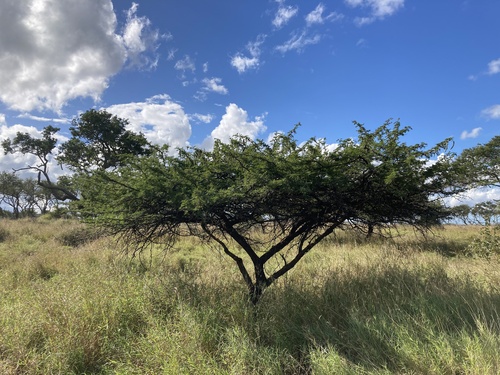
Vachellia nilotica (L.) P.J.H.Hurter & Mabb., also formerly known as Acacia nilotica, is a tree that grows 5 to 20 meters tall. It has a dense spherical crown, with stems and branches that are usually dark to black in color. Its bark is fissured, with a grey-pinkish cut surface, and it exudes a low-quality reddish gum. This tree produces thin, straight, light grey spines that grow in axillary pairs, usually with 3 to 12 pairs of spines per branch. On young trees, spines are 5 to 7.5 cm (3 inches) long; mature trees commonly do not have thorns. Its leaves are bipinnate, with 3–6 pairs of pinnulae and 10–30 pairs of leaflets per leaf. Leaves are tomentose, and the leaf rachis has a gland at the base of the last pair of pinnulae. Flowers grow in golden-yellow globular heads 1.2–1.5 cm in diameter; these heads are arranged either axillary or in whorls on 2–3 cm long peduncles located at the ends of branches. The tree’s pods are strongly constricted, hairy, white-grey, thick and softly tomentose. Approximately 8000 seeds of this species weigh one kilogram. This species is native to Egypt, across the Maghreb and Sahel, south to Mozambique and KwaZulu-Natal, South Africa, and east through the Arabian Peninsula to the Indian subcontinent and Burma. It has become widely naturalized outside its native range, including in Zanzibar and Australia, and is spread by livestock. In India, this plant is used as an ingredient in various dishes. The Maasai people eat both the inner phloem bark and the fruit pulp after boiling them in water. East African savanna tribes use this plant medicinally to treat conditions including sore throat, cough, and chest pains. In Northern Nigeria, this plant is called bagaruwa in the Hausa language. Medicinal uses here include soaking the tender bark in water, and consuming the preparation to treat dysentery and hemorrhoids (piles). Ground fruits and seeds mixed with honey are taken to treat stomach ulcers.