About Erythrina herbacea L.
Nomenclature and Growth Form
Erythrina herbacea L., commonly called coral bean, grows as a low shrub or small tree. In regions where freezing does not kill the plant back, it reaches around 5 m (16 ft) in height; in other areas, it only grows to 1.2 m (3.9 ft).
Stem Characteristics
Stems are covered in curved spines.
Leaf Structure
Its leaves are yellowish-green, 15–20 cm (5.9–7.9 in) long and 6 cm (2.4 in) wide, divided into three arrowhead-shaped leaflets that measure 2.5–8 cm (0.98–3.15 in) in length.
Bark Features
The bark is smooth and light gray.
Flower Characteristics
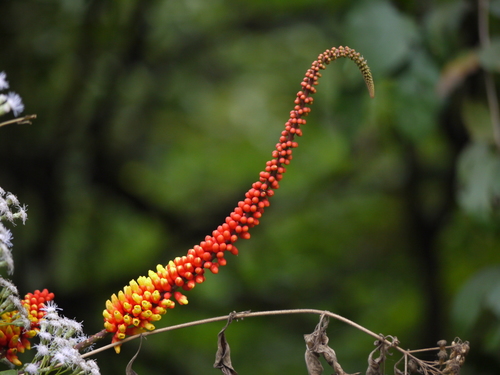
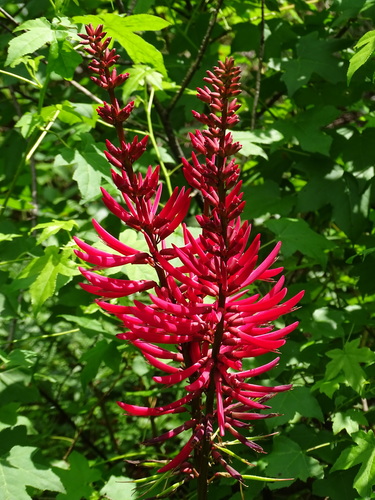
Bright red tubular flowers grow in long spikes, with each individual flower 4–6.5 cm (1.6–2.6 in) long, and blooming occurs from April to July.
Fruit and Seed Features
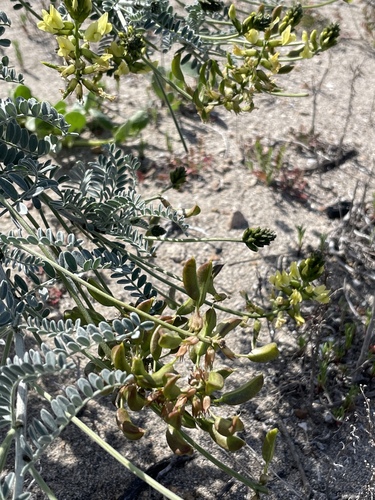
Flowers are followed by 5–10 cm (2.0–3.9 in) pods that contain bright red seeds, which gives the plant its common name.
Root Structure
The plant forms a woody caudex.
Toxic Alkaloid Content
A range of toxic alkaloids, including erysopine, erysothiopine, erysothiovine, erysovine, erythrinine, erythroresin, coralin, erythric acid, and hypaphorine, occur throughout the entire plant. Leaves additionally contain erysotrine and erythrartine.
Toxicity Effect
Ingestion of these compounds causes paralysis that acts much like curare.
Soil and Salt Tolerance
Coral bean grows best in sandy soils and has moderate salt tolerance.
Natural Habitat
It occurs naturally in open woods, forest clearings, hammocks, and disturbed areas.
Native US Range
In the United States, its natural range extends from southeastern North Carolina south to Florida, and west to southeastern Oklahoma and eastern Texas.
Native Mexican Range
It also inhabits Tamaulipas, Mexico.
Introduced Arizona Range
Populations have been recorded in parts of the Dragoon Mountains in Southern Arizona, around the Cochise Stronghold and other older Indian archaeological sites; it is thought to have been introduced to this area through trade by the Mogollon culture, which occupied the region from 150 AD to 1400 AD, and potentially later by 19th-century Apache Indians.
Arizona Range Research Need
Further research of the surrounding area is needed to confirm the full extent of the plant's range here.
Cultivation Suitability
Erythrina herbacea can be easily grown in gardens within its natural range.
Gardening Appeal
Though it is not commonly grown in gardens, it is popular among gardeners who grow it for providing early season color, its hardiness in USDA Zones 7-10, and its ability to attract hummingbirds.
Native American Medicinal Uses
Native American groups used this plant for a variety of medicinal purposes, with uses varying between nations and localities: Creek women used an infusion of the root to treat bowel pain; the Choctaw used a decoction of the leaves as a general tonic; the Seminole used root extract for digestive problems, and extracts of the seeds or inner bark as an external rub for rheumatic disorders.
Mexican Poison Uses
In Mexico, the seeds are used as rat poison, while bark and leaves are made into fish poison.
Central American Culinary Uses
In some Central American countries, the flowers are used in traditional cuisine, most often added to bean soup or meat patties, and are known to have mild narcotic properties.