About Turdoides caudata (Dumont, 1823)
External Appearance
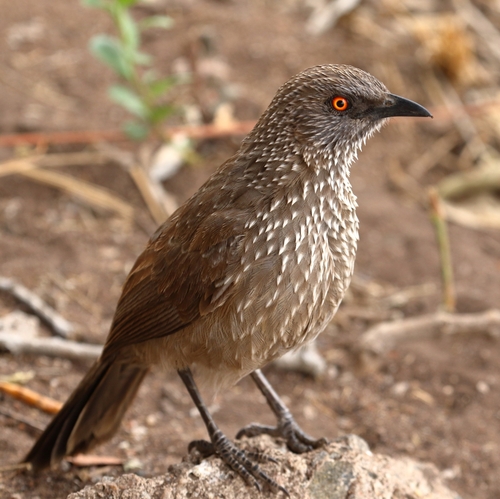
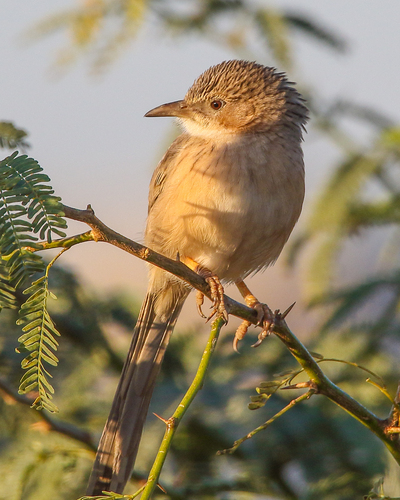
This small, slim babbler with a long tail is buff to grey with dark streaks on its upperparts. Its underside is paler, unstreaked, and the throat is almost whitish.
Taxonomic Naming History
The species was first described under the name Crateropus caudatus, later moved to the genus Argya, and later still moved to the genus Turdoides. The specific epithet was retained through these genus changes, and the corrected feminine form caudata matches the Latin grammatical gender of the genus Turdoides.
Subspecies Distribution
Two subgroups are recognized within the common babbler: eclipes (Hume, 1877), found from northern Pakistan to northwestern India, and the nominate subspecies caudata (Dumont de Sainte Croix, 1823), found in southern Pakistan, Nepal, Bangladesh, India, and the Lakshadweep Islands.
Group Size
Like most other babblers, the common babbler lives in small parties of six to twenty individuals.
Movement Behavior
They are vociferous, and move primarily on the ground, often with some group members standing watch from the tops of bushes. They forage through undergrowth, hopping on the ground and creeping in a rodent-like way, and usually hold their long tail raised when moving on the ground.
Vocalizations
Their typical call is a rapid trill, while their alarm call is a high-pitched squeak.
Habitat
This species occurs mainly in dry regions with sparse, low thorny scrub vegetation.
Diet
It feeds on insects, berries, and grains, with Lantana and Capparis berries being favorite foods.
Social Group Structure
Multiple breeding pairs may live within a single common babbler group. Adults frequently preen the head and neck feathers of other group members.
Nesting Season
In India, the nesting season falls in summer, from May to July, with two distinct peaks separated by a gap during the rainy season.
Nest and Eggs
Common babblers build a shallow cup-shaped nest low in a thorny bush, and lay around 2 to 3 turquoise blue eggs. In northern India, this species has been recorded nesting in heaps of lopped Zizyphus branches.
Incubation Period
Eggs hatch after 13 to 15 days of incubation.
Brood Parasitism
Broods may be parasitized by the Jacobin cuckoo and the common hawk-cuckoo.
Fledgling Development
Young birds can fly about a week after hatching, and remain with the group, roosting alongside adults.
Helper Behavior
Helpers, likely young birds from an earlier brood, may assist the breeding parents by feeding brooding females and young chicks. After delivering food, the feeding helper typically hops, gives a low trill call, and shivers its feathers.
Juvenile Traits
Young birds have yellow gapes, and their iris color changes from hazel to dark brown as they mature.
Roosting Behavior
Common babblers roost communally.
Cooperative Breeding Origin
It is thought that their cooperative breeding structure forms from groups of closely related males, with females dispersing away from their natal groups.