About Tupaia glis (Diard, 1820)
Taxonomic Status
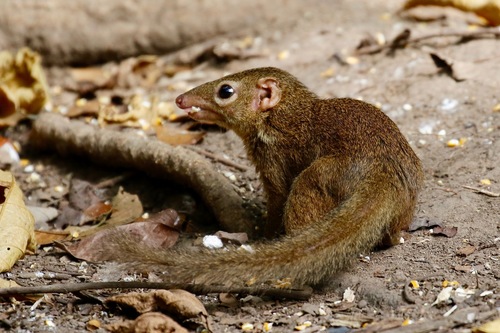
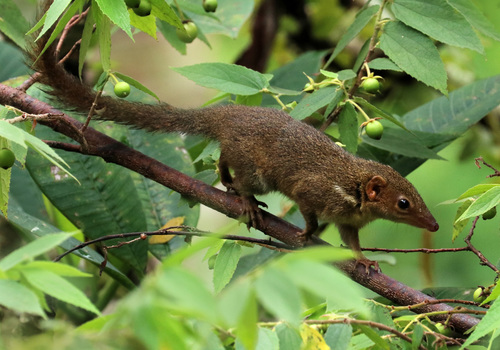
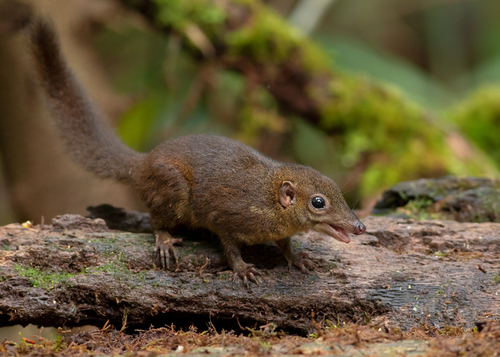
The common treeshrew, Tupaia glis, is one of the largest treeshrew species.
Body Measurements
It has an average body length of 16 to 21 cm (6.3 to 8.3 in) and an average weight around 190 g; other recorded measurements give a head and body length of 13–21 cm and a tail length of 12–20 cm.
Body Coloration
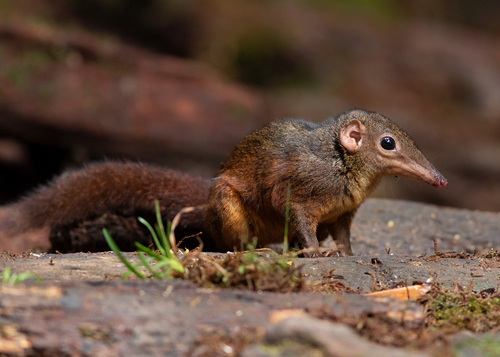
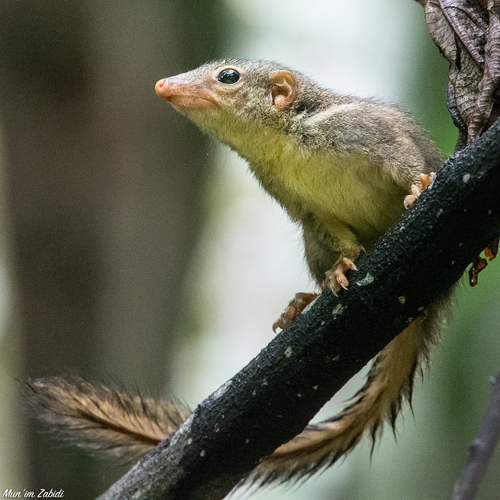
Its upperparts can vary in colour between reddish-brown, greyish or black, with a whitish belly, and it usually has a pale white stripe on each shoulder.
Tail Characteristics
It has a long, bushy, dark greyish-brown tail that is nearly as long as its body.
Distinctive Physical Features
The paws are hairless with sharp nails, and there is a bare patch of skin above its long nose.
Sexual Dimorphism
The sexes have similar appearance.
Subspecies Recognition
There are two recognized subspecies: T. g. longipes and T. g. salatana.
T. g. longipes Traits
T. g. longipes is duller in overall colour, with dull buff to reddish-buff underparts and a greyish tail underside.
T. g. salatana Traits
T. g. salatana has dark reddish underparts and tail underside.
Similar Species
Similar species include Tupaia splendidula and Tupaia montana.
Mainland Distribution Range
Common treeshrews occur south of approximately 10°N latitude, ranging from southern Thailand through mainland Malaysia and its adjacent coastal islands to Singapore.
Protected Area Records
They have been recorded in protected areas such as the Pasoh Forest Reserve and Krau Wildlife Reserve on the Malay Peninsula.
Indonesian Island Distribution
In Indonesia, they inhabit the islands of Siberut, Batu, Sumatra, Java, Bangka, Riau, Lingga and Anambas.
Borneo Elevation Range
They are likely present throughout lowlands and hills up to 1,100 m (3,600 ft) in the Kelabit Highlands of Borneo.
Borneo Subspecies Distribution
On Borneo, T. g. longipes is found in the north, including Sarawak, Sabah and East Kalimantan, while T. g. salatana occurs south of the Rajang River and Kayan River.
Primary Habitat
This species most commonly inhabits primary dipterocarp forest, but it is somewhat tolerant of habitat modification.
Modified Habitat Records
It has also been recorded in secondary forest, plantations, fruit orchards, and trees located near residential areas.
Foraging Behavior
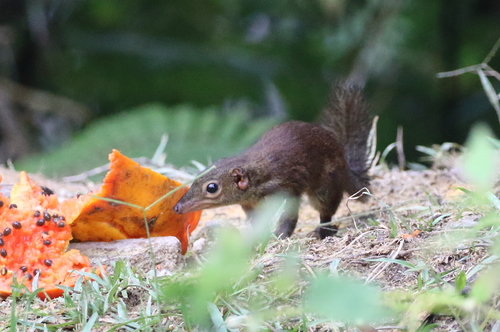
Common treeshrews are diurnal, and forage for food alone or in pairs, mostly on the ground, within shrubs and tree hollows.
Diet Composition
Their diet includes fruits, seeds, leaves, insects (especially ants and spiders), and they have been reported to catch lizards.
Climbing Abilities
They are very agile climbers of large vertical tree trunks and bushes, and can occasionally jump between stems of different young trees up to 60 cm (24 in) apart.
Climbing Height Preference
They mostly climb at lower heights.
Scent Marking Behavior
They frequently scent-mark their territories by rubbing their chest and anogenital area using secretions from glands on their chest and scrotum.
Scent Productivity Variation
Adult males are more scent-productive than females and juveniles.
Home Range Sizes
A study in Bukit Timah Nature Reserve recorded mean home range sizes: 10,174 m² (109,510 sq ft) for adult males, 8,809 m² (94,820 sq ft) for adult females, 7,527 m² (81,020 sq ft) for juvenile males, and 7,255 m² (78,090 sq ft) for juvenile females.
Opposite Sex Range Overlap
Overlap between male and female home ranges ranges from 0.4% to 56.8%.
Same Sex Range Overlap
Same-sex adult home ranges overlap less than ranges of opposite sexes.
Male-Female Range Dynamics
One male's range can include the ranges of two or three females.
Pair Bond Indication
A large overlap between an adult male and an adult female's range indicates a stable pair bond.
Juvenile Range Dynamics
Juvenile ranges of either sex adjoin or overlap with adult ranges, suggesting juveniles are part of the adult family group.
Territorial Behavior
Same-sex individuals engage in aggressive territorial chases, and juvenile males leave their family territory earlier than juvenile females.
Sexual Maturity Age
Both sexes reach sexual maturity at around three months of age.
Captive Female First Birth
In captivity, females have their first birth at approximately 4.5 months old, usually in February.
Postpartum Oestrus Births
Postpartum oestrus leads to additional births in April.
Oestrus and Gestation Length
The oestrus cycle lasts 8 to 39 days, and gestation lasts 40 to 52 days.
Litter Characteristics
Litters consist of 1 to 3 newborns that weigh 10 to 12 grams each.
Maternal Care Behavior
Females suckle their young every other day, and neglect their young as much as possible; they can only recognize their own young because they mark them with scent from sternum and abdominal glands.
Juvenile Nest Departure Age
Juveniles leave the nest between 25 and 35 days old.
Captive Lifespan Record
The longest recorded lifespan of a captive common treeshrew is 12 years and 5 months.
Reproductive Inactivity Period
Common treeshrews are reproductively inactive from October to December.
Mating Season Timing
The mating season begins when monsoon season starts in December, and lasts until February.
Male Mating Behavior
During oestrus and proestrus, adult males pursue adult females, emit chattering vocalizations, and appear highly excited; males also chase and fight each other.
Mate Selection Dynamics
Females do not actively choose a mate from competing males, and the dominant male mates with available females.
West Malaysia Population Density
In West Malaysian tropical rainforest habitats, population density ranges from two to five individuals per hectare.
Regional Breeding Timing
Annual breeding aligns with increased invertebrate abundance that follows the dry season, with the main reproductive period falling between February and June.
West Malaysia Reproductive Traits
In this region, litter size is consistently two, some females breed more than once per season, and first pregnancy occurs at seven months old.
Juvenile Mortality Timing
Most juvenile emigration or mortality takes place during the breeding season or monsoon.