About Harpactes oreskios (Temminck, 1823)
Scientific Naming and Size
The orange-breasted trogon (scientific name Harpactes oreskios (Temminck, 1823)) is a medium-sized bird that measures 25 to 31 cm in length and weighs 49 to 57 g.
Male Plumage (Head and Upperparts)
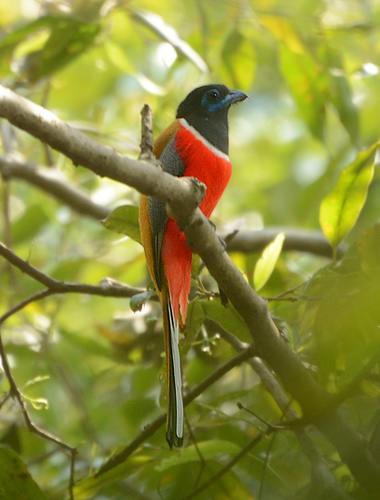
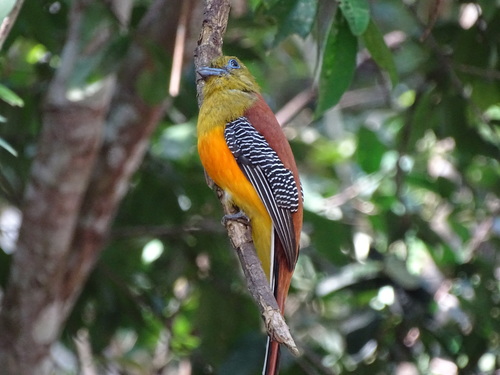
Males have a dull olive-yellow head and rufous-chestnut color extending from the upperparts to the upper part of the tail. The undertail area is black and white. Primaries are black with white vertical bars, and wing coverts are barred black.
Male Plumage (Underparts and Soft Parts)
Males have a yellow-orange lower breast that lightens toward the vent, and a blue eye ring.
Female Plumage
Females have a more grey-brown head and upperparts, a grey breast, and yellow at the belly and vent.
Shared Morphological Trait
Both sexes have grey feet with two toes pointing backward, which is a common trait for trogons.
Subspecies Morphological Variation
Subspecies differ slightly: uniformis and dulitensis are smaller than other subspecies, with uniformis having a more yellow breast and dulitensis having a more green breast; the nias subspecies has a darker crown and a larger bill than other subspecies; stellae has a paler breast and longer tail.
General Species Distribution
Different subspecies of the orange-breasted trogon are distributed across southern China, Laos, Thailand, Peninsular Malaysia, Borneo, Sumatra, Java, and Nias.
Subspecies Specific Ranges
H. o. stellae ranges from southern China and Myanmar to Indochina; H. o. uniformis ranges from southern Thailand and Peninsular Malaysia to Sumatra; H. o. nias occurs only on Nias; H. o. dulitensis occurs on Borneo; and H. o. oreskios occurs on Java.
Migratory Status
This species does not migrate.
Habitat Types
Its natural habitats include subtropical or tropical moist lowland forests, montane forests, humid lower-to-middle elevation evergreen forests, swampy forests, open dry forests, bamboo forests, thin tree jungles, and sometimes clumps of trees near forests.
Elevational Range
Populations occupy lowlands up to 1100 m in Thailand, up to 1300 m in Peninsular Malaysia, 300–1500 m in Borneo, up to 1200 m in Sumatra and Java, and low secondary jungle on Nias.
Breeding Season Timing
Breeding seasons differ between subspecies, and on average the breeding period lasts 2–3 months between January and May.
Nest Excavation Behavior
Both the male and female work together to excavate a shallow cavity for a nest, located in the side or top of a rotten stump or a dead tree limb attached to an otherwise healthy tree. They work in rotation: when one excavates, the other perches nearby.
Clutch Details
The female lays a clutch of 2–3 eggs.
Incubation Behavior
Both sexes alternate incubation responsibilities, with males typically incubating during the day and females incubating overnight. The incubation period lasts around 17–18 days.
Egg Characteristics
The eggs are smooth, oval, and colored dirty ivory or pale olive, with no markings.
Nestling Period Duration
The nestling period lasts around 12–14 days.
Nestling Provisioning Behavior
Males play a more dominant role than females in provisioning food for nestlings; in many cases, the male passes food to the female before she gives it to the nestlings, rather than feeding the nestlings directly.
Breeding Timing Context
This species breeds outside the period of peak food availability, which occurs 4–5 months earlier. This timing may be a response to avoid overlapping with the breeding period of the larger red-headed trogon, which competes with the orange-breasted trogon for food.