About Trochilus polytmus Linnaeus, 1758
Male Size and Weight
The male red-billed streamertail (Trochilus polytmus Linnaeus, 1758) measures 22 to 25 cm (8.7 to 9.8 in) long including its 10 to 13 cm (3.9 to 5.1 in) tail streamers, and weighs 4.0 to 6.5 g (0.14 to 0.23 oz).
Female Size and Weight
The female is approximately 10.5 cm (4.1 in) long, and weighs 3.0 to 6.1 g (0.11 to 0.22 oz).
Male Bill and Head Features
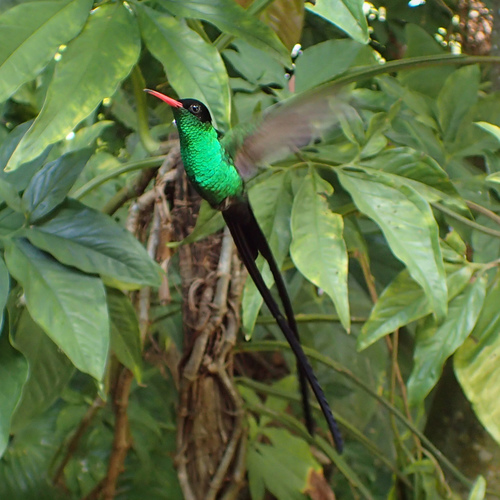
Adult males have a coral red bill with a black tip. They have a dull black to blue-black crown that, along with the nape, forms a deep velvety black crest.
Male Upperparts
The rest of their upperparts are bright metallic green.
Male Tail Features
Their tail is black with a green to bronzy green gloss; the next to outermost pair of tail feathers is very long, which gives the species its English name.
Male Underparts
Males have metallic yellowish green faces and most of their underparts, with blue-black or black undertail coverts that have a bluish gloss.
Female Bill and Upperparts
Adult females have a duller red bill than males. Their upperparts are metallic bronze green to greenish bronze, and are duller on the crown.
Female Tail Features
Their tail lacks the male's streamers. Their central pair of tail feathers are bright bronze green, while the rest are black with some bronze green gloss, and the outermost two pairs have wide white tips.
Female Underparts
Females have white underparts with metallic bronze green spots on the breast and flanks.
Immature Male Features
Immature males are similar to adults, but lack tail streamers, and their tail feathers have bronze green tips.
Species Distribution
The red-billed streamertail is found across all of Jamaica except the extreme eastern end, where the black-billed streamertail occurs.
Habitat Preferences
It lives in evergreen montane forest, lowland tropical forest, and secondary forest, and avoids mangroves and arid highlands.
Elevation Range
Its elevation range extends from sea level to 1,500 m (4,900 ft).
Population Abundance
It is fairly common in the lowlands, and abundant at middle and higher elevations.