About Trioceros jacksonii (Boulenger, 1896)
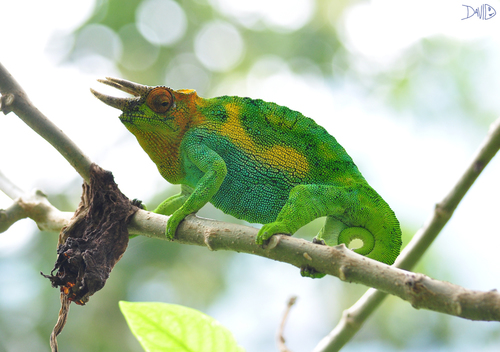
Jackson's chameleon, scientifically named Trioceros jacksonii, is sometimes called the three-horned chameleon.
Horn Arrangement
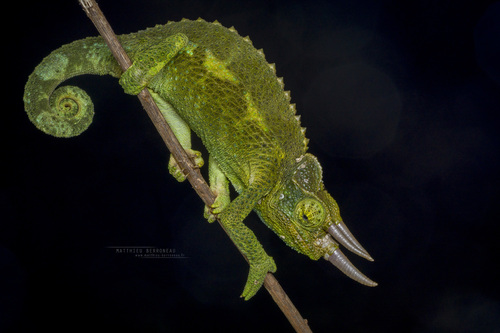
This common name refers to the three brown horns that males have: one rostral horn on the nose, and one preocular horn above each of the superior orbital ridges above the eyes. This horn arrangement is somewhat similar to that of the ceratopsid dinosaur genus Triceratops. Females generally do not have horns, though they may have traces of the rostral horn in the subspecies T. j. jacksonii and T. j. merumontanus.
Coloration
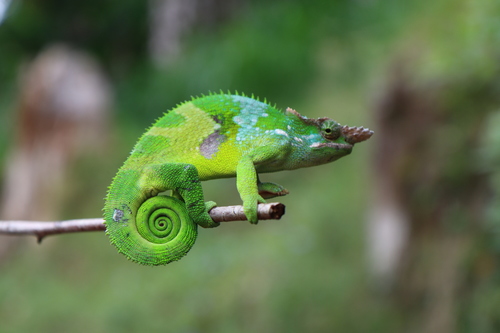
The typical base coloring of Jackson's chameleon is bright green, and some individuals have traces of blue and yellow. Like all chameleons, it can change color quickly based on its mood, health, and surrounding temperature.
Size
Adult males can reach a maximum total length of 38 cm (15 in) including the tail, while adult females can reach up to 25 cm (10 in). More typical adult lengths fall between 15 and 25 cm (6 to 10 in).
Physical Features
It has a saw-tooth shaped dorsal ridge and has no gular crest.
Maturity and Lifespan
This species reaches sexual maturity at five months old. Its lifespan varies, and males generally live longer than females.
Largest Subspecies
The largest subspecies of Jackson's chameleon is T. j. xantholophus, which has been captively bred since the 1980s.
Jackson's chameleon is an arboreal lizard.
Native Habitat Range
It is native to woodlands and wet forests located at altitudes between 1,600 to 2,440 m (5,250 to 8,010 ft) in south-central Kenya and northern Tanzania.
Native Climate
In its native range, rainfall is seasonal but totals over 127 cm (50 in) per year. Daytime temperatures in this area are typically 16–27 °C (61–81 °F), and nighttime temperatures are typically 4–18 °C (39–64 °F).
Tanzania Distribution
In Tanzania, Jackson's chameleon is only found on Mount Meru in the Arusha Region, which is the native range of the relatively small endemic subspecies T. j. merumontanus.
Kenya Distribution
The species is more widespread in Kenya, and even occurs in wooded areas of some Nairobi suburbs.
Hawaiian Introduction
The subspecies T. j. xantholophus, which is native to the Mount Kenya region, was introduced to Hawaii in 1972. It has since established populations on all of Hawaii's main islands and has become an invasive species there.
Florida Introduction
This subspecies has also been introduced to Florida.
Hawaiian Habitat
In Hawaii, Jackson's chameleon occurs mainly at altitudes of 100 to 1,000 m (330 to 3,280 ft) in wet, shady locations.
Pet Trade Regulations
Historically, the Hawaiian population was the main source of Jackson's chameleons for the exotic pet trade in the United States, but exports from Hawaii are now illegal. This ban was put in place to stop people from intentionally establishing new feral populations to capture and sell the chameleons.
Chameleon Reproductive Types
Most chameleon species are oviparous, meaning they lay eggs. However, Jackson's chameleon and several other highland species in the genus Trioceros are ovoviviparous: they give birth to live young, shortly before the offspring would hatch from their egg sac.
Gestation and Offspring
After a gestation period of five to six months, females give birth to between eight and thirty live young. The subspecies T. j. merumontanus typically gives birth to between five and ten live young.