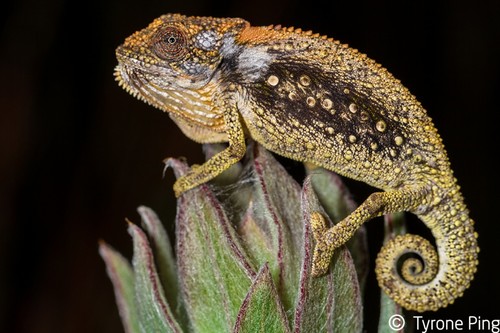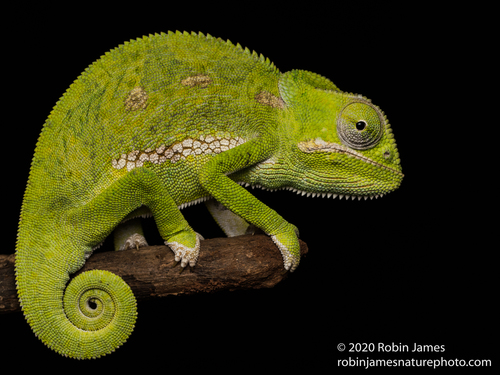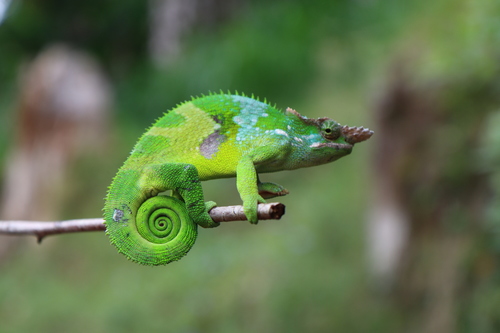
About Kinyongia multituberculata (Nieden, 1913)
Nomenclature
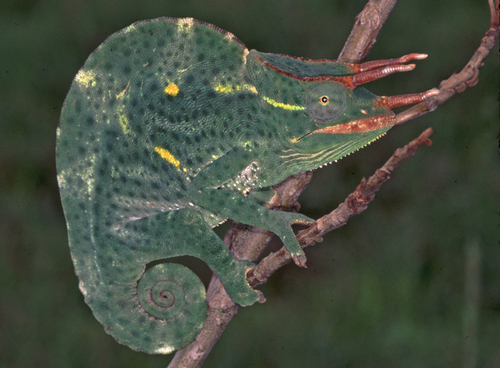
The West Usambara two-horned chameleon, also called the West Usambara blade-horned chameleon, has the scientific name Kinyongia multituberculata. It is a chameleon species that is endemic to the West Usambara Mountains of Tanzania.
Taxonomic History
Before 2008, it was commonly mistaken for Fischer's chameleon (K. fischeri), a species that does not live in the Usambara Mountains. No close relatives of K. multituberculata share its range; K. matschiei and K. vosseleri are both restricted to the East Usambara Mountains instead.
Habitat Elevation Range
This species lives in Afrotemperate forests of the West Usambara Mountains, found at elevations between 1,200 and 2,500 m (3,900 to 8,200 ft) above sea level.
Modified Habitat Tolerance
It can also live in modified vegetation next to forest patches, and on shrubs and trees alongside roads. It does require structurally complex habitats, however, and cannot spread across fully transformed landscapes.
Habitat Threats
The forest patches this species occupies are threatened by timber harvesting and natural resource use, and habitat is lost to human encroachment and conversion for agriculture. Its remaining habitat is highly fragmented, so improved protection of forest reserves for this species is needed.
CITES Listing Status
Like all other chameleons, K. multituberculata is listed under CITES, so legal international trade in the species requires a permit.
Historical Pet Trade
Before it was recognized as a separate species, it was traded under the name K. fischeri, and it was estimated that K. multituberculata was one of the most heavily exported chameleons from East Africa for the international pet trade. Researchers estimate that over 95% of "K. fischeri" exported from Tanzania were actually K. multituberculata.
Recent Export Regulations
After CITES recognized it as a separate species, Tanzania at first permitted limited legal exports of K. multituberculata, but halted all exports of the species after 2017.