About Trichostema lanatum Benth.
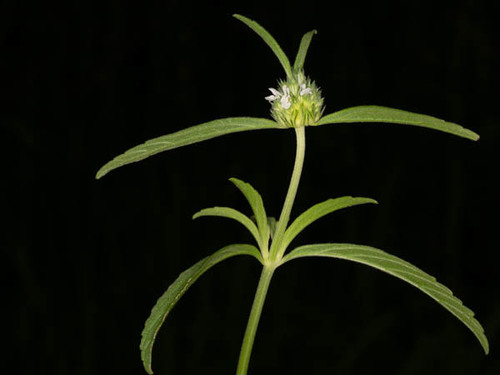
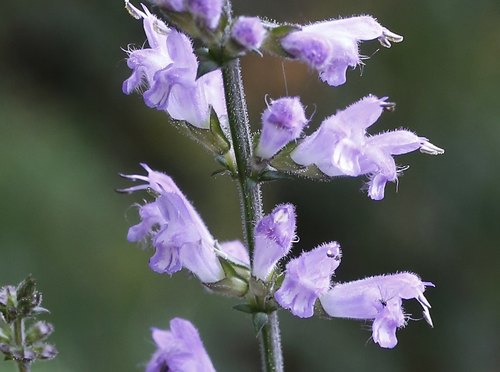
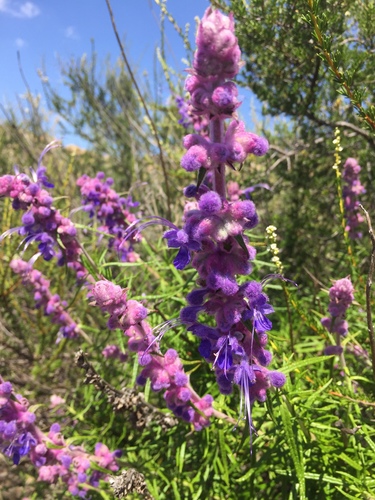
Trichostema lanatum Benth. is a many-branched species that grows up to 1.5 m (5 ft) tall, bearing narrow, pointed green leaves. Its smooth-petaled blue flowers grow in dense clusters; the plant’s stems and calyces are covered in woolly hairs that may be blue, pink, or white. Flowering occurs from March to June. Spanish explorers in California named this plant romero, the Spanish word for rosemary, and this common name is still sometimes used in Mexico today. Trichostema lanatum is cultivated as an ornamental plant, and several cultivars have been developed. It attracts hummingbirds and bumblebees. Native Americans have used this species for a range of medicinal and other purposes, and its leaves and flowers can be brewed into a flavorful tea. The Chumash people incorporated Trichostema lanatum into their care to help support healing during menstruation and birth; they also used it as a general disinfectant and a treatment for rheumatism. When tested against an E.Coli ΔtolC mutant, the plant showed anti-bacterial properties. Additional studies have identified anti-inflammatory properties against the pro-inflammatory cytokine TNF-ɑ, and anti-bacterial properties against macrophages and gram-positive bacteria. This species and its close relative Trichostema lanceolatum were both used by other Indigenous tribes of California, prepared as tea or with crushed leaves, to treat a wide range of ailments including colds, body aches, skin disorders, digestive problems, and malaria. The two species differ in scent, physical anatomy, and native growing location, though Indigenous tribes used T. lanatum to treat the same ailments as T. lanceolatum. Woolly bluecurls and other native plants have historically been used by Indigenous peoples as part of a holistic approach to medical care. This approach typically considers patient health and well-being at the intersection of biology, psychology, and culture, and leverages the biochemical properties of native plants to treat specific ailments. Future research on woolly bluecurls and other plants used for medicinal purposes by Indigenous peoples will need to center the use of these plants within their broader cultural system of care. This work can be challenging due to the historical, systematic erasure of Indigenous wisdom that has been a core feature of settler colonialism.