About Tricholaema leucomelas (Boddaert, 1783)
Head and Face Features
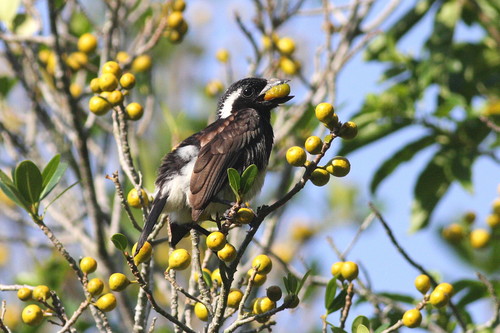
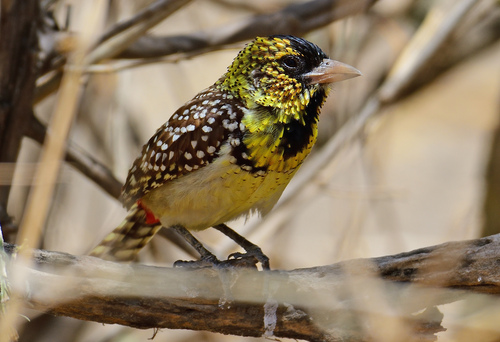
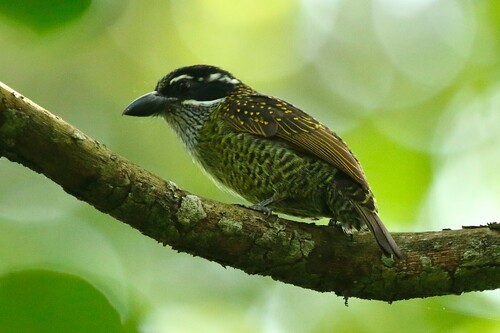
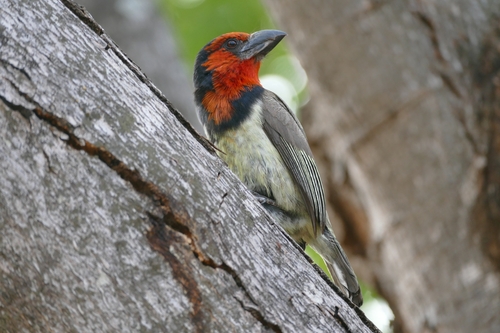
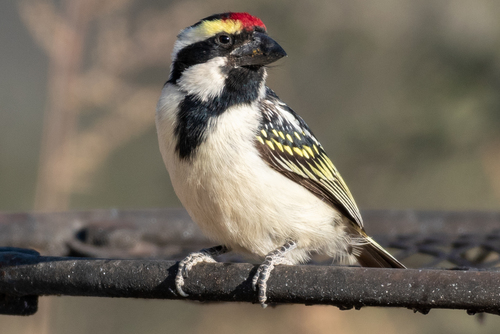
The acacia pied barbet, Tricholaema leucomelas, has dark brown eyes and blackish legs and feet. Its head is striped black and white, with red on the front and forecrown, and a pale yellow superciliary stripe.
Throat Plumage
It has a black bib under the chin.
Central Subspecies Underparts
Drier land subspecies T. l. centralis have a white breast and white underparts.
Regional Subspecies Underpart Variation
The southerly nominate subspecies has more dusky, streaky breast and underparts, while the easterly subspecies T. l. affinis has more yellowish underparts.
Sexual Dimorphism
Males and females look identical.
Juvenile Plumage
Juvenile acacia pied barbets do not have the red forehead mark, and their underpart plumage is more streaky.
Habitat Types
This species primarily lives in semi-arid savanna, and can also be found in grassland, fynbos, agricultural areas, and urban gardens, habitats it did not occupy historically.
Range Expansion Driver
The introduction of alien vegetation, especially Australian Racosperma species, to regions adjacent to its original range has allowed this barbet to expand its range into areas it could not reach before.
Geographic Distribution
It occurs in Angola, Botswana, eastern Eswatini, western Lesotho, southern Mozambique, Namibia, South Africa, southern Zambia, and Zimbabwe.
Social Behavior
The acacia pied barbet is a sedentary, fairly restless species that is usually found alone or in pairs.
Flight Characteristics
Its flight is fast and direct.
Nest Building
Like most other barbets and woodpeckers, it drills holes into dead wood to create cavity nests.
Reproduction
It lays between two and four eggs between August and April, and both sexes take turns incubating the eggs.
Diet
It has been observed feeding on fruit from a range of trees and shrubs including Ficus, Searsia, and Phoenix reclinata, as well as on Aloe nectar and insects.