About Trachyphonus erythrocephalus Cabanis, 1878
Taxonomy and Common Name
This species is Trachyphonus erythrocephalus Cabanis, 1878, commonly known as the red-and-yellow barbet.
Male Plumage Overview
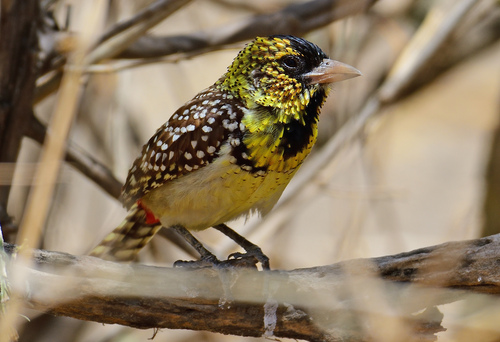
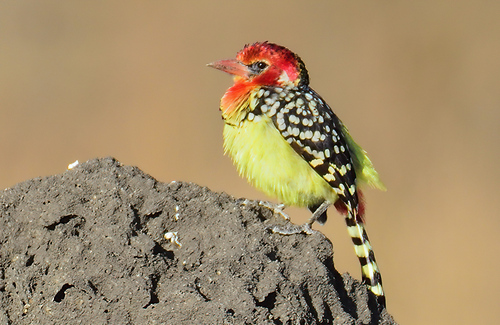
Adult males of the species have distinctive plumage patterned with black, white spots, red, and yellow.
Male Head and Nape Plumage
They have a black forehead and crown with a slight crest. Their nape is orange and red, marked with black spots.
Male Neck and Back Plumage
The sides of the neck are red, fading to yellow further down. The back is mostly black with white spots.
Male Tail Plumage
The tail is blackish brown, with up to eight cream spots arranged into bars; the underside of the tail is yellow with black bars.
Male Throat Plumage
The chin and throat are yellow, with a black patch at the center of the throat. The throat is bordered by more orange areas.
Male Breast and Belly Plumage
The breast ranges from orange to red-orange, becoming yellower toward the sides, and a dark band with white spots crosses through its middle. The lower breast and belly are yellow.
Male Wing Plumage
The wings are black with brown wing feathers, and every wing feather has white spots, creating a spotted or banded overall appearance.
Male Beak and Eye Features
The long beak is typically red. The skin surrounding the eyes is dark grey or black, while the iris can be yellow brown, dark brown, red brown, or an intermediate shade.
Male Leg and Foot Color
The legs and feet are both blue-grey.
Female Plumage Comparison
Females are similar in general pattern to males, but are overall much duller in coloration, with less red and orange and more yellow and white.
Female Key Plumage Differences
Specifically, females lack the male’s central black throat patch, and typically lack the male’s dark full crown.
Juvenile Plumage Comparison
Juvenile birds are also duller than adult males: like females, they generally have less red and orange.
Juvenile Plumage Details
Their back spots are less distinctly white, and all dark areas that are black in adult males are more brown in juveniles. Juvenile eyes are typically grey.
Subspecies Overview
Three subspecies have documented distributions.
Nominate Subspecies Range
The nominate subspecies T. e. erythrocephalus occurs from central Kenya to northeast Tanzania.
T. e. versicolor Range
Subspecies T. e. versicolor is found in southeast South Sudan, northeast Uganda, southwest Ethiopia, and north Kenya.
T. e. shelleyi Range
Subspecies T. e. shelleyi occurs in Somalia and eastern Ethiopia.
Habitat Preference
This species avoids both very open areas and dense woodland, and prefers broken terrain such as riverbeds, cliffs, or termite mounds.
Behavior
It nests and roosts in tunnels, and forages on or near the ground.