About Trachinotus goodei Jordan & Evermann, 1896
Scientific Nomenclature and Key Identification Feature
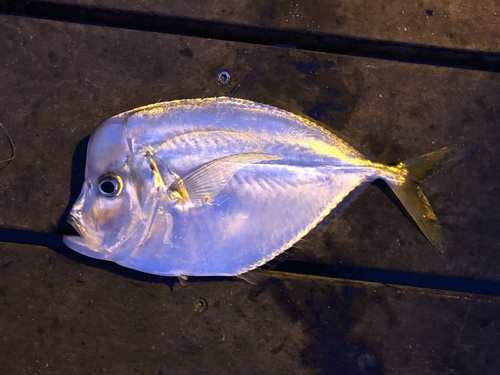
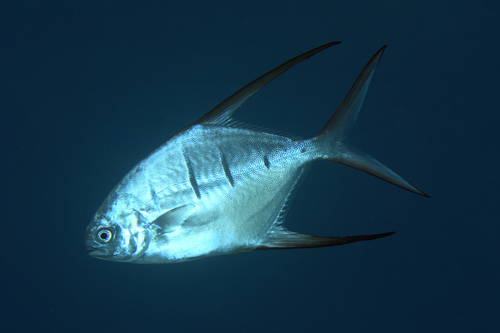
The palometa, scientifically Trachinotus goodei Jordan & Evermann, 1896, is most easily identified by its elongated dorsal and anal fins, which have dark anterior lobes.
Fin Ray and Spine Counts
The dorsal fin typically has seven or eight spines and 19 to 20 soft rays, while the anal fin has two or three spines and 16 to 18 soft rays.
Head and Side Coloration
Its top of the head ranges in color from gray to blue-green, and its sides are silver, marked with four narrow vertical bars.
Additional Body Markings
A faint fifth bar is visible near the base of the tail.
Breast Coloration
The breast usually has an orange tint.
Tail Morphology
Unlike many other members of its family, the tail of the palometa has no scutes.
Recorded Size and Weight
The largest recorded palometa measured 50 cm (1 ft 8 in) in length, and the heaviest recorded individual weighed 560 g (1 lb 4 oz).