About Caranx caballus Günther, 1868
Taxonomic Identification
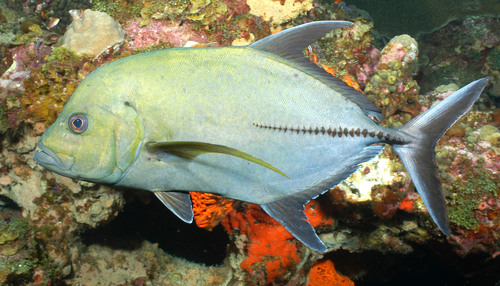
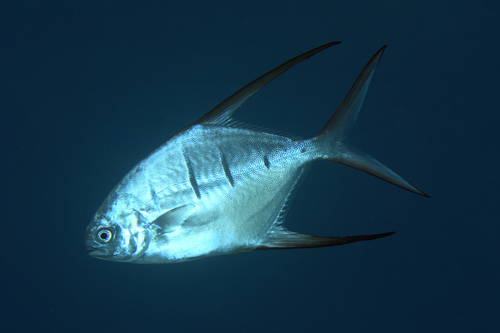
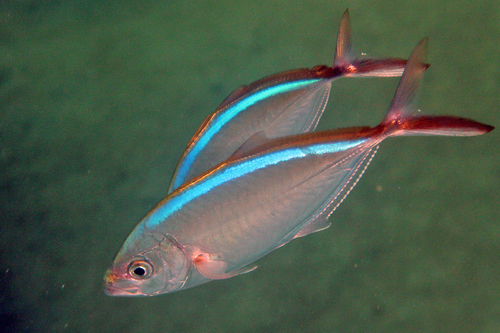
The green jack (scientific name Caranx caballus Günther, 1868) is a moderately large fish.
Size
Confirmed maximum measurements for the species are 55 cm in length and 2.81 kg in weight, while unconfirmed reports note it may reach up to 1 m in length. Most individuals observed are shorter than 40 cm.
General Morphology
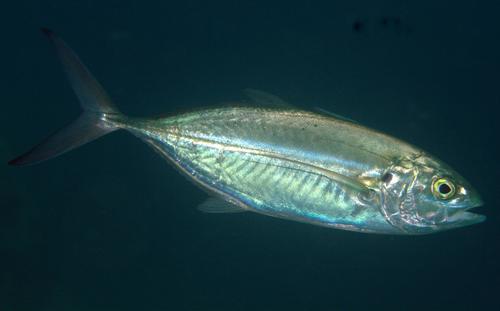
Morphologically, the green jack is similar to many other carangids. It has an elongated, moderately compressed fusiform body, with dorsal and ventral profiles of roughly equal convexity and a slightly pointed snout.
Head Features
A moderately well-developed adipose eyelid covers the posterior section of the eye, and the back tip of the jaw sits vertically below the center of the eye.
Dorsal Fin Structure
The dorsal fin is split into two parts: the first has 8 spines, and the second has 1 spine followed by 22 to 25 soft rays.
Anal Fin Structure
The anal fin has 2 anteriorly detached spines, followed by 1 spine and 16 to 21 soft rays. The lobes of both the second dorsal fin and anal fin are slightly elongated, almost entirely covered in small scales, and are still much shorter than the head length.
Lateral Line Structure
The lateral line has a pronounced but short anterior arch; the curved section intersects the straight section below the second dorsal fin's spine. The straight section holds 0 to 7 scales followed by 42 to 56 very strong scutes, for a total of 43 to 47 scales across the entire straight section.
Body Scaling
The entire chest is covered in scales.
Dentition
The upper jaw holds an irregular outer series of canines, plus an inner band of small, regularly spaced teeth. The lower jaw holds a single band of small teeth.
Gill Raker Features
The species has 40 to 45 total gill rakers: 10 to 15 on the upper gill limb and 27 to 30 on the lower gill limb. This gill raker count is the only feature that distinguishes C. caballus from Caranx crysos.
Vertebrae Count
The green jack has 25 vertebrae.
Adult Body Coloration
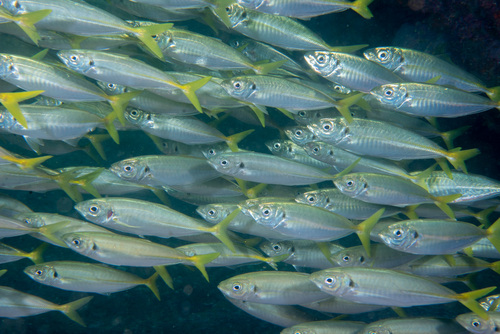
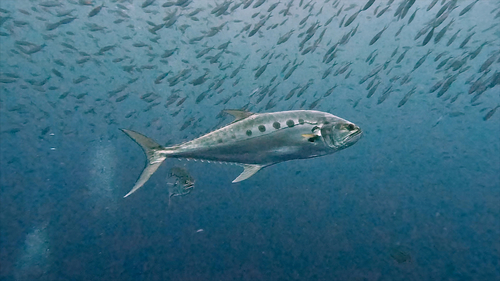
In life, the green jack is greenish blue overall, with an olive green to dark blue back and a golden to grey belly. It has a distinct black blotch on the outer edge of the operculum.
Schooling Individual Markings
Individuals swimming in schools often have a clearly visible pearly white marking near this black blotch.
Juvenile Coloration
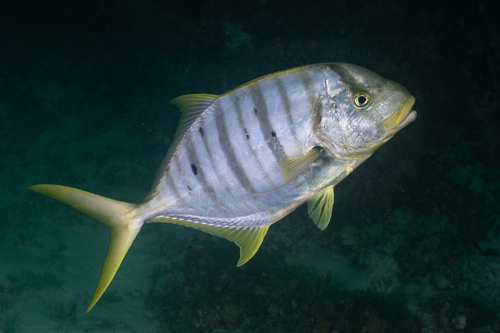
Juveniles have 7 dark vertical stripes on their flanks that fade as the fish ages.
Fin Coloration
The caudal fin is grey with dark tips, and all other fins range from light grey to hyaline in color.
General Distribution
The green jack is found throughout coastal tropical and subtropical waters of the eastern Pacific Ocean. Its range stretches along the American coast from Santa Cruz Island, California, south through Mexico and Central America to Peru.
Offshore Island Distribution
It also lives on many offshore islands, including the Galápagos Islands.
Hawaiian Islands Historical Records
Individuals of the species have been caught in the Hawaiian Islands since 1923, but all specimens were misidentified until William Smith-Vaniz re-examined them in 1981 and correctly identified them as Caranx caballus.
Hawaiian Islands Population Origin Hypothesis
Due to heavy fishing pressure across Hawaii and the rarity of captures, researchers originally concluded these few individuals were strays carried to the islands by ocean currents from the eastern Pacific, as these were the only known specimens.
Hawaiian Islands Established Population Confirmation
However, in 1998 the species appeared in large numbers in fishermen's catches, and has continued to be caught there ever since, confirming a population has become established in the Hawaiian island chain.
Depth Range
The green jack lives in a range of continental shelf environments down to at least 100 m deep.
Habitat Types
It is found most often in inshore reef systems, and also inhabits shallow bays, estuaries, and lagoons.
Behavior and Mobility
It follows both demersal and pelagic lifestyles, and forms large schools that can travel long distances offshore. This mobility allows the species to reach offshore islands as well as deep, isolated seamounts.