About Torquigener pleurogramma (Regan, 1903)
Common Names
Torquigener pleurogramma, commonly called the weeping toadfish or blowie, is a fish species belonging to the family Tetraodontidae. Additional common names for this species are banded toadfish and common blowfish.
Taxonomic History
It was first described by Charles Tate Regan in 1903. Early records of the orange-spotted toadfish (Torquigener hypselogeneion) from Australian waters actually refer to this species; the orange-spotted toadfish itself is not found in Australian waters, and T. pleurogramma can be distinguished from it by its more prominent spines.
Native Range
This species is native to the coastal waters of Australia. Its full range extends along Australia's east coast from Hervey Bay in central Queensland to Narooma in southern New South Wales, and from Adelaide around to Coral Bay in Western Australia. It is also present off Lord Howe Island, but not found in Tasmania.
Habitat and Depth
It inhabits shallow salt water, and individuals can gather around jetties and piers, occurring at depths up to 27 metres (89 feet).
Seasonal Movement and Mortality
During summer, schools of this species may form in deeper coastal waters after moving from their estuarine habitat, and large numbers may die off in autumn.
Toxicity
The flesh of Torquigener pleurogramma is highly toxic; domestic animals such as dogs are especially vulnerable to poisoning from consuming this species' flesh.
Interaction with Divers
Large groups of this species are known to attack divers, in the same way as the silver pufferfish Lagocephalus sceleratus, though they cannot inflict large bites.
Size
This species reaches a maximum total length of 22 cm (8.7 in).
Body Shape
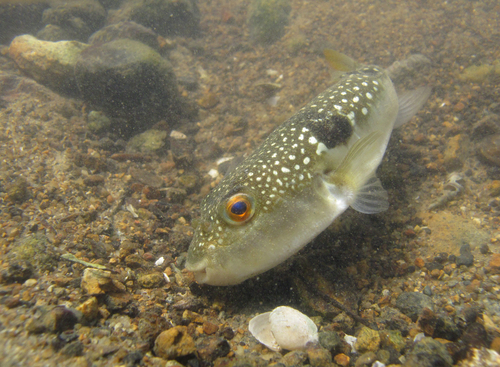
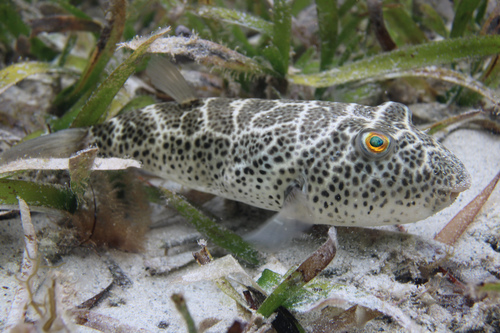
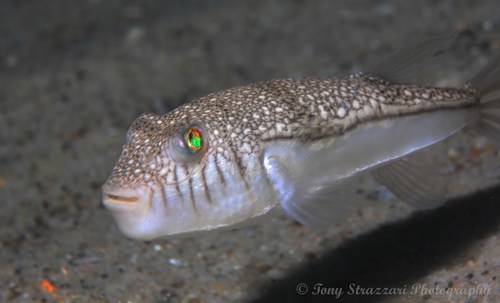
It has an elongated body with a rounded back and flattened belly. It has a small mouth at the apex of its body with thin lips, and a small chin.
Body Spines
Dense, sturdy spines cover its body from the nose to halfway between its pectoral and dorsal fins.
Body Coloration
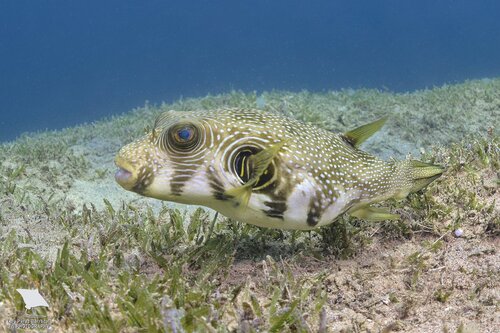
The upperparts of the body are greyish or greenish, marked with lighter and darker dots and dark bands; its chin is yellowish, and its belly is white. A dark brown stripe runs along the side of the body from the base of the pectoral fin to the tail fin.
Weeping Markings
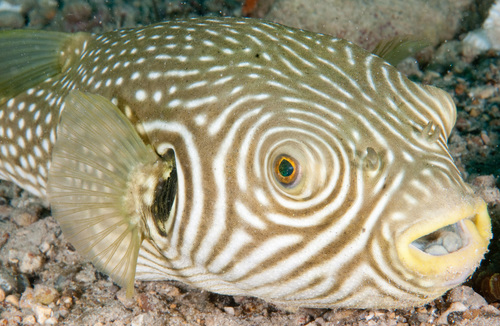
Multiple dark vertical lines run down its cheeks, which give the fish its characteristic "weeping" appearance.
Cornea Trait
Its corneas turn yellow when exposed to bright light.
Lifespan and Schooling Behavior
Torquigener pleurogramma is a schooling species that can live up to six years. Individuals reach sexual maturity by the end of their second year, at a length of around 125 mm.
Spawning
Spawning most likely occurs in aggregations just outside estuaries, with peak spawning activity in mid-summer.
Egg and Fry Traits
Eggs of this species are demersal, while newly hatched young fry are pelagic. Fry transition to the juvenile stage when they reach 5–10 mm in length.
Juvenile Movement
Juveniles that reach approximately 50 mm in length enter estuaries in large groups during July and August, which coincides with peak freshwater discharge into these habitats.