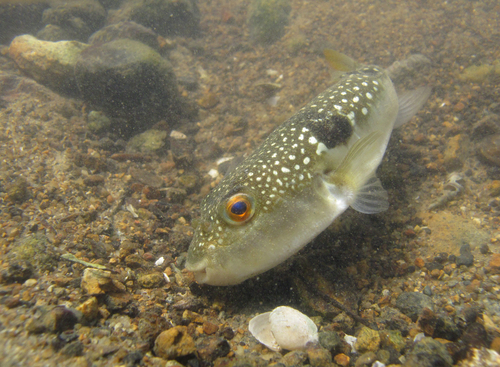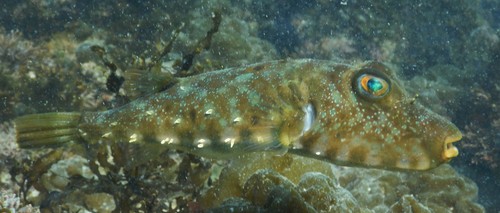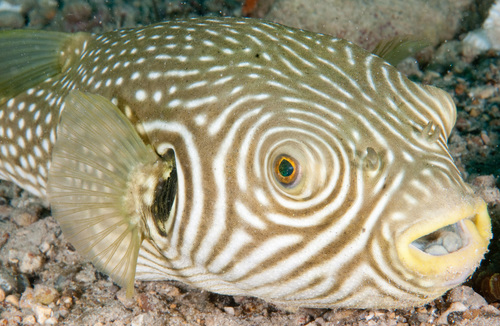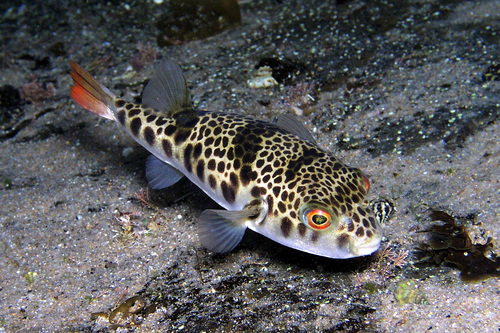
About Sphoeroides testudineus (Linnaeus, 1758)
Taxonomic Classification
The checkered puffer, Sphoeroides testudineus, is a fish species in the family Tetraodontidae, a name that means "four teeth".
Jaw and Tooth Structure
Puffers have four tooth plates arranged in quadrants, with two on the bottom jaw and two on the top jaw.
Diet and Feeding
These teeth form a strong, heavy beak that can crack through hard prey including mollusks, crustaceans, sipunculids, and tunicates; the species also feeds on seagrass and detritus.
Inflation Defense
Puffers get their common name from their ability to swell up by swallowing water or air when they feel threatened.
External Morphology
They lack a spinous dorsal fin, have absent or reduced scales, sandpapery denticles across various areas of their body, and a reduced gill opening.
Puffer Identification Traits
Species identification for puffers is partially based on body color, patterning, the presence and number of spines, and the presence of fleshy skin tabs called lappets.
Base Body Color and Pattern
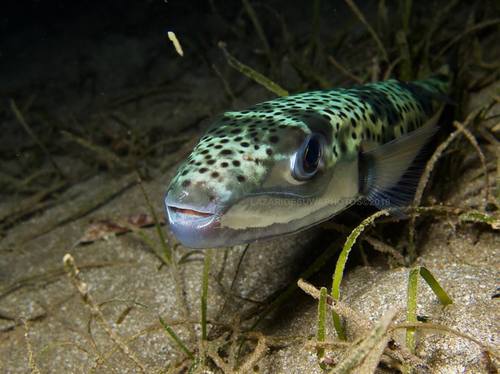
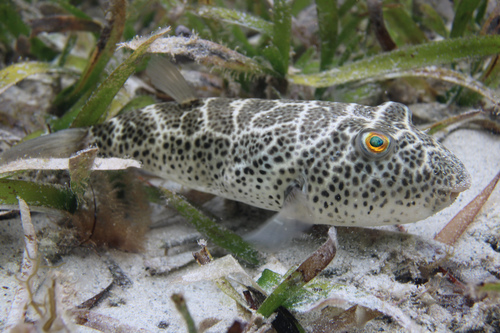
The checkered puffer has a base body color ranging from pale tan to yellowish, marked with a polygonal or square network of dark gray to olive lines.
Dorsal Pattern
This line pattern is centered on a bulls-eye pattern on the midback, in front of the dorsal fin.
Cheek and Side Markings
Small dark brown spots appear on the species' cheeks and lower sides.
Abdomen and Caudal Fin Markings
The abdomen is whitish and has no markings, and dark bands are present on the caudal fin.
Geographic Range
In terms of habitat and distribution, the checkered puffer's range extends from Rhode Island to Florida, and includes Bermuda, the southeastern Gulf of Mexico, and continues along the southeastern coasts of Brazil.
Typical Habitats
It is commonly found in bays, seagrass beds, tidal creeks, and mangrove swamps, and can also move into freshwater areas.
IRL Distribution
The checkered puffer is distributed throughout the IRL.
Specific Habitat Associations
Most populations are found living near seagrass beds and mangroves, though some individual fish also occur in rocky intertidal and hardbottom areas.