About Topaza pella (Linnaeus, 1758)
Taxonomic Identity
The crimson topaz, Topaza pella (Linnaeus, 1758), has distinct size differences between males and females.
Male Size Measurements
Males measure 21 to 23 cm (8.3 to 9.1 in) long including a 5 cm (2.0 in) bill and 8.6 to 12 cm (3.4 to 4.7 in) tail, and weigh 11 to 18 g (0.39 to 0.63 oz).
Female Size Measurements
Females are 13 to 14 cm (5.1 to 5.5 in) long and weigh 9 to 12.5 g (0.32 to 0.44 oz).
Species Size Ranking
This species may be the second largest hummingbird after the giant hummingbird, matched only by its close relative the fiery topaz.
Shared Morphological Traits
Males and females have different plumage, but both have a straight to slightly decurved bill.
Male Head Plumage
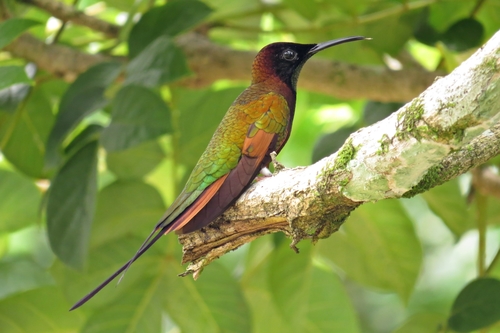
The male's head, face, and sides of the neck are velvety black.
Male Upperpart Plumage
Its back is iridescent crimson, changing to gold on the uppertail coverts.
Male Tail Structure
Central tail feathers are bronzy green and outer tail feathers are chestnut; two outer feathers are elongated and crossed.
Male Underpart Plumage
The male's throat is golden green, surrounded by a black band, and its underparts are bright red.
Male Wing Plumage
Its wings are brown.
Female Body Plumage
The female's head and back are dark green, and her underparts are a lighter green with golden green patches.
Female Throat Plumage
Her throat is green with crimson patches.
Female Tail Structure
The female's central tail feathers are bronzy, the middle pair are violet, and the outer pair are chestnut, and none are elongated like the male's.
Subspecies Distribution
Three subspecies of crimson topaz have distinct distributions: T. p. pella ranges from eastern Venezuela through Guyana and Suriname into northern and western Brazil as far south as Rondônia; T. p. smaragdulus is found in French Guiana and northeastern Brazil between the Tapajós and Tocantins Rivers; T. p. microrhyncha occurs in Brazil's northeastern Pará state east of the Tocantins River, and on Marajó Island at the mouth of the Amazon River.
Elevation Range
The species mostly lives in inland rainforest in lowlands and foothills, at elevations up to 500 m (1,600 ft).
Habitat Preferences
It is often found around granite outcrops and in gallery forest along small waterways.