About Clytolaema rubricauda (Boddaert, 1783)
Scientific Nomenclature and Total Length
The Brazilian ruby, Clytolaema rubricauda (Boddaert, 1783), measures 10.8 to 11.3 cm (4.3 to 4.4 in) in total length.
Weight
Males weigh between 7 and 9.2 g (0.25 to 0.32 oz), while females weigh 5.9 to 7.1 g (0.21 to 0.25 oz).
Shared Morphological Features
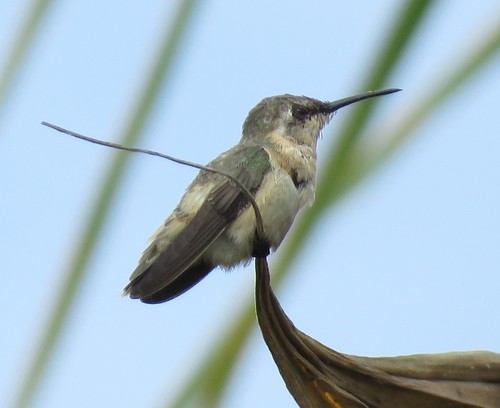
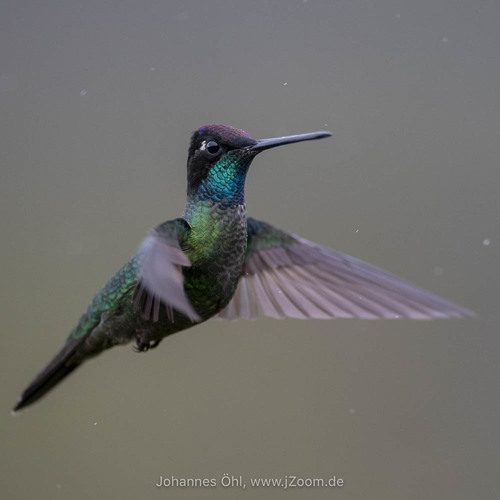
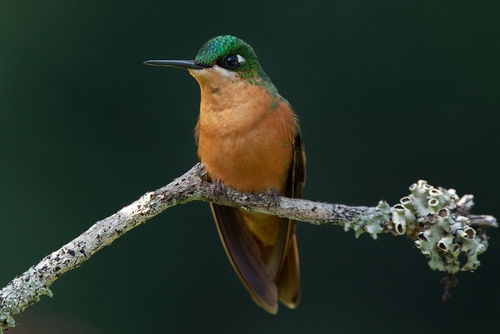
Both sexes share a medium-length black bill and a distinct white spot behind the eye.
Adult Male Head and Upperpart Coloration
Adult males have an iridescent emerald green forehead and crown, a green nape, and golden bronze coloring on the back and rump.
Adult Male Underpart Coloration
Their chin is blackish, their throat gorget is a shining ruby red, their breast is iridescent emerald green, and their belly is dark gray with green speckles.
Adult Male Tail Structure
The central tail feathers are golden bronze, and the remaining tail feathers are rufous with bronze edges.
Adult Female Body Coloration
Adult females have grass green coloring on the crown and back, a cinnamon rump, and entirely cinnamon underparts.
Adult Female Tail Structure
Their tail matches the color pattern of the male's tail.
Juvenile Morphology
Juveniles resemble adult females, with the addition of medium-length head feathers.
Color Morphs
Melanistic color morphs of this species are frequent.
Geographic Distribution
The Brazilian ruby is distributed across eastern and southeastern Brazil, ranging from Bahia in the north southward to Rio Grande do Sul.
Habitat
It inhabits forest interiors, scrublands, parks, and banana plantations, and is frequently observed visiting bird feeders.
Elevation Range
It is most abundant at elevations below 500 m (1,600 ft), though its range extends as high as 1,500 m (4,900 ft).