About Tolypeutes matacus (Desmarest, 1804)
Nomenclature
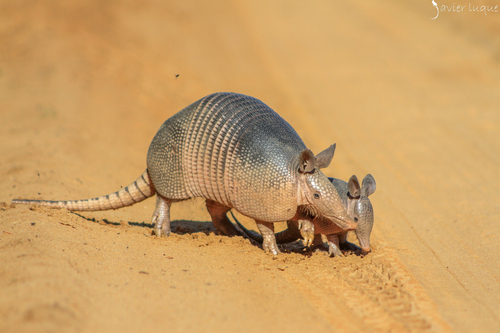
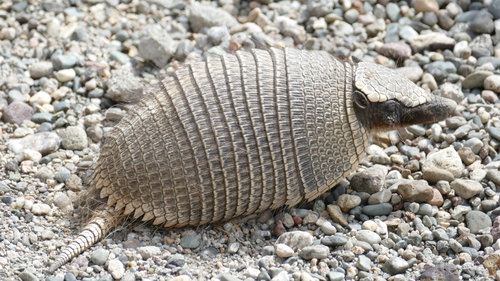
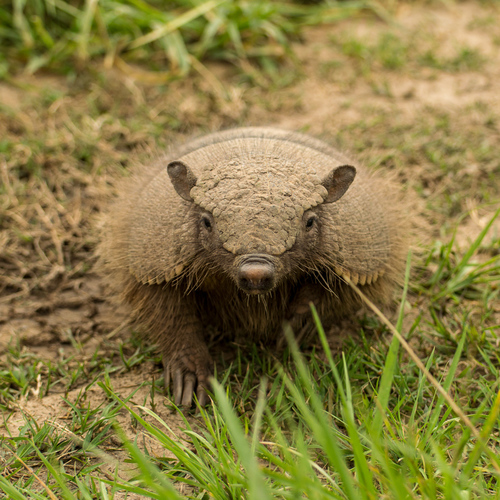
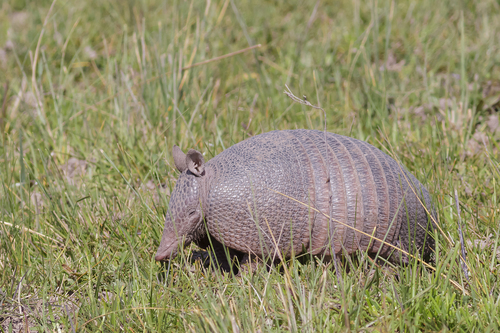
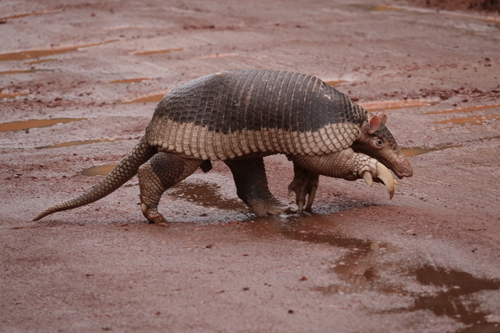
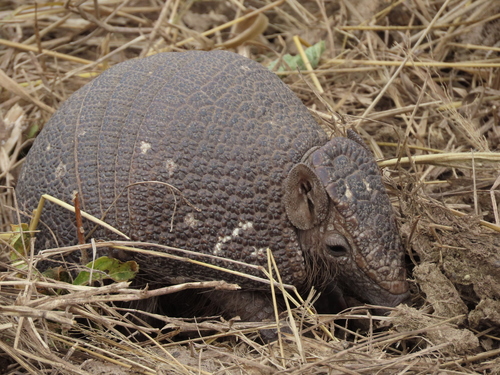
The southern three-banded armadillo, scientifically named Tolypeutes matacus, is also commonly called the La Plata three-banded armadillo or Azara's domed armadillo. It is an armadillo species native to South America.
Distribution
Its range covers parts of northern Argentina, southwestern Brazil, Paraguay, and Bolivia, occurring at elevations from sea level up to 770 m (2,530 ft).
Defense Mechanism
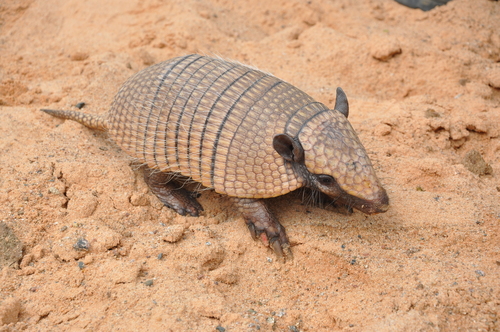
Along with the only other living member of the genus Tolypeutes, the Brazilian three-banded armadillo, this species is one of the only two armadillo species that can roll into a complete ball for self-defense. The three characteristic bands covering the animal's back give it enough flexibility to bring its head and tail together, enclosing its underbelly, limbs, eyes, nose, and ears to protect these areas from predators.
Shell Composition
The body is covered by an armored shell, whose outer layer is made of keratin — the same protein that forms human fingernails.
Coloration
Southern three-banded armadillos are typically yellow or brownish in color.
Size and Weight
They count among the smaller armadillo species, with a head-and-body length of roughly 22 to 27 cm (8.7 to 10.6 in) and a body weight between 1 and 1.6 kg (2.2 and 3.5 lb).
Burrowing Behavior
Unlike most armadillos, they are not burrowing animals, but they will use abandoned burrows that were originally dug by giant anteaters.
Diet
This three-banded armadillo has a long, sticky, straw-like pink tongue that it uses to gather and eat many different insect species, most commonly ants and termites. Individuals kept in captivity will also eat foods such as fruits and vegetables.
Threats
This species is currently threatened by habitat destruction caused when its native Dry Chaco habitat is converted to farmland, as well as by hunting for food and capture for the pet trade.