About Dasypus novemcinctus Linnaeus, 1758
Weight
Nine-banded armadillos (Dasypus novemcinctus Linnaeus, 1758) generally weigh 2.5–6.5 kg (5.5–14.3 lb), with the largest recorded specimens reaching up to 10 kg (22 lb), making them one of the largest armadillo species.
Body Length
Their head and body length measures 38–58 cm (15–23 in), paired with a 26–53 cm (10–21 in) tail, for a total combined length of 64–107 cm (25–42 in).
Shell Height
They stand 15–25 cm (5.9–9.8 in) tall at the top of their shell.
Shell Composition
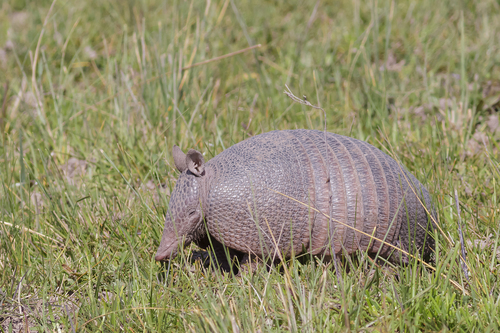
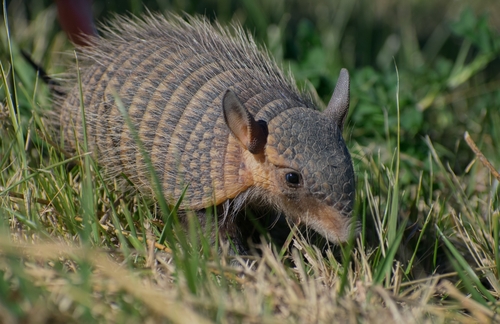
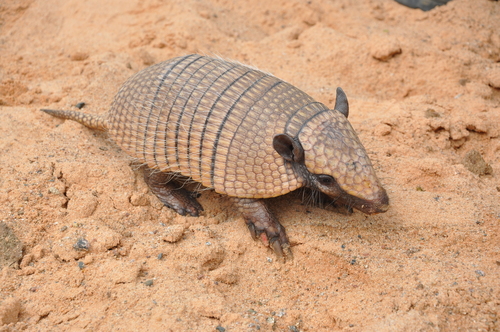
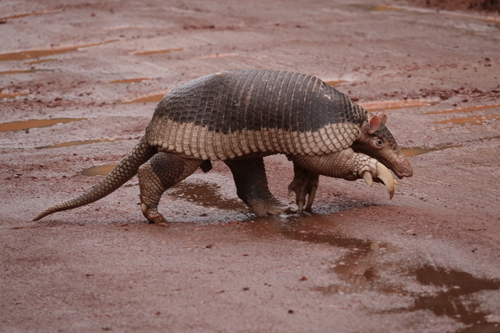
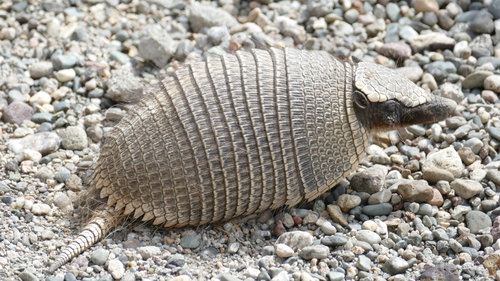
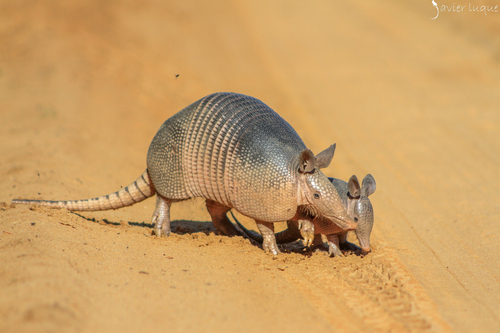
The outer protective shell is made of ossified dermal scutes covered by nonoverlapping, keratinized epidermal scales, connected by flexible bands of skin.
Armor Coverage
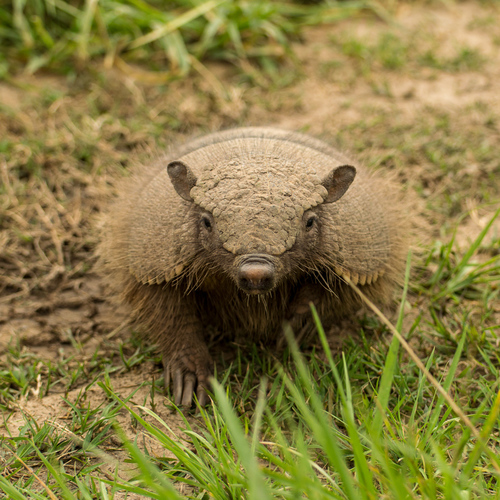
This armor covers the back, sides, head, tail, and outer surfaces of the legs.
The underside of the body and inner surfaces of the legs have no armor, and are instead covered in tough skin and a layer of coarse hair.
Carapace Attachment
The animal's vertebrae attach to the carapace.
Forefoot Claws
The claws on the middle toes of the forefeet are elongated for digging, though not to the same extent as the claws of the much larger South American giant armadillo.
Preferred Climate
A low metabolic rate and poor thermoregulation mean this species is best suited to semitropical environments.
Rolling Ability
Unlike South American three-banded armadillos, nine-banded armadillos cannot roll themselves into a ball.
River Crossing Methods
They can cross rivers in two ways: by inflating their intestines to float, or by sinking and walking across the riverbed.
Breath Holding Adaptation
The second method is possible because they can hold their breath for up to six minutes, an adaptation originally developed to let them keep their snouts submerged in soil for long periods while foraging.
Armor Band Variation
While nine is the typical number of flexible armor bands for this species, the actual number varies across different geographic ranges.
Dental Structure
Nine-banded armadillos have the same type of teeth found in all sloths and anteaters: all teeth are small, peg-like molars with open roots and no enamel.
Embryonic Incisors
Incisors form in embryos, but quickly degenerate and are usually absent by birth.
Ancestral Habitat
The nine-banded armadillo evolved in a warm, rainy environment, and is still most commonly found in regions that match this ancestral habitat.
Habitat Adaptability
It is a highly adaptable species, however, and can also live in scrublands, open prairies, and tropical rainforests.
Climate Limitations
It cannot survive well in particularly cold or dry environments, because its large surface area is not well insulated by fat, making it especially vulnerable to heat and water loss.
Northern Sightings
In recent times, nine-banded armadillos have been found as far north as Virginia, and multiple studies suggest sightings this far north may become more common as temperatures rise.
U.S. Range Expansion
The nine-banded armadillo is rapidly expanding its range north and east within the United States, where it is the only armadillo species that occurs regularly.
U.S. Introduction
The species crossed the Rio Grande from Mexico in the late 19th century, and was introduced to Florida by humans around the same time.
1995 U.S. Distribution
By 1995, it had become well established in Texas, Oklahoma, Louisiana, Arkansas, Mississippi, Alabama, Georgia and Florida, and had been sighted as far away as Kansas, Missouri, Tennessee, Kentucky, and the Carolinas.
2005 U.S. Distribution
A decade later, armadillos had become established in all of those areas and continued their migration, with sightings recorded as far north as southern Nebraska, southern Illinois, and southern Indiana.
Expansion Drivers
This rapid expansion is primarily explained by three factors: the species has few natural predators in the United States, Americans have little interest in hunting or eating armadillos, and the animals have a high reproductive rate.
Projected Northern Expansion
Northern expansion is expected to continue until the species reaches as far north as Ohio, Pennsylvania, New Jersey and Connecticut, and all points southward along the U.S. East Coast.
Expansion Limits
Further expansion north and west will likely be limited by the armadillo's poor tolerance of harsh winters, caused by its lack of insulating fat and inability to hibernate.
2009 Northern Range
As of 2009, newspaper reports showed the nine-banded armadillo had expanded its range north to Omaha, Nebraska in the west, and to Kentucky Dam and Evansville, Indiana in the east.
South Carolina Spread
In 1995, armadillos were only seen in the southern tip of South Carolina, but within two to three years they had spread across most of the state.
North Carolina Hunting Proposal
In late 2009, North Carolina began considering establishing a hunting season for armadillos, after reports of the species moving into the southern part of the state, roughly between the Charlotte and Wilmington areas.
Central and South American Range
Outside the United States, the nine-banded armadillo's range extends south through Central and South America into northern Argentina and Uruguay, where it is still expanding its range.
Florida Fossil Study
A 2014 genetic study by Shapiro et al. found that a 10,000-12,000 year-old fossil tibia from Medford Cave, central Florida, previously thought to belong to the extinct beautiful armadillo (D. bellus), actually belonged to the nine-banded armadillo.
Pleistocene U.S. Presence
This finding suggests the nine-banded armadillo naturally lived in the southeastern United States, including Florida, during the Late Pleistocene, until it was extirpated from the region early in the Holocene.
Recolonization Barriers
It is unknown why armadillos did not recolonize the United States until European settlement of the area, but it has been suggested that hunting by Coahuiltecan tribes and habitat clearance from intentionally set brushfires prevented earlier recolonization.
Movement Corridors
Armadillo movement patterns often follow corridors like railroads and roads, which likely helped speed their rapid expansion into and throughout the United States.
Mating Season
Mating occurs during a two-to-three month mating season, which takes place from July to August in the Northern Hemisphere and from November to January in the Southern Hemisphere.
Delayed Implantation
A single egg is fertilized, but implantation is delayed for three to four months to ensure young are not born during an unfavorable period.
Gestation Period
After the zygote implants in the uterus, a four-month gestation period follows.
Polyembryony
At that point, the zygote splits into four identical embryos through collapse of the common amnion and subsequent division of the embryonic shield.
Placental Structure
Each of the four embryos has its own amnion and umbilical cord, but all four attach to a single common placenta.
Birth Details
The young are born in March and weigh 85 g (3 oz).
Juvenile Development
After birth, the quadruplets stay in the burrow, feeding on the mother's milk for around three months.
They then begin foraging alongside the mother, eventually leaving the group between six months and one year of age.
Reproductive Maturity
Nine-banded armadillos reach sexual maturity at one year old, and reproduce every year for the rest of their 12-to-15 year lifespans.
Lifetime Reproductive Output
A single female can produce up to 56 young over her lifetime.
This high reproductive rate is a major driver of the species' rapid range expansion.
Foraging Impacts
Foraging by nine-banded armadillos can cause mild damage to the root systems of some plants.
Burrow Commensals
Skunks, cotton rats, burrowing owls, pine snakes, and rattlesnakes often live in abandoned armadillo burrows.
Gopher Tortoise Threat
Occasionally, nine-banded armadillos threaten the endangered gopher tortoise by aggressively displacing tortoises from their burrows and taking the burrows for their own use.
Foraging Associations
Studies show that fan-tailed warblers regularly follow armadillos to feed on insects and other invertebrates displaced by the armadillos' foraging.
Hunting Drivers
Nine-banded armadillos are typically hunted for their meat, which is reported to taste like pork, but they are more often killed because they steal eggs from poultry and game birds.
Conservation Status
This has caused certain local populations of nine-banded armadillo to become threatened, though the species as a whole faces no immediate threat.
Medical Research Use
They are also valuable for medical research, because they are among the few mammal species besides humans that are susceptible to leprosy.
Armadillo Racing
In Texas, nine-banded armadillos are raised to take part in armadillo racing, a small-scale but well-established sport where the animals run down a 12-metre (40 ft) track.