About Chaetophractus villosus (Desmarest, 1804)
Common Name and Abundance
Chaetophractus villosus, commonly known as the big hairy armadillo, is the most abundant armadillo species in Argentina.
Bony Armor Structure
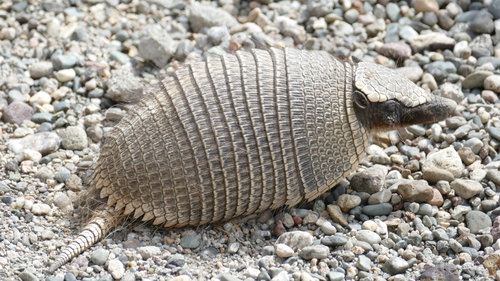
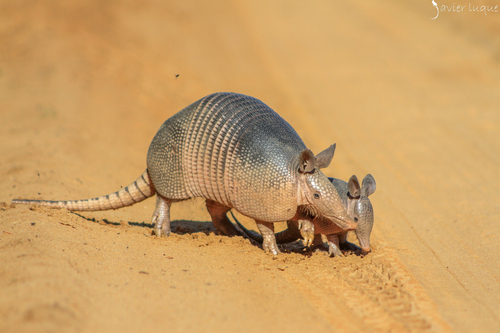
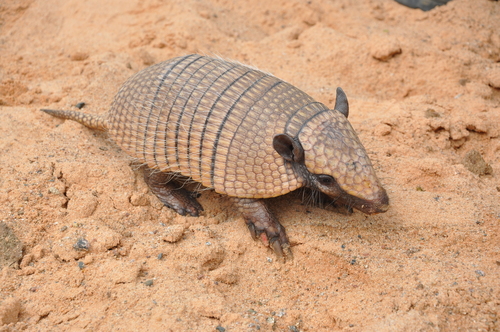
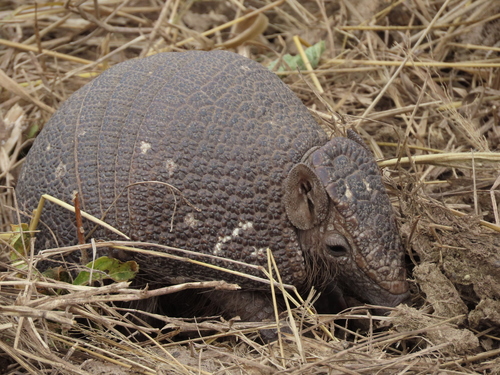
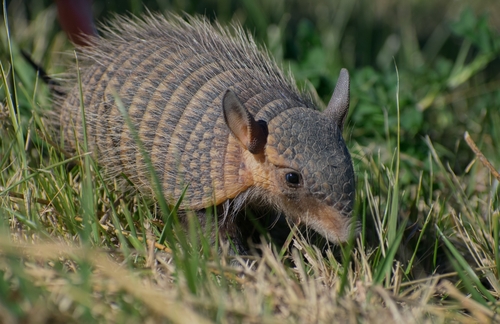
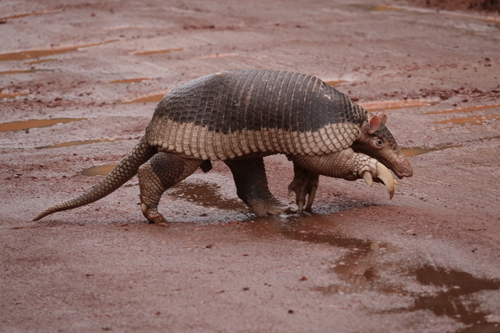
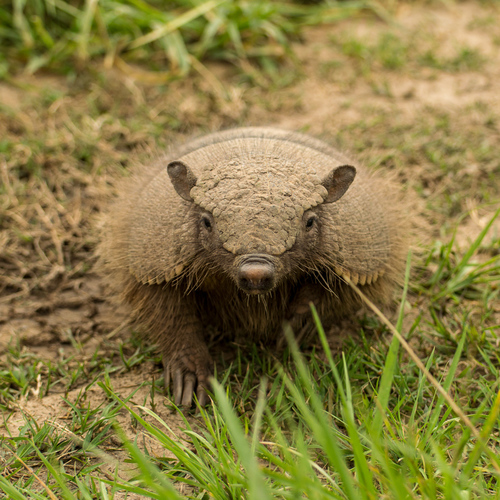
Its head and body are covered in protective bony plates, with the head plate being the most prominent. Flexible bands that encircle the torso along its back give flexibility to its otherwise stiff armor.
Common Name Origin
The underside of the big hairy armadillo is densely covered in hair, which is how it earned its common name. Long, coarse hairs also grow out from the bony plates, making this species much hairier than other related armadillo species.
Body Length
When mature, the average body length of an individual is 26 to 34 cm (10 to 13 in), with extreme cases ranging from 22 to 40 cm (8.7 to 15.7 in).
Weight
Mature individuals average 2 kg (4.4 lb) in weight, with a total weight range of 1 to 3 kg (2.2 to 6.6 lb).
Tail Length
The tail measures 9 to 17 cm (3.5 to 6.7 in) long.
Claw Function
Powerful front claws are used both for foraging and escaping predators.
Nasal Adaptation
This armadillo has specially evolved nasal membranes that let it obtain oxygen from surrounding soil particles without inhaling soil itself.
Genus Species Composition
The genus Chaetophractus contains two or three species: C. vellerosus (the screaming hairy armadillo), C. nationi (the Andean hairy armadillo, which may actually be a population of C. vellerosus), and C. villosus.
Genus Identifying Trait
All species in this genus are recognized by the large amount of hair covering their bodies, especially their undersides.
Skull Sexual Dimorphism
Their skulls follow the same general pattern as other dasypodids, but females have longer bones in the rostrocaudal plane, which is a key characteristic showing the sexual dimorphism of these species.
Cranial Morphology Research Gap
Little is known about the cranial morphology of these Chaetophractus species, particularly when it comes to bone descriptions.
Species Identification Methods
More research is ongoing to better describe these species and the skeletal differences between them; for now, body size, habitat, and behaviors are the most reliable ways to tell the species apart.
Natural Range
The natural home range of C. villosus covers a continuous area across large parts of Argentina, Bolivia, and Paraguay.
Argentine Range Extent
In Argentina, its natural range extends beyond the Pampas, reaching as far south as Santa Cruz Province in southern Patagonia.
Tierra del Fuego Introduction
The species was introduced to Tierra del Fuego Island in 1982, spreading from a property northeast of Río Grande.
Introduced Population Adaptation
The introduced individuals originally came from Buenos Aires Province, and have adapted well even though Río Grande has a mean annual temperature 2 to 3 °C lower than Río Gallegos, which sits near the southern limit of C. villosus' natural distribution.
Family Classification
C. villosus is a member of the family Chlamyphoridae, and its members, including C. villosus, have evolved distinct specialized traits to support survival.
Armor Protective Function
The most well-known of these are the bony plates covering the head and back, which provide a substantial level of protection from natural predators.
Soil Respiration Adaptation
This species also has a remarkable respiratory adaptation for when its nostrils are fully covered in soil: it can maintain sufficient respiration using a mechanism that lets it use air trapped between soil particles, without inhaling the soil particles themselves.
Fossorial Lifestyle Adaptations
Along with its powerful digging claws and high surface-area-to-mass ratio, this adaptation supports its fossorial, or subterranean, lifestyle.
Surface-Area-to-Mass Ratio
Even with the added challenges of burrowing, this armadillo maintains similar surface-area-to-mass ratios as non-fossorial species.
Burrowing Adaptation Purpose
This suggests it adapted to a burrowing lifestyle to avoid extreme temperatures and predators, rather than to support foraging.
Hemostasis Research Gap
Little is known about hemostasis in this species.
Platelet Count Characteristics
Platelet counts are similar between sexes, and remain similar even when individuals are held in captivity. Counts are comparable to most other mammals, and the species reacts the same way to proven hemostatic agonists.
Hemostasis Research Potential
More research in this area could lead to new biomedical advances, but little additional information is currently available.
Penis Muscle Study Findings
Studies of C. villosus penis muscles have found the species' very long penis has variable traits and behaviors.
Waking Penis State
During waking hours, the penis stays hidden inside a skin receptacle, only projecting outward in a rostral direction when it becomes erect.
Slow Wave Sleep Penis Behavior
During the slow wave sleep phase, the penis makes complex movements while protruding. In this sleep phase, the penis is not erect, but remains outside of its receptacle.
Paradoxical Sleep Penis State
During paradoxical sleep, no erections occur, and the penile muscles share the same characteristics as the rest of the body's muscles.