About Tiliqua occipitalis (Peters, 1863)
Common Names & Taxonomy
The western blue-tongued lizard (Tiliqua occipitalis), also called the western blue-tongued skink, is a large skink native to Australia. It is one of six blue-tongued skink species native to Australia; additional blue-tongued skink species live in New Guinea and Indonesia.
Size
This species reaches an overall length of around 45 cm (18 in).
Body Coloration
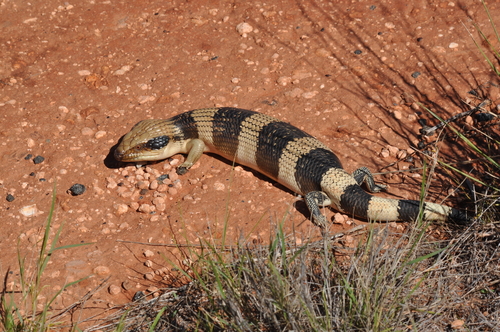
It has a brown, banded pattern across its body and tail, and its underbelly is usually pale. Each eye has a distinctive black marking just behind it.
Body Shape
Its body is wide and large relative to the size of its legs.
Tongue Characteristics
As its common name suggests, it has a blue tongue that contrasts with the pink interior of its mouth.
Threat Displays
When threatened, it may open its mouth and extend its tongue as a threat display. If this initial display does not make the predator or threat retreat, it may hiss and flatten its body to appear larger.
Activity Pattern
The western blue-tongued lizard is diurnal.
Diet
It hunts insects, spiders, and snails, and also forages for plants (especially berries) and carrion. It is not an agile lizard, so it typically preys on slow-moving items.
Jaw Adaptations
It has powerful jaws that let it break open snail shells and beetle exoskeletons.
Habitat Types
It inhabits grasslands, dunes, shrublands, and sparse woodlands.
Sheltering Behavior
At night it rests under leaf litter or rocks, and will sometimes use abandoned rabbit burrows as shelter.
Pet Trade Status
While blue-tongued lizards overall are popular pets that can live up to 30 years in captivity, the western blue-tongued lizard is extremely uncommon as a pet because it is one of the rarer blue-tongued skink species.
Reproduction
This species gives birth to approximately 5 live young. Immediately after birth, the young consume the placental membrane.
Juvenile Development
They are precocial, and disperse within a few days of birth. Juvenile western blue-tongued lizards have yellow and brown bands across their bodies and tails.
Distribution in Western Australia
The western blue-tongued lizard is found mostly in Western Australia.
Distribution in Northern Territory
In the Northern Territory, it is only found in the far south.
Distribution in South Australia
In South Australia, its population is split into separate eastern and western groups.
Conservation Status in Victoria
In Victoria, where it is restricted to the northern part of the state, it is listed as Near Threatened.
Distribution & Status in New South Wales
In New South Wales, it has a population in the southwest and an isolated small population in the centre of the state, and is listed as Threatened.
Threats
Threats to the species include predation by introduced species such as the red fox and domestic cat, habitat clearing for agriculture, and the destruction of rabbit warrens that the lizards use for shelter.