About Tiliqua nigrolutea (Quoy & Gaimard, 1824)
Taxonomy and Morphological Overview
Tiliqua nigrolutea, commonly known as the blotched blue-tongued lizard, is a relatively large robust species in the skink family Scincidae, with relatively short limbs. It reaches 14 to 20 inches (35 to 50 cm) in total length.
Coloration Form Classification
Its coloration and pattern vary geographically, and some herpetologists recognize two distinct forms: lowland and highland.
Lowland Form Coloration
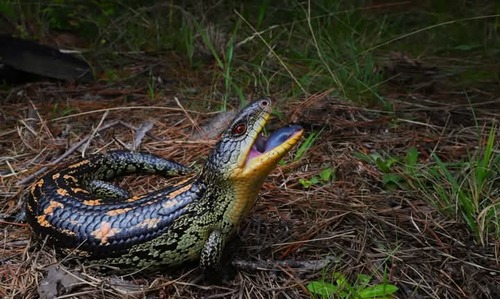
The lowland form is usually in shades of grey or brown, with pale silvery to tan blotches along the back contrasted by darker surrounding areas.
Highland Form Coloration
The highland form is typically darker, often jet black, which creates strong contrast with much paler cream or more brightly colored pink, salmon, or orange blotches.
Tongue Function
This species has a fleshy blue tongue it uses to taste the air and scare off potential predators.
Primary Defense Mechanisms
It relies primarily on camouflage and bluff for defense. If cornered or molested, it will perform an impressive and effective defensive display, and will bite as a last resort if further harassed.
Bite Characteristics
While its bite is painful due to its powerful jaws, its teeth are blunt and generally do not break skin. This species is harmless and inoffensive by nature, like all skinks.
Captivity Suitability
It is sometimes kept as a pet, because it adapts well to captivity and eats a wide range of readily available foods.
Diet Composition
It is an omnivore; its diet includes a variety of insects, snails, carrion, wildflowers, native fruits, and other vegetation such as select leaves, and it occasionally eats small vertebrates like mice or other young rodents when it has the opportunity.
Tail Autotomy Behavior
Like most skinks, it can drop its tail via autotomy when grasped by a predator, but this large skink is much less likely to do this than most other members of the skink family.
Geographic Range
This species occurs in Victoria, Tasmania, South Australia, New South Wales, and the Australian Capital Territory in Australia.
General Habitat Types
It inhabits wet and dry sclerophyll forests, montane woodlands, and coastal heathlands.
Lowland Form Distribution
The lowland form lives in Tasmania and lower altitudes of Victoria, extending down to the coast.
Highland Form Distribution
The highland form is restricted to higher altitudes in New South Wales and the high country of Victoria.
Anthropogenic Habitat Adaptation
It has also adapted well to some rural and urban areas, where it lives on farms and in gardens. In these areas, it is considered an asset because it eats pests including snails, slugs, and occasionally rodents.
Mating Season Timing
Blotched blue-tongued lizards usually emerge from brumation in early spring, which is their mating season.
Reproductive Mode
This large skink is viviparous, meaning it gives birth to live young.
Litter Size Variation
The highland/alpine form produces relatively larger but fewer young, around five per litter, compared to the lowland form which produces around eleven young per litter.
Gestation and Birth Timing
Young are usually born in autumn after a relatively long gestation period.
Lifespan
This species is relatively long-lived compared to many smaller skink species, with reliable reports of individuals living up to 30 years in captivity.
Fossil Record
Remains of the blotched blue-tongued lizard have been identified from Pleistocene fossil sites at Naracoorte Caves National Park.