About Oligosoma maccanni (Hardy, 1977)
Identification Overview
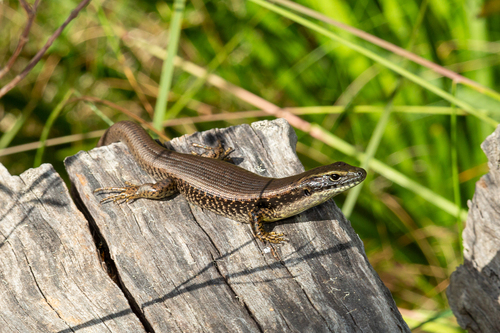
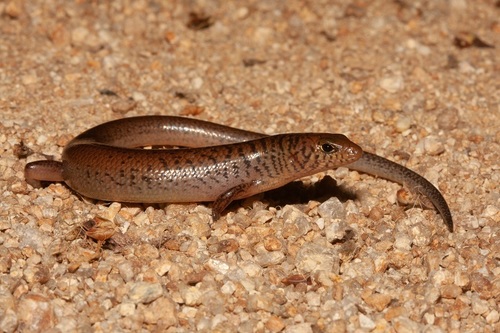
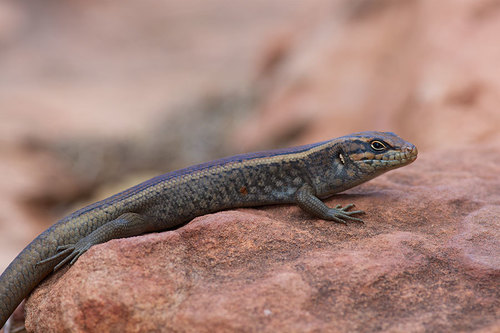
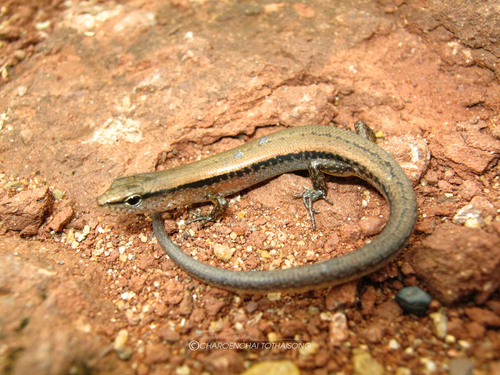
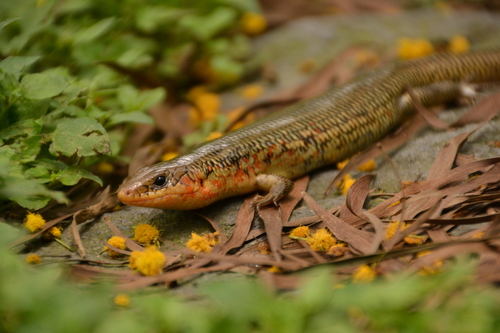
Identification: Oligosoma maccanni (McCann's skink) can be identified by a set of key physical features. It has an oval cross-sectioned body, a pointed head, a long tapering tail, and comparatively long limbs and toes. Its body is slim, with neck width nearly matching head width.
Body Scales and Stripes
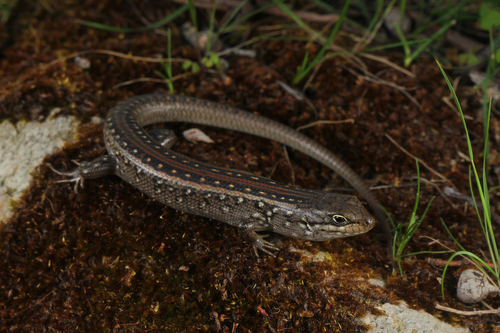
McCann's skinks have shiny scales, two distinct pale dorsolateral lines, and a well-defined pale dorsolateral stripe that does not extend to the tip of the tail. Body speckling is only found under the chin; the throat often has fine black speckling, while the soles of the feet and belly are creamy-grey, yellow, or brown.
Palpebral Disc Structure
In 1995, Patterson and Daugherty discovered this species has a transparent palpebral disc made of small rectangular granules that covers the lower eyelid.
Body Colour and Pattern
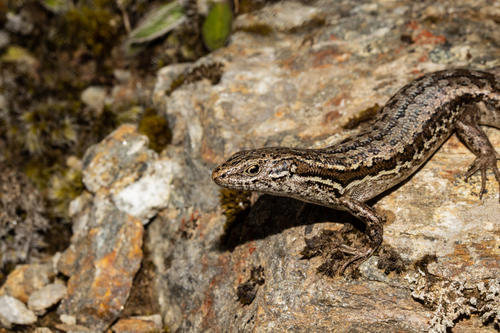
The species' background body colour is grey-brown, with patterned brown stripes; some individuals have grey spots along these stripes that form a herringbone pattern. Morphological variation occurs across its range: McCann's skinks from Canterbury have stripes, while those from Otago have speckles.
Dorsal Patterning Function
Dorsal patterning is thought to lower the risk of capture by avian predators, which primarily hunt using vision.
Global Range
Natural global range: Oligosoma maccanni is endemic to New Zealand, meaning it occurs naturally nowhere else.
New Zealand Distribution
New Zealand range: Within New Zealand, this species is found only on the South Island, predominantly in the island's southeastern regions: Marlborough, Canterbury, Otago, and Southland. In 1990, Patterson and Daugherty reported that McCann's skinks are widespread in Canterbury and Otago, areas that have experienced significant land use change, habitat destruction, and fragmentation. They are mostly found inland, but also occur in coastal Otago and on Banks Peninsula.
Preferred Habitat Types
Habitat: Oligosoma maccanni prefers coastal habitats and rocky ground, where it takes refuge in small cracks between rocks. Individuals hide themselves and their young between and under rocks to avoid predators, and to gain solar heat absorbed by the rocks during the day.
Vegetation Shelter Use
When few rocks are available, they shelter in vegetation on areas with low soil development, such as herbs and shrubs. For example, they often shelter within Aciphylla spp., whose long spiny leaves provide ideal protection. Some McCann's skinks in coastal Canterbury areas prefer to use marram grass, which connects dune vegetation like pingao on Kaikorete spit.
Open Habitat Preference
This species favours open habitat areas, including native and introduced grassland and shrubland. Common shrub hosts include divaricating species such as Discaria toumatoua, Coprosma propinqua, and Muehlenbeckia astonii. The species' broad habitat preferences are thought to lower the vulnerability of its populations.