About Theristicus caerulescens (Vieillot, 1817)
Taxonomy and Common Names
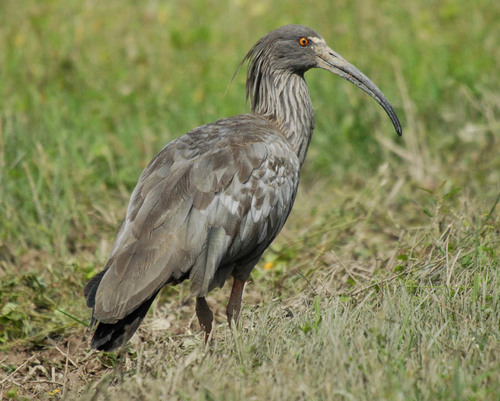
The plumbeous ibis (Theristicus caerulescens), formerly also called the blue ibis, is a large, distinctive ibis species that is endemic to parts of central South America.
Overall Range Extent
This species has a relatively narrow range extending through parts of central South America.
Country-Level Distribution
It occurs in south-western Brazil, particularly southern Mato Grosso and Rio Grande do Sul; Paraguay, particularly the Chaco and the Paraguayan section of the Paraná Basin; Uruguay; north-eastern Argentina; and northern and eastern Bolivia.
Northern Bolivian Population Isolation
The northern Bolivian population is geographically isolated from the larger continuous population that covers the rest of this ibis's range.
Western Range Limit
The westernmost part of its range reaches the Andean foothills in central Bolivia and Tucuman.
Occurrence in Southern Argentina
In Argentina, individuals have occasionally been sighted as far south as the Córdoba and Buenos Aires provinces, but the species is non-native in these regions.
Global Distribution Patterns
Although the species is relatively common overall, it is patchily distributed across its global range, being relatively abundant in some areas and less common in others.
Abundance in Southern Brazil
For example, while it is endemic to Rio Grande do Sul, it is actually uncommon there, but occurs frequently in the northern Lagoa dos Patos.
Abundance in Paraguayan Chaco
It is relatively common in the Paraguayan Chaco, especially the northern Chaco where large numbers of individuals live across expanses of freshwater; this species is considered emblematic of the wetland bird community of this region.
Abundance in Northern Argentina Pampas
In contrast, it has rarely been recorded in the pampas of northern Argentina, the southernmost part of its distribution.
Sighting Records at Laguna Melincue
Throughout the 1990s, an occasional small number of individuals were sighted during surveys at the Laguna Melincue Ramsar Site in southern Santa Fe Province.
Core Habitat Type
Its habitat mostly consists of lowland grassy wetlands of the Pantanal and the Chaco.
Foraging and Roosting Habitats
It forages in marshes, swamps, lagoons, shallow lakes, flooded pastures, ponds and other moist ground, and perches on tree branches near or above water to roost.
Upland and Dry Habitat Occurrence
It has also been sighted in upland marshes, typically up to 600m in elevation, at small remnant pools in desiccated lagoons, and on dry grasslands.
Anthropogenic Habitat Use
This ibis also commonly occurs near human settlements and other manmade features, including dams and seasonally flooded rice fields.
Occurrence Along Transpantaneira Highway
It is also a relatively common sight along the Transpantaneira Highway in the Pantanal of Mato Grosso.
Coastal Habitat Use and Salinity Preference
Finally, it has been recorded close to the east Brazilian coast in wet areas in the Lagoa do Peixe National Park on the peninsula that separates Lagoa dos Patos from the Atlantic, as documented by Pereira & Poerschke in 2009, but the species probably avoids saline and brackish waters.
Sedentary Behavior
Individuals are usually sedentary and can stay in one area year-round.
Local Scale Movement
However, they have been reported to migrate over local scales.
Inter-Population Migration Evidence
Circumstantial evidence from the unexpected presence of individuals at Incachaca Lake in the Chapare Province of Bolivia suggests that this species may migrate between the geographically separated northern Bolivian population and other South American populations, and may use Incachaca as a resting spot along the route.
Population Genetic Homogeneity
Since no subspecies have been recognized for this species, the global population is likely kept genetically homogenous by short migrations of individuals between the two geographically separated subpopulations.
Migration Pattern Uncertainty
Still, it is not known whether this species has regular migration patterns.
Incachaca Record Significance
The discovery of the species at Lake Incachaca was the first recorded occurrence of the species in the cloud forest ecoregion, and also set a new altitudinal record for the species.
Flocking Behavior
Unlike other ibis species, the plumbeous ibis does not form large flocks of its own species.
Typical Group Size
It is most often seen alone or in pairs, and groups of up to six individuals are seen more rarely.
Larger Group Composition
Larger groups usually consist of a mated pair accompanied by their fledged juveniles.