About Thalictrum alpinum L.
Scientific Classification and Growth Form
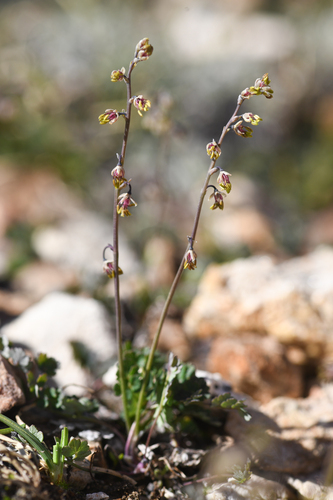
Alpine meadow-rue (Thalictrum alpinum L.) is a rhizomatous perennial herb that reaches 5 to 25 cm (2 to 10 in) in height.
Stem Characteristics
Its stems are upright, usually unbranched, and leafless.
Basal Leaf Arrangement and Structure
Most leaves grow in a basal rosette; their compound blades are one to two pinnate, divided into small triangular-ovate, scalloped leaflets.
Leaflet Morphology
Each leaflet is longer than it is wide, slightly recurved, shiny dark green on the upper surface, and pale bluish-green on the lower surface.
Inflorescence Structure
The inflorescence is a raceme of flowers that arches over as flowers and fruit develop.
Flower Sepal and Stamen Features
Each flower has a bell-shaped calyx made of green or purplish sepals, and bears up to fifteen long purple stamens tipped with large yellow anthers.
Flower Reproductive Parts
Each flower has a single carpel and no petals.
Fruit Characteristics
The fruit is a dry achene with longitudinal ridges, tipped with a bristle.
Pollination Method
This species is normally pollinated by wind, while other meadow-rue species are usually pollinated by insects.
Distribution Range
Alpine meadow-rue has a circumboreal distribution.
Geographic Occurrence
It occurs in northern Europe and Asia, Alaska, northern Canada, Greenland, and also in mountain ranges further south.
Primary Habitat Types
Its natural habitat includes tundra, open birch woodland, stream and river banks, lake shores, alpine meadows, and boggy areas.
Additional Habitat Occurrences
It is occasionally found on fens within and on the fringes of coniferous forests.