About Clematis orientalis L.
Growth Habit
Clematis orientalis L. is a deciduous scrambling shrub that uses its tendril-like stems to attach to surrounding surfaces. It grows densely, with a growth rate of at least one meter per year.
Native Distribution
This species is native to Asia and Central Europe, ranging from Turkey through West Asia to the Korean Peninsula, and extending south to Iran and Northwest India.
Introduced Distribution
It was originally planted as an ornamental in the United States, where it has escaped cultivation and become naturalized in Nevada, Idaho, Utah, Colorado, New Mexico, Oregon; it is also naturalized in Ontario, Canada.
Climbing Behavior
As a vine, Clematis orientalis grows over rocks, fences, and other plants.
Weed Classification
It is classified as a noxious weed in some US states.
Ecological Impact
It can completely cover and kill young trees and bushes, and is able to outcompete native shrubby and herbaceous species.
Soil Preferences
Clematis orientalis prefers well-drained soils, and has no preference for specific soil texture, though it grows well on chalky soil. It can tolerate a range of both alkaline and acidic soils.
Light Preferences
It favors sunny habitats, but is also tolerant of partially shaded areas.
Introduced Habitat Range
In the United States, it occurs in shrublands, riverbanks, gullies, sand depressions, and riparian forests located in hot, dry valleys, as well as in desert and semidesert areas.
Elevation Range
It can grow at elevations between 400 and 3,800 meters.
Flowering Period
Flowers of Clematis orientalis appear from August to late September, with flowers and fruits present on the plant at the same time.
Pollination
It is pollinated by flies and bees.
Seed Characteristics & Dispersal
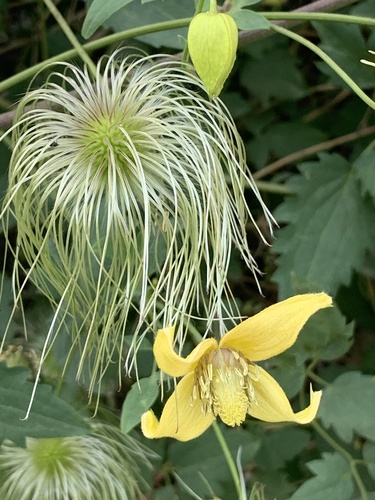
Its seedheads are rounded clusters of fluffy, winged seeds that resemble pom poms; these seeds disperse over winter and early spring, primarily carried by wind.
Ornamental Use
Clematis orientalis is cultivated as an ornamental plant.
Medicinal Uses
It is also used as an antiseptic and refrigerant. In Ancient Chinese medicine, this plant is documented to treat dog bites, and its infusion is gargled to treat ulcerated throats.