About Thalassoma purpureum (Forsskål, 1775)
Common Name and Fin Structure
Commonly called the surge wrasse, this species Thalassoma purpureum has 8 spines and 12-14 soft rays in its dorsal fin, while its anal fin has 3 spines and 10-12 soft rays.
Size and Weight
It can reach a total length of 46 cm (18 in) and a weight of 1.2 kg (2.6 lb).
Body and Jaw Structure
It has a relatively deep, laterally compressed body, with a pair of caniniform teeth at the front of its lower jaw.
Female Coloration
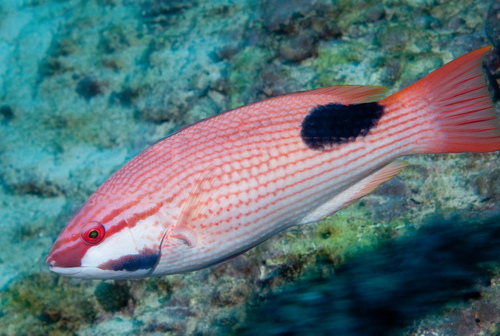
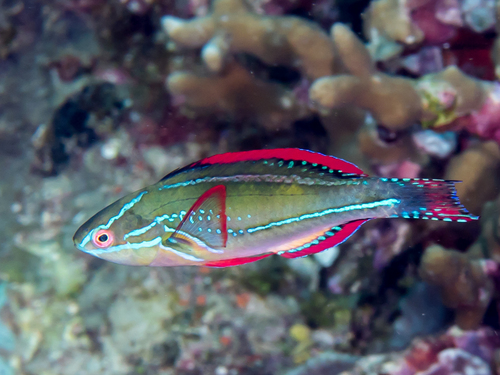
This is a colourful wrasse species: females are greenish, with a dark red V-shaped mark on the snout.
Male Body Coloration
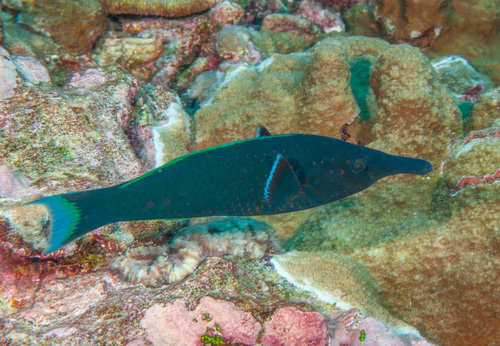
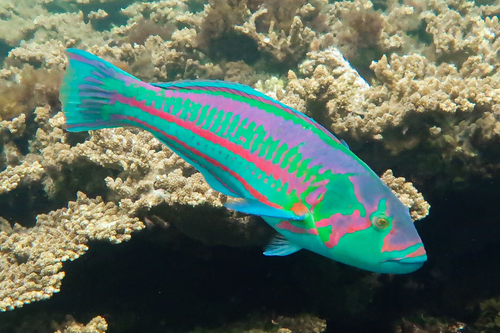
Males are greenish-blue, with two bright reddish stripes running along their flanks.
Male Head Features
Males also have a large head with a blunt snout, which is greenish-blue with pinkish-purple markings.
Similar Species Distinction
The surge wrasse is very similar to the ladder wrasse (Thalassoma trilobatum), especially in the female form, but the surge wrasse has a larger head and no spots on its head.
Initial Formal Description
The surge wrasse was first formally described in 1775 as Scarus purpureus by Swedish explorer, orientalist and naturalist Peter Forsskål, who recorded its type locality as Jeddah.
Genus Type Species Designation
In 1839, when William Swainson described the genus Thalassoma, he designated Scarus purpureus as the genus's type species.
General Distribution Range
The surge wrasse has a wide Indo-Pacific distribution that extends marginally into the southeastern Atlantic along the coast of South Africa.
Indian Ocean Distribution
Its main distribution in the Indian Ocean runs from the Red Sea south to South Africa, and extends east through Indian Ocean islands and Asian coasts into the Pacific Ocean.
Pacific Ocean Distribution
In the Pacific, its range reaches north to Japan, south to Lord Howe Island, the Kermadec Islands, and the Rapa Islands, and east as far as Panama in the eastern Pacific.
Habitat
As its common name suggests, the surge wrasse lives in the surge zone of outer reef flats, and on the reef margins of coral and rocky reefs.
Depth Range
It is normally found at depths of less than 10 metres (33 ft).
Social Structure
It lives in groups of females spread across large areas of reef, with the groups dominated by a few much larger males.
Diet
This is a carnivorous species that preys on small invertebrates including crabs, sea urchins, brittlestars, and molluscs, as well as small fishes and polychaete worms.
Reproduction
The surge wrasse is a protogynous hermaphrodite, meaning females change sex to become males, and it is a pelagic spawner.