About Cirrhilabrus exquisitus Smith, 1957
Common Name and Overall Coloration
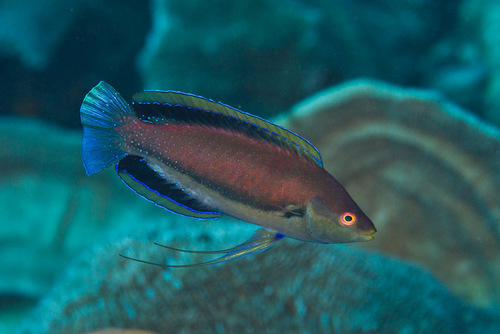
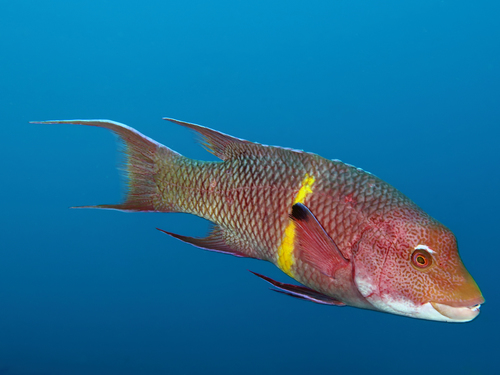
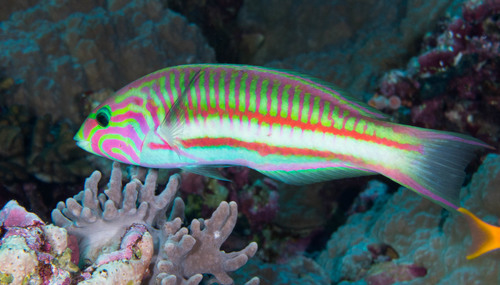
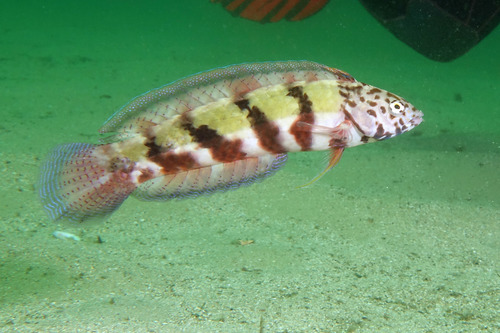
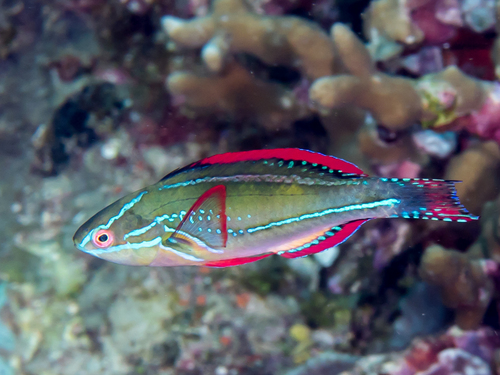
This species, commonly called the exquisite wrasse, has a body colour that ranges from greenish to reddish overall, and shows complex colour patterning.
Adult Male Dorsal and Ventral Coloration
Adult males are olive-green on their dorsal side, fading to white, pale blue, or pink on the underparts.
Caudal Peduncle Spot
They have an oval dark spot on the caudal peduncle, whose bottom margin touches the lateral line.
Blue Line from Pectoral Fin to Tail Base
One frequently interrupted blue line runs from under the pectoral fin to the spot on the tail base.
Blue Line from Mouth to Dorsal Fin Base
A second blue line runs from the corner of the mouth to a position above the eye, then continues along the base of the dorsal fin.
Blue Line from Eye to Pectoral Fin Area
A second blue line on the head runs from the posterior edge of the eye until it breaks up above the pectoral fin.
Blue Line from Mouth to Pectoral Fin Base
A third blue line runs from the rear of the mouth to just above the pectoral-fin base.
Pectoral Fin Markings
The base of the pectoral fin has a black bar edged with blue, while the margin of this fin is red.
Fin Red Pigmentation
All fins have variable amounts of red in their middle portions.
Juvenile and Small Female Coloration
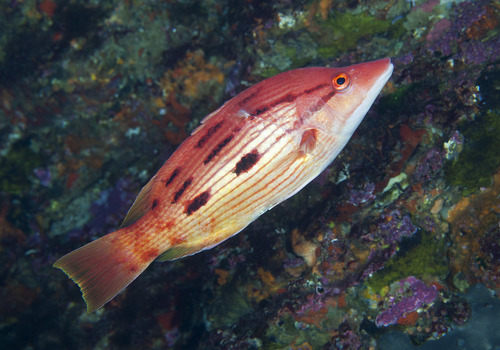
Juveniles and smaller females are reddish, with a blue-margined black oval spot on the caudal peduncle and a white spot at the tip of the snout.
Geographic Color Variation
Exquisite wrasse colouration varies geographically.
Maximum Male Size
Males can reach a maximum standard length of 12 centimetres (4.7 in).
Indian Ocean Distribution
The exquisite wrasse is distributed from the eastern coast of Africa, as far south as South Africa's Sodwana Bay, east through the Indian Ocean to Australia, and into the Pacific Ocean as far east as the Tuamotus, French Polynesia.
Pacific Ocean Range Limits
It ranges north as far as the Ryukyu Islands, and south as far as the northern Great Barrier Reef.
Primary Habitat Preferences
This wrasse lives in areas with rubble or low reef patches that have strong currents.
Additional Habitat Locations
It is also found on reef edges and around exposed reef outcrops within rubble areas.
Feeding Group Behavior
It can form reasonably large mixed-sex groups when feeding on zooplankton high above the seabed.
Male Display Behavior
Males often display to one another.
Coral Association Hypothesis
Researchers believe the species may have an association with the mushroom coral Heliofungia actiniformis.
Reproductive Biology
Exquisite wrasse are protogynous hermaphrodites: when individuals transform from females to males, males develop larger body size, longer more pointed fins, and more colourful body patterns.
Aquarium Trade Status
This species is collected for the aquarium trade, and has not yet been bred in captivity.