About Terminalia chebula Retz.
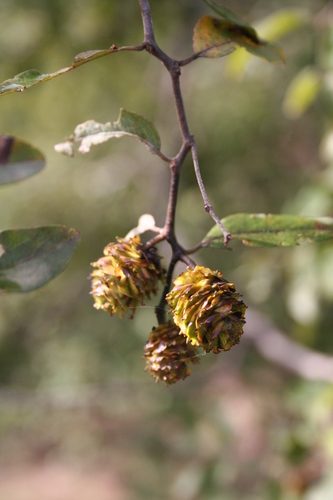
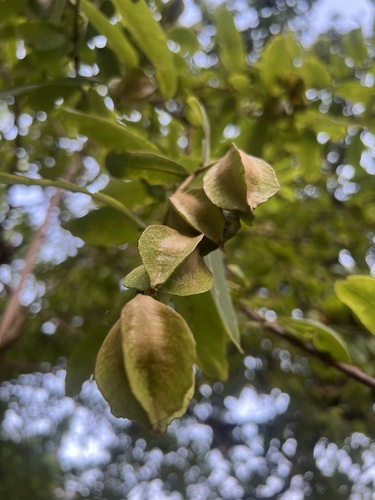
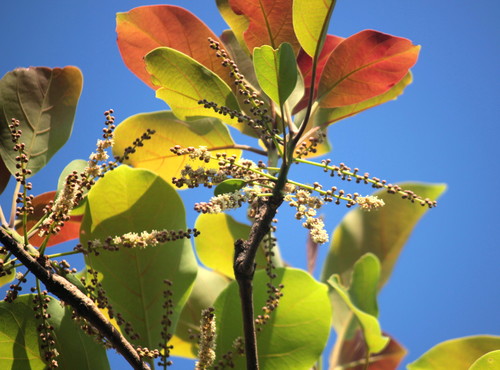
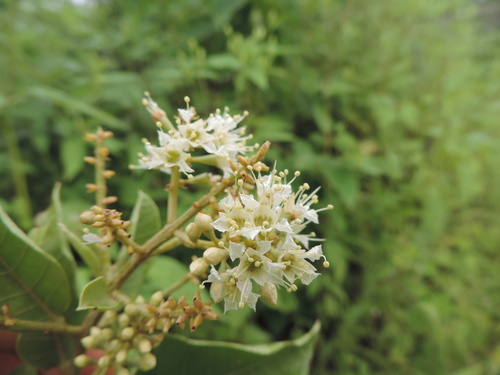
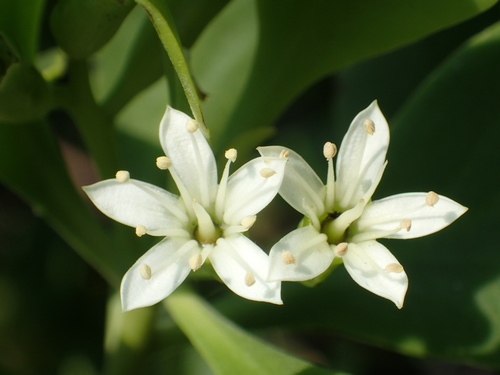
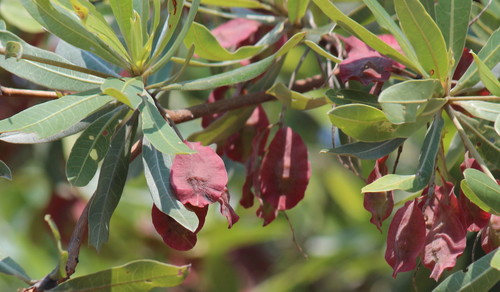
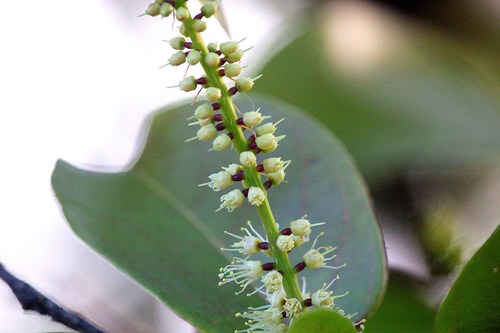
Terminalia chebula Retz. is a medium to large deciduous tree that grows up to 30 m (98 ft) tall, with a trunk reaching up to 1 m (3 ft 3 in) in diameter. Its leaves are arranged alternately to suboppositely, have an oval shape, measure 7–8 cm (2.8–3.1 in) long and 4.5–10 cm (1.8–3.9 in) broad, and grow from a 1–3 cm (0.39–1.18 in) petiole. Leaves have an acute tip, a cordate base, entire margins, are hairless on the upper surface, and have yellowish downy hair on the lower surface. The dull white to yellow flowers are monoecious, have a strong unpleasant odor, and are borne in terminal spikes or short panicles. The fruit is drupe-like, with a smooth ellipsoid to ovoid shape, measuring 2–4.5 cm (0.79–1.77 in) long and 1.2–2.5 cm (0.47–0.98 in) broad. Fruits are blackish with five longitudinal ridges, yellow to orange-brown in color, and contain a single angled stone. Terminalia chebula is distributed across southern and southeast Asia, including India, Sri Lanka, Bhutan, Nepal, Bangladesh, Myanmar, Cambodia, Laos, Vietnam, Indonesia, Malaysia, Pakistan and Thailand. In China, it is native to western Yunnan, and cultivated in Fujian, Guangdong, Guangxi (Nanning), and Taiwan (Nantou). In India, it occurs in the sub-Himalayan region from Ravi eastwards to western Bengal and Assam, and grows up to an altitude of 1,500 m (4,900 ft) in the Himalayas. This tree grows wild in forests of northern India, the central provinces and Bengal, and is common in Madras, Mysore, and the southern part of the former Bombay presidency. Its natural habitat includes dry slopes up to 900 m (3,000 ft) in elevation. The tree produces small, ribbed, nut-like fruits that are picked while still green. These green fruits can be pickled, boiled with a small amount of sugar in their own syrup, or used in preserves. The fruit's elliptical seed is abrasive, and is surrounded by a firm, fleshy pulp. Seven types of fruit are recognized: vijaya, rohini, putana, amrita, abhaya, jivanti, and chetaki. Classification of these types is based on the harvesting region, as well as the fruit's color and shape. The vijaya variety, traditionally grown in the Vindhya Range of west-central India, is generally preferred; this variety has a rounder shape rather than a more angular one. The fruit also provides material used for tanning leather and dyeing cloth. Also known as Haritaki, Terminalia chebula is a main ingredient in the Ayurvedic formulation triphala. It was used in a Kakatiya dynasty-era 'sandbox' foundation laying technique designed to make buildings earthquake-resistant. This technique involved filling the foundation pit with a mixture of sand, lime, jaggery (used as a binder), and karakkaya, the black myrobalan fruit of Terminalia chebula, before building construction on the finished 'sandboxes'.