About Teratohyla midas (Lynch & Duellman, 1973)
Taxonomic Classification
Teratohyla midas (Lynch & Duellman, 1973) is an arboreal species of glass frog, meaning it primarily lives in trees.
Skin and Visible Skeletal Features
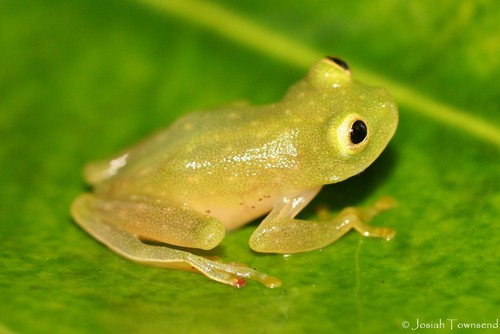
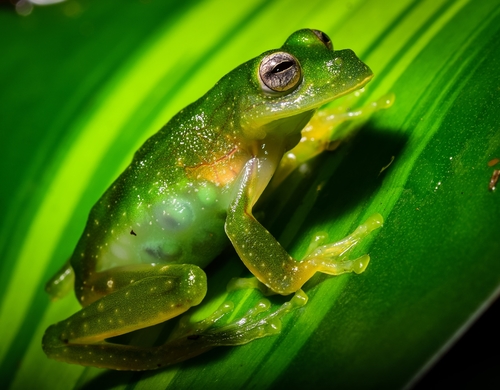
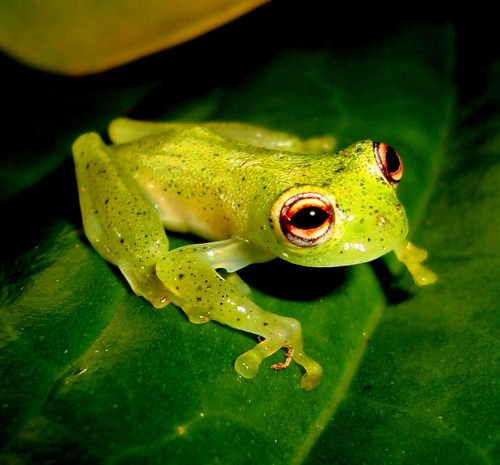
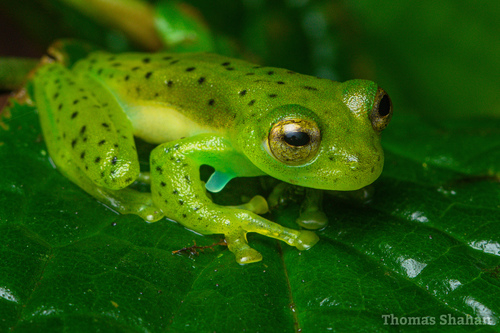
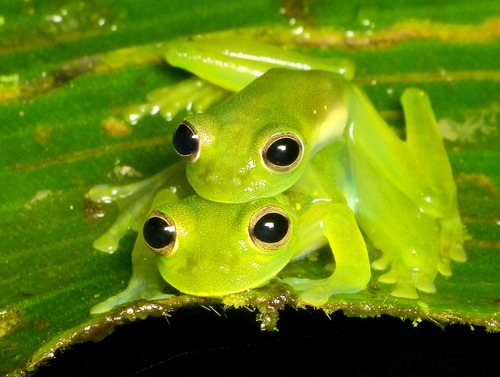
Through its semi-opaque skin, the green bones are visible; in female specimens, the humerus spine can also be seen.
Snout Shape
When viewed from above, the snout is truncated, creating an angled shape around the lateral nostril area.
Body Size
Adult males have a snout-vent length of 17.4 mm to 19.2 mm, while adult females measure 20.6 mm to 25.6 mm in snout-vent length.
Finger Disc Morphology
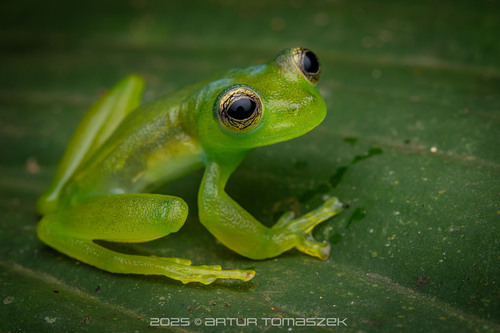
The finger discs of T. midas are rounded and truncated, and all discs are roughly the same size. Narrow lateral fringes are not present on the fingers.
Limb Webbing
Both the hands and feet have moderate webbing: webbing completely covers all toes, but only covers the third and fourth fingers.
Base Body Color
The base body color of T. midas is a darker lavender.
Dorsal Fleck Characteristics
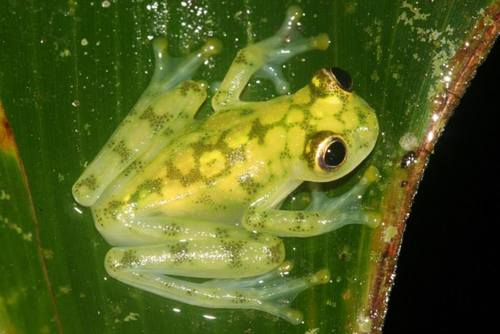
It has bright yellow flecks on its dorsal side; these flecks are unique to each individual, similar to human fingerprints, and researchers use them to tell different specimens apart.
Preservative Color Change
When the frog is preserved in preservative, these yellow flecks turn white.
Limb Coloration
Both the hands and feet are dull greenish yellow.
Internal Organ Visibility and Pigmentation
The heart is not visible through the skin, and the internal organs are unpigmented.
Iris Appearance
The iris is silvery brown with black reticulation.
Distinguishing Visceral Structure
T. midas can be distinguished from other glass frog species by its unique internal visceral structures: its liver is covered by a transparent membrane called the heptadic peritoneum.
Resting Posture
In its normal resting state, T. midas holds all four legs pressed close to the sides of its body.
Habitat Range
T. midas is mostly found in lowland areas of northern South America, in regions with highly diverse vegetation that includes both humid and dry forests.
Elevation Range
It typically occurs at elevations between 190 and 1050 meters above sea level.
Recent Distribution Record
The most recently recorded specimen was found around 1200 kilometers southeast of Crique Grand Leblond in French Guiana, which is the easternmost known record of the species.
Species Complex Hypothesis
Because T. midas has such a wide geographic range, researchers suspect it may actually be a species complex rather than a single species.
Tadpole Development
Tadpoles of T. midas develop in streams.
Conservation Status
The species is experiencing local habitat loss, but large areas of suitable habitat still remain.
Captivity Record
While other glass frogs (family Centrolenidae) are kept as pets worldwide, there is no specific data available on T. midas being held in captivity.