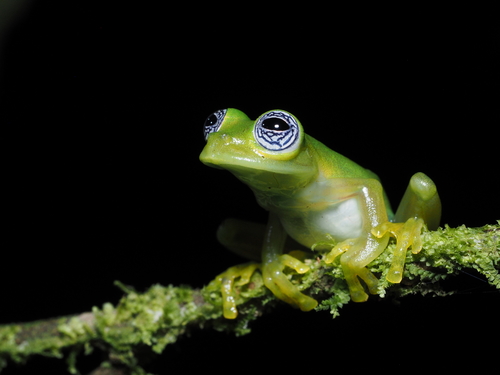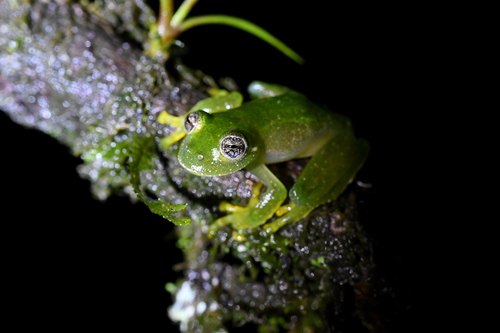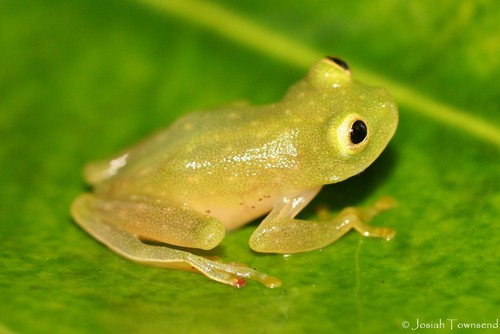
About Hyalinobatrachium fleischmanni (Boettger, 1893)
Common Names and General Range
Hyalinobatrachium fleischmanni, commonly known as Fleischmann's glass frog or the Northern Glass Frog, is a small arboreal glass frog species that lives in lowland and mid-elevation forests of Central and South America.
Size
Males measure 19–28 mm in length, while females are slightly larger, ranging from 23–32 mm.
Body Coloration and Skin Translucency
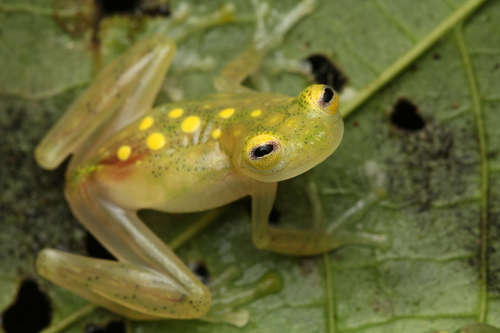
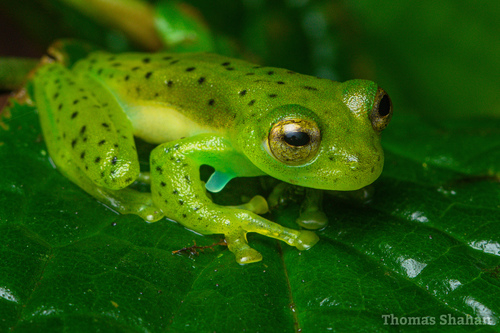
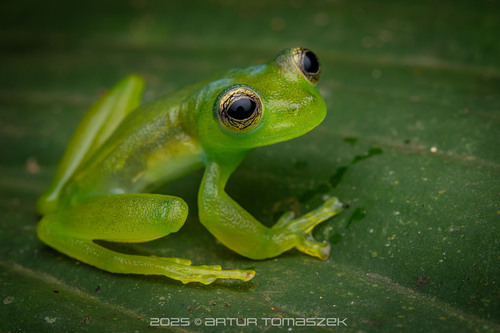
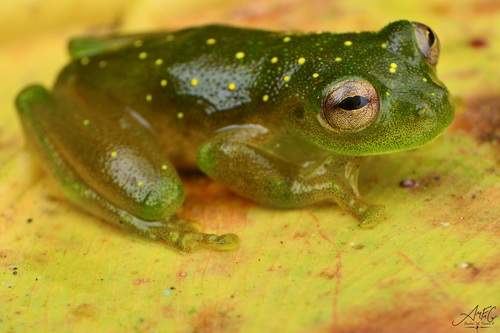
They have a primarily green semi-translucent body with pale yellowish spots, yellow fingertips, and translucent skin covering the stomach.
Underbelly Structure
A guanine sheet covers half of the frog's underbelly, stretching over several internal organs but leaving parts like the liver visible.
Limb and Spot Characteristics
Their hands are yellow and translucent, and skin spots match the color of local leaves.
Eye Features
Unlike tree frogs, which they closely resemble to the naked eye, H. fleischmanni have forward-pointing golden eyes.
Skin Light Reflectivity
Their green skin reflects visible light between 400 nm and 700 nm.
Sexual Dimorphism
Males have a visible white vocal sac used for mating calls, and a noticeable hook protruding from their spine, which is thought to be used for fighting other frogs or defending territory or eggs; females are larger and do not have this spine hook.
Anti-Predator Behavior
When approached or threatened, these frogs freeze and do not move.
Diet and Activity Pattern
They are nocturnal carnivores, active on rainy nights to keep their skin moist, and feed on small insects including crickets, moths, and flies, as well as spiders and even other smaller frogs.
Daytime Camouflage
During the day, they camouflage themselves under leaves above water.
Rainfall Fatality Risk
Strong rainstorms can kill these frogs, as a direct impact from a single raindrop has been observed to be fatal.
Broader Habitat and Range
Fleischmann's glass frogs inhabit areas near fast-moving streams, in forests up to 2,000 meters above sea level, with a broad geographic range extending from Mexico to Ecuador and Suriname.
Altitudinal Range
It is one of the most altitudinally diverse species in its genus, found from approximately sea level to above 1,600 m.
Costa Rica Distribution
In Costa Rica, it occurs in lowland wet forests, rainforests, and higher elevations; it avoids dry areas such as the northwestern lowlands, high mountains, and coasts, and is the most abundant glass frog species in the country.
Regional Glass Frog Diversity
Over 100 glass frog species have been recorded across Central and South America, with 13 of these found in Costa Rica.
Arboreal Lifestyle
As arboreal frogs, they live in trees.
Male Territory Tenure
Males typically do not hold the same territory for long. Most males remain in a single territory for around ten days, with an overall range of 1 to 18 days; some stay for 15 to 20 days or longer.
Territory Relocation Distance
New territories are usually within two meters of the original territory, though they can occasionally be as far as five meters away.
Territory Egg Capacity
A single territory can hold up to five egg clusters.
Post-Oviposition Male Site Fidelity
Males occupying large leaves usually stay on the same leaf after laying eggs to attract additional females, while males on small leaves typically move to another leaf on the same plant.
Male Calling Site Locations
Male calling sites are most often found on the undersides of leaves of broad-leaved plants such as Dieffenbachia, as well as on shrubs, ground bromeliads, and epiphytes on tree trunks, 0.5 to 10 meters above ground.
Calling Site Proximity to Water
Males prefer calling sites positioned over the main stream channel, so calling sites are typically 0 to 6 meters from the water.
Calling Season Timing
Calling activity occurs during the rainy season.
Daily Calling Pattern
Males begin calling at dusk, and calling often continues until dawn, decreasing in frequency as the night progresses.
Calling Inhibition
Males do not call when they are engaging in amplexus or guarding eggs.
Calling Tradeoffs
While conspicuous calling helps males attract females, it also increases their risk of being detected by predators.
Breeding Season Timing
The breeding season for H. fleischmanni runs from May to September, when females regularly seek out mates.
Amplexus Initiation
When a female approaches a calling male in vegetation, she stops moving near him, pushes him gently from the side, crawls under him, and the male clasps the female in amplexus.
Oviposition Site and Clutch Size
Females prefer to lay eggs on overhanging leaves above rivers, laying clutches of 18 to 30 eggs on the undersides of leaves or lower branches near flowing water.
Clutch Size Variability
Clutch size varies depending on the time of year.
Clutch Mortality Rate and Threats
Around 80% of all clutches are eaten or destroyed by threats including fungal infections and predators such as crickets and possums.
Male Egg Guarding
After laying, the male stands guard over the clutch to protect eggs from predators until hatching.
Egg Guarding Behaviors
Male guarding behaviors include staying with the clutch and urinating on eggs to prevent them from drying out.
Egg Incubation Period
Eggs hatch between 8 to 21 days after laying, most often after 10–15 days.
Clutch Hatching Timeline
All tadpoles in a single clutch hatch within one day, and leave the clutch within 2–3 days.
Post-Hatching Tadpole Behavior
When they hatch, tadpoles drop into the stream below, where they hide in silt and debris at the river bottom.
Tadpole Developmental Color Changes
Tadpoles go through a series of color changes as they develop: they start yellow, turn orange, then turn red.
Tadpole Hatching Stage Threshold
Hatching almost only happens when tadpoles reach the orange or red stage; yellow tadpoles generally cannot survive on their own, so their early disappearance is most often due to predation.
Tadpole Independent Survival Threshold
Tadpoles are able to survive independently once they reach the orange stage by the eighth or ninth day of development.
Tadpole Maturation Period
Tadpole maturation is slow, taking between 1–2 years to complete.