About Espadarana prosoblepon (Boettger, 1892)
IUCN Conservation Status
Espadarana prosoblepon, commonly called the emerald glass frog, was assessed by the IUCN in 2020 and listed as Least Concern. This listing is based on the species' wide distribution, large overall population, and low probability of rapid population decline.
Lifespan
The emerald glass frog has a lifespan of over 5 years.
General Body Appearance
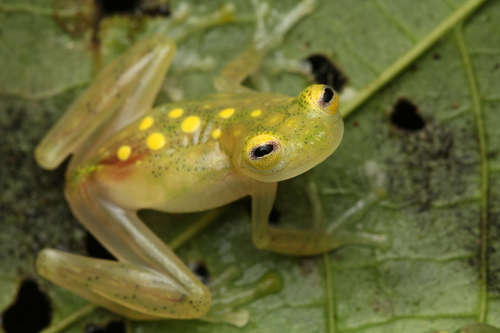
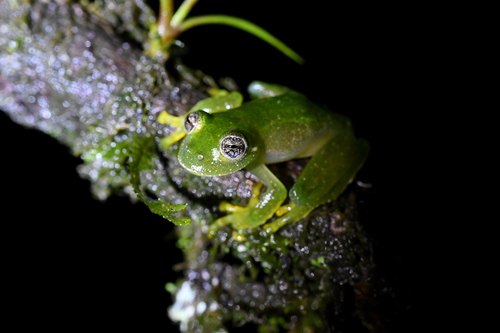
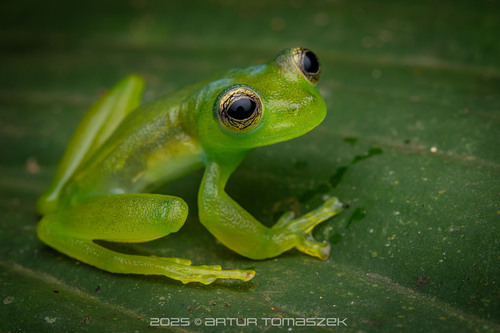
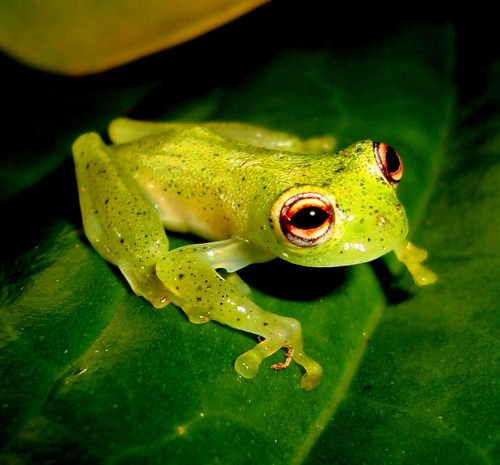
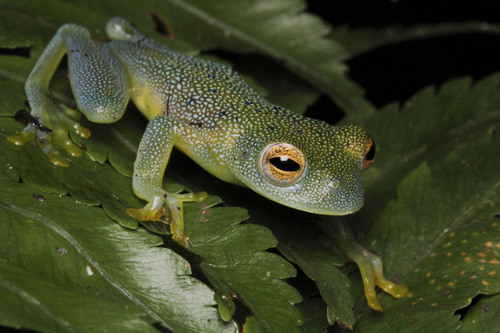
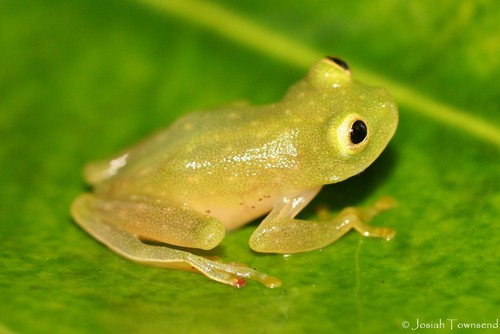
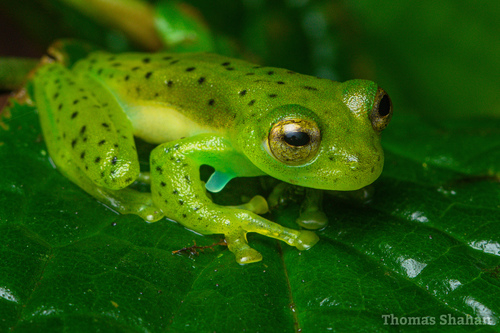
It is a small, green frog that may occasionally have dark spots on its back. Its body is translucent for camouflage, it has green bones, and both males and females have humeral hooks used for fighting; these hooks are larger in males.
Native Range
This species is native to Colombia, Costa Rica, Ecuador, Honduras, Nicaragua, and Panama.
Male Territoriality and Mating Calls
Males are territorial, and males call from leaf branches to attract mates, with the spacing between male territories dependent on their calls.
Breeding Season
Breeding takes place during the rainy season from May to November.
Adult Size and Weight
Espadarana prosoblepon is medium-sized: adult males measure 2.1–2.8 cm in snout-to-vent length and weigh approximately 0.11 g, while adult females measure 2.5–3.1 cm.
Tadpole Morphology
Tadpoles are around 1.2 cm long, with eyes and nostrils positioned on the dorsal side of the head.
Species Distinguishing Features
The species can be distinguished from other glass frogs by the protruding humeral spine in males and the presence of webbing between the third and fourth fingers.
Aggressive Interaction Traits
While male body size and humeral spine size varies between individuals, these traits do not determine the outcome of aggressive interactions between males.
Head Shape
Viewed from above, the head is wide and appears rounded.
Ocular and Auditory Features
It has large, protruding eyes set close together, and the tympanum is either absent or not visible.
Skin and Internal Visibility
It has vomerine teeth, and its smooth translucent skin makes its bones and intestines visible; the intestines are less visible due to a covering white membrane.
Finger Characteristics
Its fingers vary in length (the first finger is longer than the second) and are webbed.
General Habitat Types
Emerald glass frogs live in humid terrestrial and freshwater habitats, including rainforests and wet forests.
Streamside Habitat Use
They have both terrestrial and aquatic life stages, so they typically inhabit vegetation alongside streams.
Preferred Stream Characteristics
They prefer shallow streams, as these have more rocks and logs with vegetation suitable for egg deposition and experience less flooding than deeper streams.
Broad Geographical Range
The species' overall range extends from eastern Honduras, through Nicaragua, Costa Rica, and Panama, to the Pacific slopes of Colombia and Ecuador.
Distribution in Colombia
In Colombia, it occurs in northern and eastern areas along the Cordillera Oriental and the Magdalena Valley, and is also found along both the Caribbean and Pacific slopes.
Costa Rica Population Trends
It is frequently recorded across Costa Rica, but has experienced a drastic population decline in Monteverde, Costa Rica since the mid-1980s.
Costa Rica Decline Cause Hypothesis
Recorded declines in Costa Rica may be caused by chytridiomycosis, though this requires further investigation.
Costa Rica Population Stability
Other Costa Rican populations remain stable, and in some locations such as Zarcero, the emerald glass frog is the most common glass frog species in the area.
Regional Population Abundance
It is common in Panama, Nicaragua, and Ecuador, and reasonably common in Honduras and Colombia.
Global Population Trend
The overall population of the species has a currently stable trend and its range is not considered fragmented.
Site Fidelity and Home Range
Emerald glass frogs show strong site fidelity, typically staying within a 2-meter home range, though migration may be possible.
Rainfall and Activity Correlation
Studies have found that the activity level of both males and females increases with rainfall.
Protected Areas
The species' range includes at least one protected area: the Ranita Dorada Amphibian Reserve.
Reproductive and Mating System
Like most frogs, the emerald glass frog is oviparous and has a polygynandrous mating system.
Mating Season and Egg Clutch Correlation
Its mating season aligns with the local wet season from May to November, and research has found a positive correlation between rainfall and the number of egg clutches laid.