About Tamias umbrinus J.A.Allen, 1890
Common Name and Size Class
Tamias umbrinus, commonly known as the Uinta chipmunk, is a medium-sized chipmunk.
Body Measurements
Adult individuals range from 20 to 24 cm (7.9 to 9.4 in) in total length, which includes a tail measuring 7 to 11 cm (2.8 to 4.3 in), and have an average weight of 67 g (2.4 oz).
Summer Coat Coloration
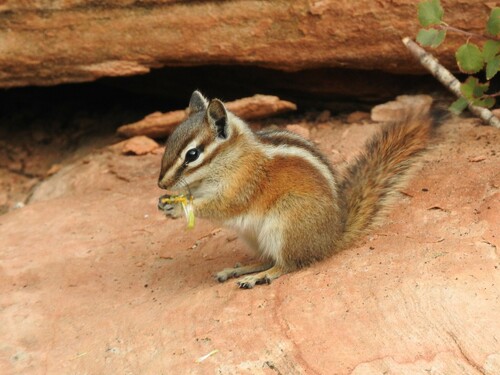
The predominant color of the species' summer coat ranges from yellowish brown-grey to dark brown, and often carries a reddish tinge.
Dorsal Striping Pattern
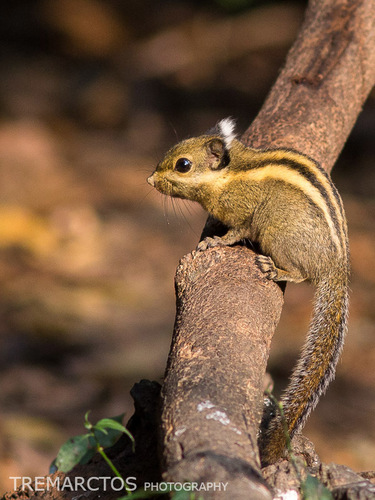
Three wide, distinct dark blackish-brown stripes run down the back, separated and surrounded by four paler stripes made of pale grey to white fur.
Facial Striping Pattern
Each side of the face also has three dark stripes and three pale stripes.
Winter Coat Characteristics
In winter, the coat becomes duller and more greyish, and the stripes grow less distinct.
Extremities Coloration
The ears are black, and the underparts are a very pale grey.
Tail Appearance
The tail is covered in orange and black fur, with a paler fringe of hair on its underside.
Geographic Range and Elevation
Uinta chipmunks live in montane and subalpine forests of the western United States, at elevations between 1,400 and 3,650 m (4,590 and 11,980 ft).
Preferred Habitat
They are most common at the margins of pine and fir forests, or in clearings, often near rocky terrain or steep slopes.
Sympatric Chipmunk Species
The species frequently shares and divides habitat with other chipmunk species, including the cliff chipmunk and the Colorado chipmunk.
Elevation Partitioning with Colorado Chipmunk
In northeastern Colorado, a boundary between Uinta chipmunks and Colorado chipmunks occurs at approximately 2,100 m (6,900 ft), with Uinta chipmunks found at higher elevations.
Additional Sympatric Species
Uinta chipmunks are also known to co-occur with the least chipmunk.
Disjunct Distribution Pattern
They do not have a continuous unbroken range; instead, they occupy a number of disjunct localities, a distribution pattern that may reflect changing forest cover patterns during the Pleistocene.
Recognized Subspecies
Seven subspecies of Uinta chipmunk are currently recognized: T. u. adsitus, found in southern Utah and northern Arizona; T. u. inyoensis, found in central Nevada and eastern California; T. u. fremonti, found in western Wyoming; T. u. montanus, found in western Colorado; T. u. nevadensis, found in southern Nevada and possibly extinct; T. u. sedulus, found in southeastern Utah; and T. u. umbrinus, found in northern Utah.
Breeding Season Timing
The Uinta chipmunk's breeding season takes place in spring, roughly from late April to early June, with the exact timing dependent on local climate and latitude.
Gestation and Litter Size
After a gestation period of around 30 days, the mother gives birth to a single litter of three to five young.
Juvenile Development
The young are weaned around 25 days after birth, and begin leaving the burrow shortly after weaning.
Survival and Lifespan
Only 27.5% of Uinta chipmunks survive through the winter, and the maximum life expectancy of the species is believed to be two years.
Baculum General Structure
The baculum of the Uinta chipmunk is notably short and thick, with a wide base.
Baculum Midpoint Feature
A distinctive characteristic is a bend at its midpoint.
Baculum Tip Morphology
The tip of the baculum makes up 36 to 50% of the total shaft length, and is angled dorsally between 90 and 100 degrees.
Baculum Shaft Features
The dorsal surface of the tip has a low keel that extends along approximately 25% of the tip's length, while the distal half of the shaft is laterally compressed.
Baculum Morphological Variation
Although variation in baculum morphology among Uinta chipmunks is generally minimal, some individuals may have a smaller, S-shaped baculum.
Baubellum General Shape
The baubellum of the Uinta chipmunk has a characteristic U-shape.
Baubellum Proximal Orientation
Its proximal end points caudally, with the shaft running parallel to the body and pointing posteriorly.
Baubellum Distal Tip Angle
The distal tip angles ventrally, to the right, at approximately 30 degrees.
Baubellum Base Structure
The base of the baubellum is long and straight, with a deep notch between two knobs at its proximal end.
Baubellum Shaft Features
The shaft is straight and laterally flattened, and often has a tubercle (heel) at the junction of the tip and shaft.
Baubellum Base-Shaft Angle
The angle between the base and the shaft is about 80 degrees.
Baubellum Tip Morphology
Notably, the tip is slightly longer than the shaft, has a keel on its ventral surface, has a slightly concave opposite side, and bears lateral flanges.