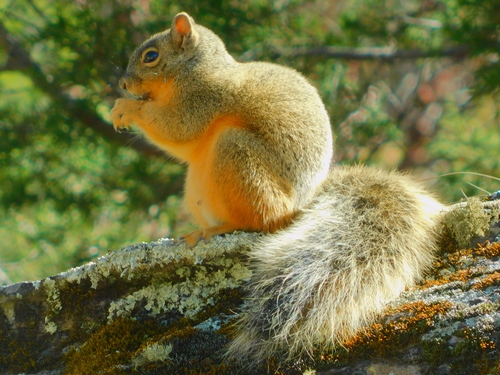
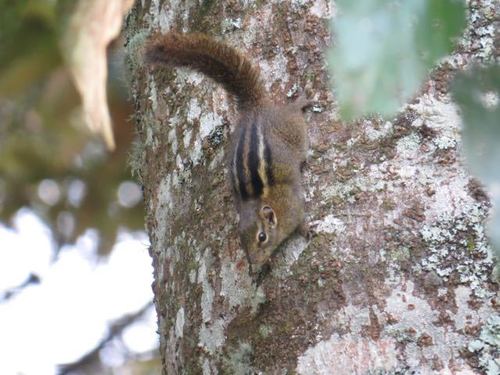
About Sciurus spadiceus Olfers, 1818
Common and Scientific Name
This species, commonly known as the southern Amazon red squirrel, has the scientific name Sciurus spadiceus Olfers, 1818.
Size Relative to Sympatric Squirrels
It is one of the largest squirrel species within its native range.
Body and Tail Length
Total body length ranges from 48 to 63 cm (19 to 25 in), which includes a very long tail measuring 24 to 34 cm (9.4 to 13.4 in).
Sexual Size Dimorphism and Body Weight
Males and females are of similar size, with body weights falling between 570 and 660 g (20 and 23 oz).
Dorsal Fur Coloration
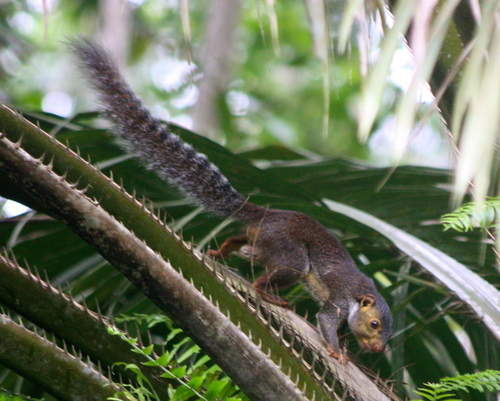
Most of the body is covered in typically reddish-brown fur that is grizzled with paler yellow, though fur can also be dark brown to near-black, a trait that is especially common in the subspecies S. s. tricolor.
Underpart and Lateral Band Coloration
The underparts range in colour from white to pale ochre, and are separated from the fur on the rest of the body by a narrow dark fur band.
Head and Tail Coloration
Cheeks and head colour ranges from yellow to reddish-orange, while the tail fades from dark brown at the base to orange along most of its length.
Distinction from Closely Related Species
This southern Amazon species differs from the closely similar northern Amazon red squirrel by having a longer, narrower head, and orange fur located behind the ears and on the tops of the feet.
Female Reproductive Morphology
Female individuals have eight teats.
Overall Distribution Range
The southern Amazon red squirrel inhabits northwestern South America, east of the Andes mountain range.
Country-Level Distribution
It occurs from southern Colombia and western Ecuador, through eastern Peru and northern Bolivia, to Brazil south of the Amazon River.
Habitat Preferences
Most members of the species live in lowland rain forests, although some populations in the western parts of the species' range inhabit forested highlands in the Andean foothills.
Recognized Subspecies
Three subspecies are currently recognized, though the exact geographic boundaries between their ranges remain unclear: Sciurus spadiceus spadiceus occurs mostly in Brazil, Sciurus spadiceus steinbachi occurs mostly in Bolivia, and Sciurus spadiceus tricolor occurs mostly in Peru.