About Suncus etruscus (Savi, 1822)
Taxonomy
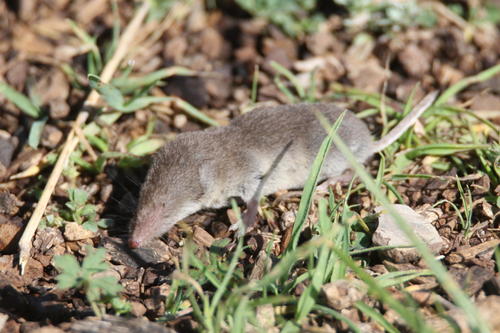
The Etruscan shrew (Suncus etruscus, first described by Savi in 1822) has a slender, non-truncated body.
Body Length
Its body length (excluding the tail) ranges from 3 to 5.2 cm (1.2 to 2.0 in), while the tail adds an additional 2.4 to 3.2 cm (0.94 to 1.26 in).
Body Mass
Body mass falls between 1.3 g (0.046 oz) and 2.5 g (0.088 oz), with an average mass of around 1.8 g (0.063 oz).
Size Comparison
The related greater white-toothed shrew is roughly twice as long and weighs four to five times more than the Etruscan shrew.
External Features
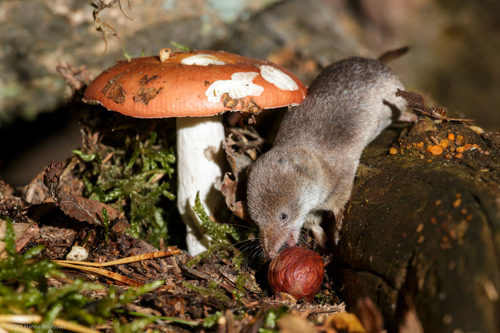
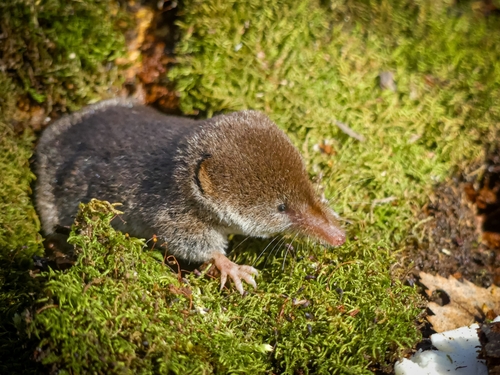
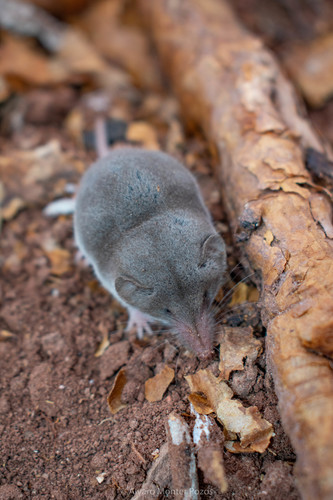
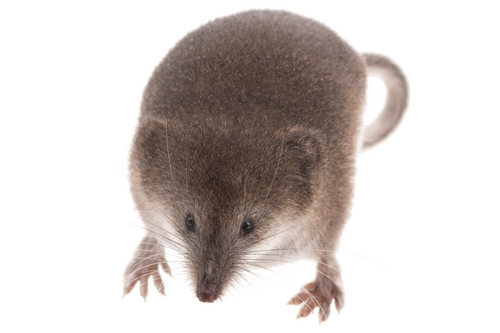
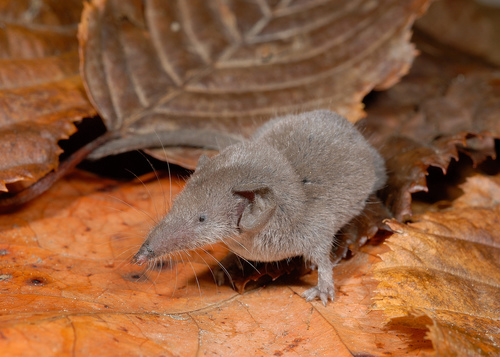
The Etruscan shrew has a relatively large head, a long mobile proboscis, relatively small hind limbs, and relatively large, prominent ears.
Cardiac Physiology
It has an extremely fast heart rate that can reach up to 1511 beats per minute (25 beats per second), and a relatively large heart muscle mass that makes up 1.2% of its total body weight.
Fur Coloration
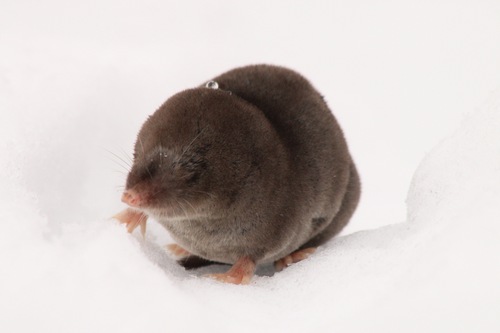
Its fur is pale brown on the back and sides, and light gray on the stomach.
Seasonal Fur Variation
Fur becomes denser and thicker from fall through the winter.
Dentition
Etruscan shrews usually have 30 teeth, but the 4th upper intermediate tooth is very small and rudimentary, and is absent in some individuals.
Whiskers
A dense array of short whiskers grows near the mouth, which the shrew actively uses to search for prey, particularly at night.
Sexual Dimorphism
There is no sexual dimorphism in body features between male and female Etruscan shrews.
Overall Latitudinal Range
This species occupies a range that spans 10° to 40°N latitude across Eurasia.
Southern Europe Distribution
In Southern Europe, it has been confirmed in Albania, Bosnia and Herzegovina, Bulgaria, Croatia, Cyprus, France, North Macedonia, Malta, Montenegro, Greece, Italy, Portugal, Slovenia, Spain, and Turkey.
Unconfirmed European Records
Unconfirmed reports of its presence exist for Andorra, Gibraltar and Monaco.
Introduced European Populations
It has been introduced by humans to European islands including Mallorca and the Canary Islands.
North Africa and Arabian Peninsula Distribution
The Etruscan shrew also occurs in North Africa (Algeria, Egypt, Libya, Morocco, Tunisia) and around the Arabian Peninsula (Bahrain, Israel, Jordan, Lebanon, Oman, Syria, and Yemen, including Socotra).
Asian Distribution
In Asia, it has been observed in Afghanistan, Azerbaijan, Bhutan, China (only in Gengma County), Myanmar (Burma), Georgia, India, Iran, Iraq, Kazakhstan, Laos, Malaysia (the Malaysian portion of Borneo island), Nepal, Pakistan, Philippines, Sri Lanka, Tajikistan, Thailand, Turkey, Turkmenistan and Vietnam.
Unconfirmed Global Records
Unconfirmed reports note possible presence in West and East Africa (Guinea, Nigeria, Ethiopia), and in Armenia, Brunei, Indonesia, Kuwait and Uzbekistan.
Global Conservation Status
Overall, the species is widespread and not considered threatened, but its population density is generally lower than that of other shrews that live in the same areas.
Regional Conservation Status
It is rare in some regions, most notably Azerbaijan, Georgia, Jordan and Kazakhstan, where it is included in the national Red Book.
Preferred Habitat Characteristics
The Etruscan shrew prefers warm, damp habitats with shrub cover, which it uses to hide from predators.
Terrestrial Habitat Preferences
It most often inhabits areas where open terrain such as grasslands and scrub meet deciduous forests.
Elevation Range
It can be found at sea level, but is usually restricted to the foothills and lower elevation belts of mountain ranges, though it has been recorded at up to 3,000 m (9,800 ft) above sea level.
Anthropogenic and Riparian Habitats
It colonizes riparian thickets along the banks of lakes and rivers, as well as human-cultivated areas including abandoned gardens, orchards, vineyards, olive groves, and field edges.
Avoided Habitats
However, it avoids intensively cultivated areas, dense forests, and sand dunes.
Nesting Behavior
It is poorly adapted to digging its own burrows, so it builds nests in various natural shelters, crevices, and uninhabited burrows dug by other animals.
Rocky Habitat Use
Etruscan shrews frequently frequent rocky areas, boulders, stone walls, and ruins, darting quickly in and out between these structures.