About Stegastes xanthurus (Poey, 1860)
Scientific Naming and Body Shape
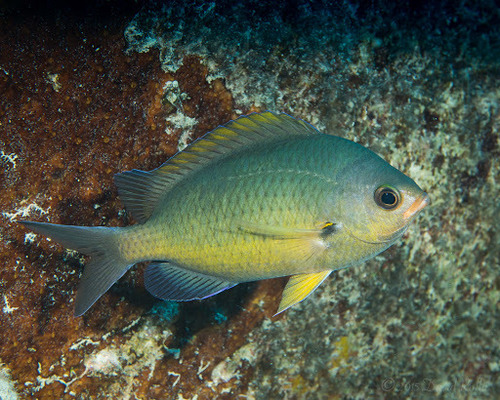
The Caribbean cocoa damselfish, scientifically named Stegastes xanthurus (Poey, 1860), is an oval, laterally compressed fish that grows to about 12.5 centimetres (4.9 in) long.
Head Markings
Several blue stripes run across the top of its head and snout.
Adult Body Coloration
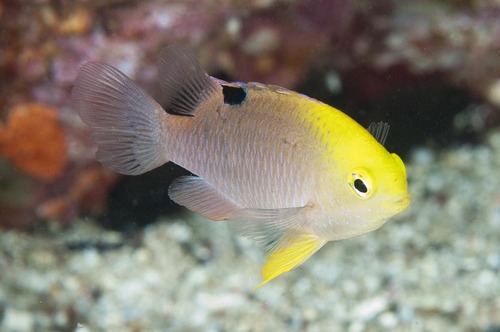
The top half of its body is generally dark blue or brown, and the bottom half is yellow. Its sides are marked with fine, vertical dark bars.
Adult Body Spots
It has two small black spots: one above the pectoral fins, and the other on the top of the caudal peduncle.
Fin Structure
Its large dorsal fin has 12 spines and 14 to 17 soft rays, while its anal fin has two spines and 12 to 15 soft rays. Its caudal fin is shallowly forked with rounded lobes.
Juvenile Head and Upper Body Markings
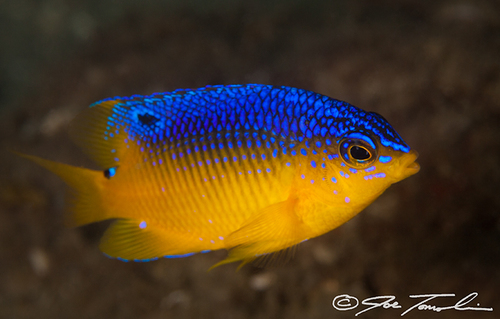
Juvenile Caribbean cocoa damselfish have numerous tiny blue spots and stripes on the head and upper body, including two spots and a stripe on the upper iris. These regions also have a dusky blue sheen.
Juvenile Fin Spot
A black eyespot rimmed with blue sits where the dorsal fin spines meet the soft rays.
Juvenile Caudal Peduncle Spot
A similar blue-rimmed spot is found on the top of the caudal peduncle, and it extends down nearly as far as the lateral line.
Juvenile Color Development
Older juveniles develop the characteristic blue and yellow coloration of adult individuals.
Geographic Distribution
Caribbean cocoa damselfish are distributed in the western central Atlantic, ranging from the Florida Keys and the Gulf of Mexico to northern South America.
Adult Habitat
They are marine, reef-associated fish, and are common on offshore reefs, oil platforms, and wrecks.
Juvenile Habitat
Juveniles can occasionally be found inshore.
Territoriality
Individual Stegastes variabilis do not have overlapping territories with other damselfish.
Lifespan
This species appears to survive longer in captivity, reaching up to 18 years of age, while wild individuals do not live beyond 12 years.