About Hypsypops rubicundus (Girard, 1854)
Body Shape and Scales
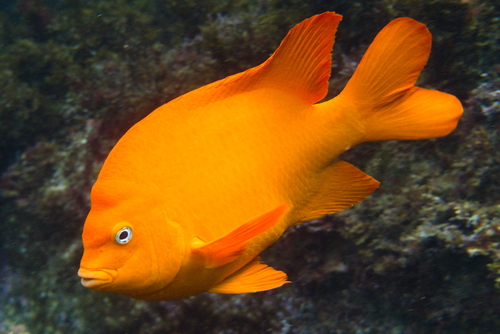
Garibaldi (Hypsypops rubicundus) are deep-bodied, laterally compressed fish covered in coarse scales.
Dorsal Fin Structure
They have one single dorsal fin with approximately 12 spines and 16 rays.
Adult Coloration
Adults of this species are uniformly bright orange.
Maximum Species Length
It is the largest member of the damselfish family, and can reach a maximum length of 35.6 cm (14 inches).
Sexual Size Dimorphism
This species displays sexual size dimorphism: on average, adult males grow 25 mm (1 inch) larger than adult females. This is an unusual trait for damselfish and other marine fish in southern California, where adult females are typically the larger sex.
Juvenile Coloration
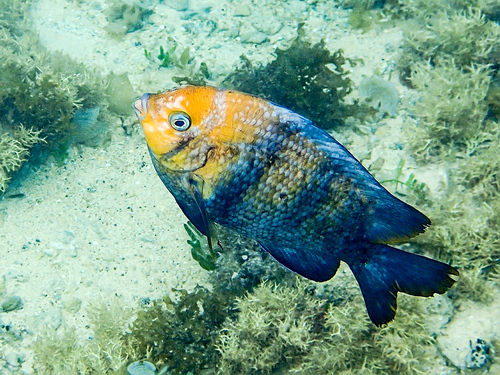
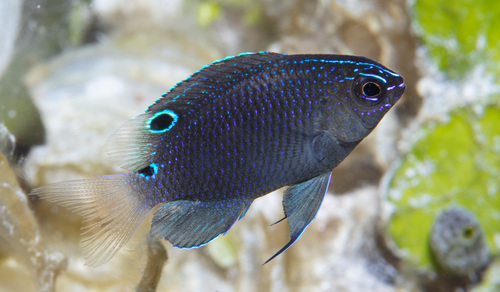
Juveniles are a deeper, more reddish orange than adults, and are covered in many small iridescent blue stripes and spots that they gradually lose as they mature.
Juvenile Fin Translucency
Their caudal (tail) fin and dorsal fin are more translucent than the same fins on adult Garibaldi.
Depth Range and Habitat Association
Garibaldis inhabit waters up to 30 metres (98 ft) deep, and are almost always associated with rock reefs, typically occurring over rocky sea-bottoms.
Adult Habitat Preferences
They prefer rocky-bottom habitats on exposed or semi-protected coasts that have clear water, and plenty of crevices and small caves for shelter.
Juvenile Habitat
Juveniles can be found in tide pools and at depths up to 40 feet (just over 12 m).
Geographic Range
This species is native to the northeastern subtropical Pacific Ocean, with a range extending from Monterey Bay, California, to Guadalupe Island, Baja California.